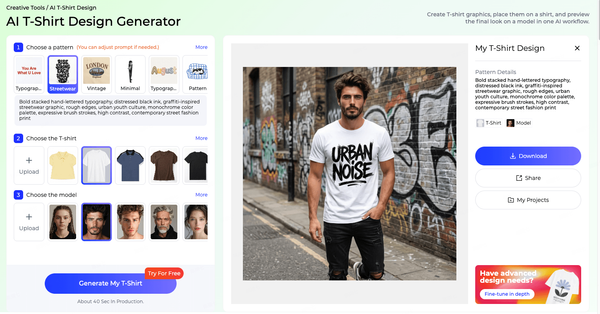
A merch generator returns a file. The file is an image with a width, a height, and a rectangle’s worth of composition, and it arrives looking finished. What it does not arrive with is any statement about which physical object it is for.
That absence is easy to miss because the same file will be accepted by a tee, a mug, and a sticker without complaint. Acceptance is not the same as suitability. Each of those objects takes something different away from the artwork, and none of them says so.
What a merch generator hands you
Generation optimizes for a viewer looking straight at a rectangle at screen distance. Every decision inside the file assumes that viewer: where the weight of the composition sits, how fine the smallest marks are, how the edges dissolve into whatever surrounds them.
The interface reinforces the order. Products appear as a row of choices after the artwork exists, which places substrate in the position of a delivery format — something you pick once the creative work is behind you. Nothing in that sequence is wrong as software. As a description of the physical situation it is backward, because the constraints being chosen from were already in force while the file was being made and had no way to participate. By the time the product row appears, every decision the substrate cares about has been taken by a process that did not know which product was coming.
A merch line does not contain a rectangle viewed straight on at screen distance. It contains woven cloth that absorbs ink, a glazed cylinder with a handle on it, and a die-cut shape with no background at all. Substrate is usually treated as the last step in the process — pick the product, apply the art, approve the mockup. Physically it is the first constraint, and it was not present when the file was made.
Three substrates, three questions
The useful way to hold this is that each substrate interrogates the artwork, and the three interrogations have nothing to do with each other:
• Cotton asks what can be lost, because a woven surface has a resolution of its own and detail finer than that surface does not degrade gracefully — it goes away.
• Ceramic asks what is visible at once, because a cylinder shows a fraction of its surface to any one viewer and the handle removes a band of what remains.
• Hardgoods ask where the artwork stops, because a cut line is a closed boundary and a generated edge is a gradient that was never asked to end anywhere in particular.
Three questions, three different kinds of answer. A line approved on one of them has been approved on one of them.
Cotton asks what can be lost
Woven cloth has its own grain, and marks below the scale of a single thread cannot be held by it. The failure is not softness. It is disappearance: a hairline that reads as a deliberate contour on screen becomes an interruption in the weave, or nothing.
What makes this hard to plan around is that the artwork contains no annotation separating structure from texture. A generated illustration is full of fine marks, some of which carry the shape of the thing and some of which are surface noise the model added because surfaces in its training material have noise. Losing the second kind costs nothing. Losing the first kind changes the drawing. Nobody marked which is which, and the person approving the file cannot tell by looking at a screen.
The rest of the garment side — ink behavior at the edges, colors that render on screen but not in print, resolution fixed at the moment of generation — has its own treatment, and it is the most developed part of this problem: from generated output to a printable garment file.
Ceramic asks what is visible at once
A mug is a cylinder, so it never presents its whole printed area to anyone. Roughly speaking, a person holding one sees a curved band, the handle occupies one side, and the region near the handle is unavailable on most bodies. The artwork does not deform in any dramatic way. It is simply never all there.
This is a composition problem wearing the costume of a technical one. The generator put the weight of the image in the middle of a rectangle, because that is what composing for a rectangle means. Wrap that rectangle around a cylinder and the middle is the part that faces away whenever the handle faces the viewer. A design whose whole argument is a centered focal point becomes a design with no focal point in two of three common orientations, without a single pixel having gone wrong.
The workable shapes for ceramic are therefore different in kind, not in quality. Art that repeats, art that reads as a band, art with more than one entry point, art that survives being seen in fragments — these work because they do not depend on a viewing position the object cannot provide. Art built around one centered subject asks the customer to rotate the mug until the design appears, which is a request no one has ever complied with.
Hardgoods ask where the artwork stops
Stickers, pins, patches, and acrylic pieces share a requirement the other two substrates do not have: something must cut them out. A cutting path is a closed contour, a single unambiguous line separating the object from the air around it.
A generated raster has no such line. Its edges are anti-aliased into a background, sometimes a background that was removed afterward and sometimes one that was never there in the first place. Soft glows, feathered shadows, and gradients that fade toward transparency are all normal outputs and all unresolvable into a boundary, because the question they answer is how gradually the image should end and the cutter needs to know exactly where. Converting to a contour is the step that forces the artwork to make a claim it has been avoiding, and it is the one conversion in merch work that cannot be skipped: turning a raster into a vector outline. When that outline is derived rather than designed, the result is a shape nobody chose — the cutter’s best guess at where a fade became an edge.
The cut shape is also the silhouette the customer perceives, which is the part that gets lost when the contour is derived instead of designed. A sticker is recognized as a shape before it is read as a picture, and a contour traced from a fade produces an outline that reads as accidental — slightly lumpy where the glow was uneven, arbitrarily tight in one place and loose in another. The artwork inside it can be excellent and the object still looks unresolved, for a reason nobody inspecting the artwork will locate.
Color separation behaves the same way for enameled goods, where every color region needs a physical ridge around it and therefore needs to be bounded and wide enough to hold. Ask a supplier for their own limits rather than working from a number found online; the thresholds differ by process and by factory, and a figure that is right for one is wrong for the next.
The mockup shows the one angle nobody uses
Every merch generator presents its work on a product mockup, and the mockups are the reason these three questions go unasked.
A mug mockup renders the cylinder with the artwork facing the camera, centered, handle turned politely to the side. That is a real view of a real object and it is also the only orientation in which the ceramic problem is invisible. A sticker mockup shows the sticker already cut, with a clean edge, which presents the cut path as a solved thing rather than a decision still outstanding. A tee mockup shows the print at a size and distance where marks below thread scale still appear.
None of these are dishonest. They are each the most flattering true view, and the flattering view is the one that gets rendered because no reviewer sends back a mockup for looking good. Reviewing merch from mockups means reviewing three substrates through the single angle that hides what each of them does to the art.
Substrate is an input, not an export setting
Working backward from this: decide the substrate list before generating, and design against the most constrained member of it.
Cotton | Ceramic | Hardgood | |
Governing constraint | Surface resolution of the weave | How little is visible at once | The cut boundary |
What the artwork must declare | Which marks are structure | Where the composition’s weight sits | Where the image ends |
Fails as | Detail that vanishes | A focal point facing away | An outline nobody chose |
Checkable before production by | Print proof on the actual garment | Wrapping the flat art and rotating it | Attempting the contour |
Design for the loosest substrate first and every other item in the line becomes a rescue. Design for the tightest and the others inherit a file that already declares its boundary, already knows which marks are load-bearing, and already survives being seen in pieces. That ordering costs nothing at the briefing stage and is close to unrecoverable afterward, which is the argument for choosing the substrate before opening a print generator rather than after.
Questions teams ask before approving a merch line
Can one generated artwork cover a whole merch line? Sometimes, and you find out by running three separate checks rather than one approval. The checks are independent, so passing the garment check tells you nothing about the mug or the sticker. What fails is the assumption that approval transfers between substrates.
Which substrate should be designed for first? The one with the hardest boundary, which is usually the die-cut item. A file that has already declared where it ends and which marks carry the shape can be adapted downward to cloth and ceramic, while a file designed for cloth has made none of those declarations and has to be re-decided for each other product.
Why does artwork that looks right on the mug mockup fail on the mug? The mockup shows the artwork facing the camera with the handle to one side. In use the mug turns, and the centered part of the design spends most of its time facing away from whoever is holding it. Nothing about the file changed between the mockup and the object; the available viewing angle did.
Does converting to vector solve the substrate problem? It solves one of the three questions. A contour settles where the artwork ends, which is what the cutter needs. It does not tell you which marks will survive a weave, and it does nothing about where the composition’s weight sits on a curved surface.
What should a merch brief contain that a design brief does not? The list of substrates, and a statement of which one governs. A design brief can describe an intended feeling and leave execution open; a merch brief that omits the substrate list has left three physical constraints to be discovered at production, one at a time, by different people.
Is ceramic harder to design for than cotton? Neither is harder — they fail in different departments. Cotton failures are material, showing up as marks that did not survive the surface. Ceramic failures are compositional, showing up as a design that is intact and mostly not being looked at.
Where this leaves you
One artwork across three substrates is a reasonable goal and a poor default. Cotton, ceramic, and a cut shape each remove something different from the same file, and a file approved on a tee has answered one of the three questions it will be asked. The order of work is the whole decision: name the substrates first, design against the tightest one, and treat every mockup as the most flattering true view of an object rather than as a test the artwork passed.
Name the substrates before you generate
List every product the artwork has to land on, then identify which one imposes the hardest boundary — usually whatever gets cut out. Generate and evaluate against that item, and treat the others as separate questions rather than as variations of the first approval. Each has its own check and none of them is a mockup: proof on the actual garment, wrap the flat art and rotate it, attempt the contour and look at the shape you get. Then bring the substrate list with you when you start generating, rather than meeting it at the product row afterward.
Written by