
Change Model and Background: Two Edits, Two Risk Levels
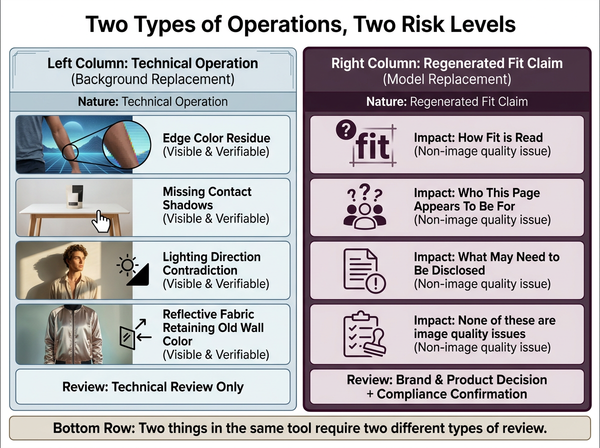
A background change is a technical edit. A model change regenerates the drape and states who the product is for. Review them separately.
Swapping a background and swapping a model arrive in the same tool and feel like the same kind of edit. They are not.
A background change is a technical operation with technical failure modes. A model change alters who the garment is being shown on, which affects how the fit reads, who the listing appears to be for, and what you may need to disclose. Treating both as routine retouching is how the second one gets made without anyone deciding it.
The background is the easier half
Backgrounds fail in ways you can see and check. The garment edge picks up the old background’s color, the contact shadow disappears and the subject floats, the new background’s light direction contradicts the light on the garment, or a reflective fabric keeps a color from a wall that is no longer there.
Most of these are edge problems rather than background problems, and the boundary quality decides the result. Where the original separation was poor — a garment close in tone to the backdrop, loose hair, a knit with visible fuzz — the replacement will show it, and the mechanics of why are covered in what makes a clean cutout.
Two checks catch most of it. View the result on a background much darker than the original, since edge contamination only shows against contrast. And look at where the subject meets the ground, because a rebuilt contact shadow is what stops a figure reading as pasted.
Marketplace requirements sit here too. Main images typically need a solid, usually pure white field, so confirm each platform’s current policy before publishing rather than assuming a generated backdrop qualifies.
Changing the model changes the garment
This is the part that gets treated as cosmetic and is not.
A model is holding the garment up. Change the body and the drape has to change with it — where the shoulder sits, how the fabric falls over the hip, how much ease is visible at the waist. That new drape is generated from what garments of that appearance usually do on bodies of that shape, not from what your garment does.
So a model change is a fit claim being regenerated. An image showing a garment skimming one body and skimming another equally is asserting something about how the piece behaves across sizes, and that assertion was inferred rather than observed.
The practical consequence is that model changes are least reliable in exactly the categories where fit matters most — tailoring, denim, swimwear, anything close-fitting — and most reliable on loose, forgiving garments where the drape barely changes between bodies.
Showing a range of bodies
Where a brand shows several body types, the intention is usually to help customers see the garment on someone like them. That intention is only served if the images are accurate about how the garment sits on those bodies.
A generated body variation produces a plausible drape for that body shape. Whether it matches what a customer of that size actually receives is a separate question, and it is the question the image is implicitly answering.
The stronger version of this practice is to photograph the garment on the range of bodies you sell to, at least for the styles where fit drives returns, and to use generation for secondary images and less fit-critical categories. A garment photographed on one body and shown on several is making a claim it has not tested.
None of this is an argument against showing diverse bodies. It is an argument for the images being true, since a customer who orders on the strength of an inferred fit and receives something different has been poorly served by the intention rather than helped by it.
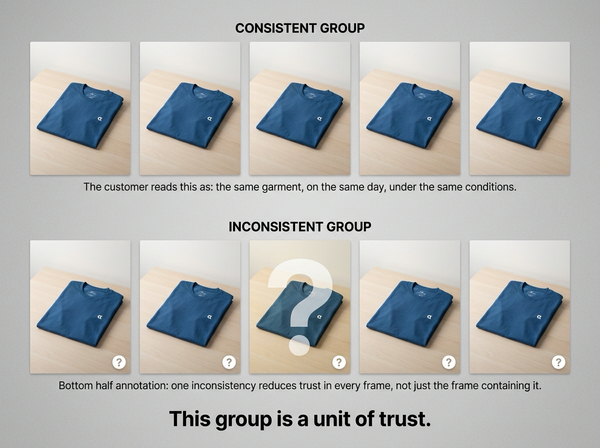
Hair and skin against a new background is the recurring technical trouble in body variations, for the same reason it is in any cutout: the boundary is a band rather than a line. A change of model brings a new hairline and a new skin tone into contact with whatever background is there, and a set produced across several bodies will show this unevenly — one figure sitting cleanly, another with a faint halo, which reads as inconsistency in the set before anyone identifies it as an edge problem.
Which decisions belong to whom
Model choice is a brand and merchandising decision, not a production one, and it drifts when the tool makes it easy.
Left to whoever is producing images, model selection gets made frame by frame, and a range ends up with a model mix nobody chose. Deciding it as a policy — which bodies, which markets, what stays consistent across a season — costs one conversation and prevents a set of small decisions accumulating into a position the brand did not take.
Consistency matters commercially as well. A category page where the model changes between adjacent products makes the garments harder to compare, and comparison is what a browsing customer is doing.
Where regional variants are being produced, decide whether the garment images vary or only the model does. If the garment is regenerated for each variant, the variants can disagree about fit, and the reasoning behind keeping a single verified source applies here as much as anywhere.
Disclosure and accuracy
Requirements around synthetic or altered imagery differ by market and have been changing, and this is a compliance question rather than a production one.
Two things are worth separating. Whether an image accurately represents the product is a longstanding obligation in most markets and applies regardless of how the image was made. Whether an image containing a generated person must be labeled as such is a newer and more varied question, and the answer differs by jurisdiction and platform.
Confirm both for every market and marketplace you sell in, before a season rather than after, and route the question to whoever owns compliance. The related considerations when customer-supplied images are involved are different again and covered in what a try-on does and does not fix.
Record-keeping helps more than it sounds like it should. Knowing which listing images contain a generated figure, and which were photographed, turns a difficult retrospective question into a lookup. Where a requirement changes mid-season — which is the pattern this area has followed — the difference between a team that can identify the affected images and one that cannot is several days of work.
There is also a straightforward commercial reason to keep this tidy. Where a brand’s images are found to have been altered in ways customers did not expect, the cost is trust rather than a fine, and trust is the thing product imagery exists to build.
When to change the model at all
The useful test is whether the model is carrying information the customer needs.
For a mood image, a lifestyle frame or a category tile, the model is context and a change is low-risk. Where changing the model or background is producing that kind of image, it does what it is meant to do.
For a main product image on a fit-sensitive garment, the model is evidence, and evidence should be photographed. The same applies to any image a customer will use to judge how the garment sits on a body like theirs.
The middle case — secondary on-model images of forgiving garments — is where the volume is and where generation earns its place, provided the set stays consistent and someone has verified the source against the physical piece.
What changing model and background cannot do
It cannot verify a fit across bodies. A generated body variation shows a plausible drape, not a tested one, and no property of the image distinguishes the two.
It cannot fix a poor original separation. Edge quality is inherited, so a background change on a badly separated source produces a well-composed image with a bad edge.
It cannot make a representation decision. Which bodies and which markets a brand shows is a position, and a tool that makes the change easy does not make the position for you.
It cannot resolve disclosure obligations. Nothing in the process assesses what a given market requires, and the requirement sits with the seller.
Frequently Asked Questions
Is changing the background risky?
Technically rather than commercially, in most cases. The failure modes are edge contamination, a missing contact shadow and mismatched light direction, and all three are checkable. Confirm the marketplace’s background requirement for main images before publishing.
Can I show one garment on several body types from one shoot?
You can produce the images; whether they are accurate about fit is a different question. For fit-critical categories, photograph the range you sell to. For forgiving garments and secondary images, generation is reasonable with review.
Why does the garment look different when I change the model?
Because the drape is being regenerated for the new body, using what garments of that appearance typically do rather than what yours does. On close-fitting styles the difference is largest and matters most.
Do I need to disclose that a model is generated? Requirements vary by market and platform and have been changing, so confirm for each jurisdiction you sell in rather than applying one rule. Treat it as a compliance question and get the answer before a season rather than during it.
Should the model be consistent across a category page?
Generally yes, since a changing model makes garments harder to compare and comparison is what browsing customers are doing. Decide it as a policy rather than letting it be settled frame by frame.
What if the background change reveals a bad edge?
Fix the separation rather than the background. Edge quality is inherited from the source, so replacing the backdrop again will reproduce the same problem against a different color.
Is a generated model acceptable for a main product image?
Where fit is not the deciding factor and the image is accurate about the product, it can be. Where a customer is judging how the garment sits on a body, the main image is doing evidentiary work and deserves photography.
Separate the two decisions
The tool bundles them; the review should not. A background change is a technical edit with technical checks, and treating it that way is efficient. A model change is a claim about fit and a statement about who the product is for, and it deserves the same deliberateness as any other brand decision — made as a policy, verified against a physical garment where fit matters, and checked against the disclosure requirements of the markets you actually sell in. The two arriving in the same interface is a convenience, not a reason to review them the same way.
Split the review in two
Treat background changes as a technical pass: check the edge against a dark background, confirm the contact shadow was rebuilt, and verify the marketplace’s main-image background requirement. Treat model changes as a brand decision: decide which bodies and which markets as a policy rather than frame by frame, photograph the fit-critical categories on the range you actually sell to, and get the disclosure requirement for each market confirmed by whoever owns compliance before the season rather than during it.
→ Change Model & Background — Style3D AI
Written by