
Change Pose: What Moving the Model Does to the Garment
A pose change is a garment decision, not a styling one. Which pose shifts stay close to what was recorded, and which invent a new drape.
A pose change looks like a styling decision. It is a garment decision, because the pose is what makes the garment hang the way it hangs in the photograph.
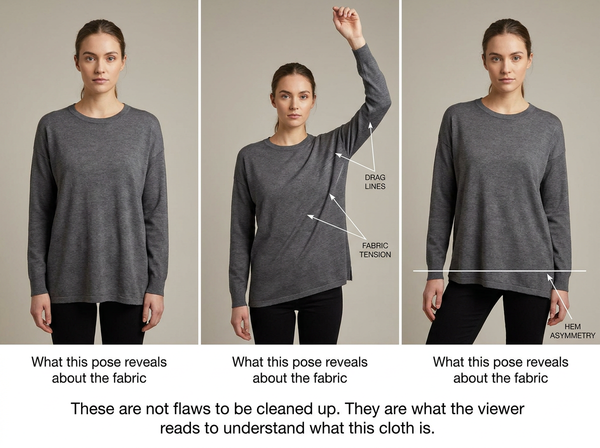
Move the arms and the shoulder line changes. Shift the weight and the hem drops unevenly. Put a hand on the hip and the side seam pulls. Every one of those is information about the garment, and when a pose is generated rather than photographed, all of it is being re-inferred rather than re-observed.
The pose is holding the garment up
A photograph of clothing on a body is a record of two things at once: the garment, and the forces acting on it in that moment.
Fabric responds to the pose. Weight pulls a hem down; an arm lifted pulls a sleeve up and creates drag lines across the back; a turned torso twists a side seam. These are not artifacts to be cleaned up. They are how a viewer reads what the fabric is — heavy or light, stiff or fluid, close-fitting or generous.
Change the pose and every one of those responses has to change with it. That is the part being generated, and it is generated from what fabrics of that appearance usually do rather than from what your fabric does.
The practical consequence: a generated pose can show a garment behaving in a way that garment cannot. Not obviously wrong, not visibly artificial — just a drape belonging to a different weight of cloth.
Which pose changes are safe
Change | Reliability | Why |
Small shift between similar standing poses | High | Little of the garment’s support changes |
Arms down to arms slightly away from body | Moderate | Reveals areas the source may not show |
Straight stance to weight on one hip | Moderate | Hem and side seam must respond correctly |
Arms raised or crossed | Low | Creates drag and occlusion with no source evidence |
Standing to seated | Low | Whole garment support changes; lap, hem and back all differ |
Static to walking or motion | Low | Fabric movement is physics being guessed |
Any pose hiding a feature the source showed | Low | Information is lost rather than transformed |
The pattern is that pose changes work when the garment’s relationship to the body barely changes and fail when that relationship is the thing being altered. Small rotations and adjustments stay close to recorded information. Anything that changes how the garment is supported is a new drape, and a new drape is an inference.
Where a generated pose starts hiding something the original showed, the new image is strictly less informative than the one you had, which is worth noticing before adding it to a listing.
Occlusion is the practical limit
Arms are the recurring problem, for the same reason they matter in every other kind of garment generation.
An arm crossing the torso hides the region a viewer uses to read the fit, and generating a pose that uncovers it means inventing the part that was covered — the print continuing behind the arm, the placket running down, the side seam. An arm moving in front of the body loses information instead, which is safer but produces an image that shows less.
Hands are a specific hazard. A hand in a pocket, on a hip, or holding a lapel is interacting with the garment, and moving it means resolving what the garment does when that interaction stops. Fabric that was being held taut relaxes, and that relaxation is being guessed.
The rule that follows is to prefer pose changes that lose information over ones that must create it. An arm moving into the frame is a bigger risk than an arm moving out of it, even though the second produces a less useful photograph.
There is a related asymmetry in how errors get noticed. A pose that makes a garment look worse than it is gets caught immediately, because someone in the room objects. A pose that makes it look better passes review without comment and is discovered by the customer. Generated drape tends toward the tidier reading, so the errors that survive review are systematically the flattering ones.
Consistency across a pose set
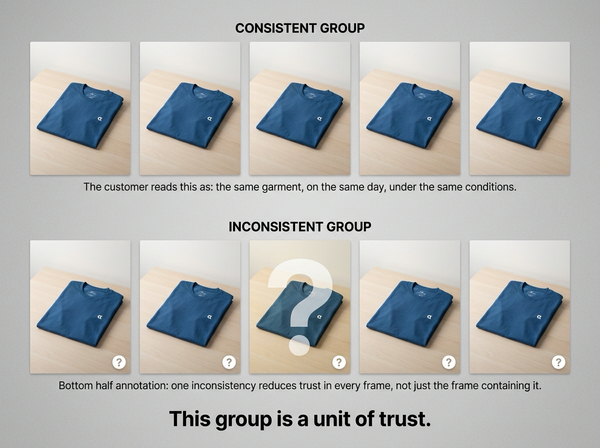
A listing gallery showing one garment in several poses has a requirement that a single image does not: the garment has to be the same garment in all of them.
The failure is subtle. Independently generated poses can each look correct while disagreeing about hem length, sleeve length or how loose the garment is, because each was inferred separately. A customer scrolling through them will not identify the inconsistency and will come away with an unclear impression of the fit, which is worse than a single clear impression that is slightly wrong.
Two habits prevent it. Generate the set from one verified source rather than chaining pose from pose, since chaining compounds each inference into the next. And review the set for agreement on the measurable things — where the hem sits relative to the body, where the sleeve ends, how much ease is visible — before reviewing any individual image for quality.
This is the same discipline that governs multi-angle sets, and the reasoning behind it is set out in which angles can be inferred and which cannot.
Fit is what a pose set is usually being asked about
Customers look at multiple poses for one reason: to work out how the garment actually sits.
That makes pose sets a place where inferred drape does real commercial damage. An image showing a garment skimming the body when it in fact clings, or hanging straight when it in fact pulls, is answering a fit question wrongly — and fit is the dominant driver of apparel returns.
The distinction worth holding is between poses that present the garment and poses that test it. A straight standing shot presents. A hand on the hip, an arm raised, a seated pose all test, because they show how the garment behaves under stress. Generated poses are least reliable exactly where they are most informative.
Where the pose is doing that testing job, photography is the honest source, and the categories where this matters most follow the same logic as which garment types survive image-based generation.
When a pose change is the right tool
Volume and variation, in the ordinary cases.
Producing a second and third standing view for a listing, refreshing a campaign image with a different stance, or expanding one shoot into more content for a category page are all reasonable uses, provided the garment is one whose drape is unremarkable and the poses stay within the same family.
Model direction is an underrated version of this. A pose that suits a garment is not obvious in advance, and a photographer working through options on the day is spending the expensive resource. Working out the shortlist beforehand converts studio time into preparation time, which costs less and produces a session with fewer wasted setups.
It is also useful before a shoot rather than after one. Testing which poses suit a garment costs nothing digitally, and arriving at a session knowing that a particular stance flatters the silhouette saves studio time — which is a use where accuracy matters much less, since nothing generated is being published.
Where the garment is simple and the pose change is small, generating additional poses from one photograph covers the volume that would otherwise require a longer session.
What a pose change cannot do
It cannot show how your fabric behaves in the new pose. Drape under a different set of forces is a property of weight, hand and construction, none of which are recorded in a photograph in a way that transfers.
It cannot reveal what the original pose concealed. Anything hidden in the source has to be invented, and inventing it means inventing the part of the garment the customer most wanted to see.
It cannot maintain fit consistency by itself. Independently generated poses agree with the source and not necessarily with each other, and that agreement has to be managed rather than assumed.
It cannot answer a fit question. What a customer is trying to learn from a pose set — how this sits on a body — is exactly the thing being inferred, so the more useful the pose, the less reliable the answer.
Frequently Asked Questions
Can I generate a seated pose from a standing photo?
Poorly, in most cases. Sitting changes how the whole garment is supported — the lap, the hem, the back all behave differently — so almost everything visible is being inferred rather than transformed. Photograph seated poses where they matter.
Why does the garment look like a different weight in the new pose?
Because drape in the new pose was generated from what fabrics of that appearance typically do. A stiff cloth and a fluid one can look similar in a static front view and behave completely differently once the pose changes.
Is it safe for arms-down to arms-slightly-out?
Usually yes, with review of the newly revealed area. That change uncovers regions the source may not have shown clearly, so check the side seam and any print continuing under the arm rather than assuming the reveal is accurate.
How do I keep a pose set consistent?
Generate every pose from one verified source image rather than from the previous pose, then review the set together for agreement on hem level, sleeve length and visible ease before judging any image individually.
Does changing pose change the fit shown? It changes how the fit reads, which is the point and the risk. Poses that test a garment — hand on hip, arm raised, seated — are the most informative and the least reliably generated, because the stress response is being guessed.
Can I use pose changes for planning a shoot? Yes, and it is one of the better uses. Nothing generated gets published, accuracy matters much less, and arriving at a session knowing which stances suit the garment saves studio time.
What about motion or walking shots? Treat these as photography. Fabric movement is physics, and a generated version is a plausible guess at how cloth of that appearance moves, which is precisely what a motion shot is supposed to demonstrate.
Poses that test, poses that present
The useful division is between a pose that shows the garment and a pose that puts a demand on it. Presenting poses — straight, still, arms clear — sit close to what was recorded and generate reasonably. Testing poses — weight shifted, hand on hip, seated, moving — are where a customer learns how the garment behaves, and they are also where a generated answer is least connected to your actual cloth. That inversion is the whole thing worth remembering: the more a pose is worth showing, the more it deserves to be photographed.
Keep the generated poses in one family
Generate additional poses only within the same family as the source — small shifts between standing views, arms moving out rather than in — and produce each one from the original verified image rather than from the previous generated pose. Before publishing, put the set side by side and check that hem level, sleeve length and visible ease agree across all of them. Photograph anything that tests the garment: weight on one hip, arms raised, seated, or in motion.
→ Change Pose — Style3D AI
Written by