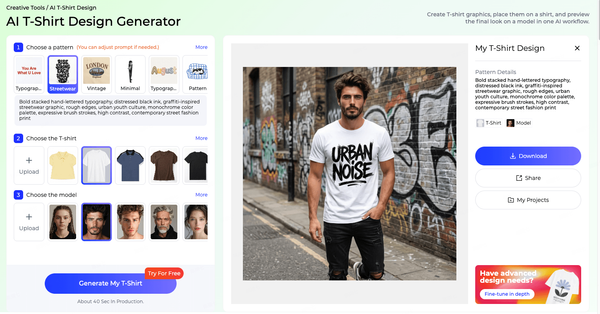
Somewhere in every growing apparel brand, sooner or later, someone tries the shortcut: send the factory a beautiful photo — or a beautiful generated render — and ask for a sample "like this." The factory sends back a wall of questions, or worse, a sample that is technically a garment and spiritually unrelated to the photo. The failure feels like a communication problem. It is a dimensional problem, and no resolution, render quality, or prompt craft will ever fix it.
The reason is structural, not personal: a photograph and a pattern are two different projections of the same garment, and neither contains the other. Understanding what each projection preserves — and what each one throws away — is the difference between a handoff that produces samples and one that produces email threads.
The Two Projections of the Same Garment
A garment exists in three dimensions: it has shape, volume, and material behavior. Every document we make about it is a flattening of that richness, and there are two fundamentally different ways to flatten. The first flattens appearance: photographs, renders, fashion illustrations. They record how the garment presents to an eye — silhouette, drape, color, surface. The second flattens construction: flat sketches and patterns. They record how the garment is assembled — seams, panels, grainlines, measurements.
Both projections are lossy, and they lose opposite things. The appearance projection keeps everything a buyer cares about and nothing a cutter can use. The construction projection keeps everything a cutter needs and almost nothing about how the finished garment will move or read. A photo cannot tell you the back panel's shape; a pattern cannot tell you the dress's mood. Expecting either to do the other's job is the root error, and it is remarkably common because both are, after all, "pictures of the garment."
The confusion has a long pedigree. Fashion illustration spent a century blurring the line, drawing garments that look constructed but are not — seams that curve for elegance rather than engineering. It trained everyone downstream to believe that a good drawing of a garment is somehow closer to a pattern than a bad one. It is not. Construction information is binary: either the document encodes the geometry, or it does not.
What a Photograph Cannot Say
Look at the best product photo you have ever taken and ask construction questions of it. Where exactly does the shoulder seam sit? How much ease is built into the chest? Is that sleeve set in or grown on? How deep is the hem allowance? The photo shrugs at all of them — not because it is a bad photo, but because those facts live on surfaces the camera cannot see, in relationships the projection erased.
Even the things a photo seems to say are unreliable for construction. Fit in a photo is fit on one body, pinned and styled; drape is drape of one fabric under one light, possibly retouched. A factory that drafts from a photo is not reproducing your garment — it is reverse-engineering a guess, and every guess it makes silently becomes a feature of your sample. The photo is evidence of intent, and it is never specification.
This is also why photo-based sourcing disputes are so bitter. Both parties believe the photo "showed" the garment clearly — the brand means its mood and silhouette, the factory means its visible seams — and both are right about different projections. The argument was baked into the handoff the day the photo was asked to carry construction weight.
What a Pattern Actually Is
A pattern piece is a promise written in flat geometry: cut fabric to this outline, align these notches, sew this edge to that edge, and the flat cloth will fold into a specific three-dimensional volume. The promise is astonishing when you think about it — a flat shape that knows what it will become — and it is encoded entirely in the piece's contours, its curves, its darts, its grainline.
This is why a pattern is not a drawing of the garment. Drawings describe; patterns instruct. The curve of a sleeve cap is not a picture of a sleeve — it is a calculation about how much fullness must be absorbed where, so the sleeve hangs correctly off a shoulder that slopes. Nothing in that curve is visible in any photograph, because the curve answers a question photographs never ask: how does flat become volume?
The instruction-reading skill is what the pattern room is paid for. Two factories handed the same pattern should cut the same garment; two factories handed the same photo will cut two different ones. That reproducibility — the property that geometry transfers and appearance does not — is the entire economic reason patterns exist.
The Flat Sketch as the Bridge Between Them
Between the two projections sits the document the industry built precisely to translate between them: the flat sketch. It borrows the appearance of the garment — you can see it is a shirt, with this collar and those pockets — but draws it in construction language, with seams placed where seams actually go and proportions measured rather than impressionistic. Knowing what a flat sketch can hand to the next step is knowing which parts of the translation it carries reliably: structure, placement, and proportion, but never drape, hand, or fit on a body.
The flat sketch is also the honesty test for a design idea. Anything you cannot draw flat — a collar whose construction you have not decided, a seam that only exists as a vibe — is not designed yet, only imagined. Teams that skip the flat and jump from mood image to factory are not moving fast; they are delegating their design decisions to whoever holds the pen at the other end.
Where Generated Images Legally Sit in the Chain
Generated imagery has a legitimate and valuable place in this chain, and it is worth stating precisely. Generation lives on the appearance side: it produces candidates for how a garment could look — silhouette directions, colorway options, styling contexts — at a speed sketching never matches. It accelerates the question "which of these do we want to exist?"
What generation cannot do — today, and by the logic of projection, ever — is cross the dimensional boundary. A generated render contains no more pattern information than a photograph does, no matter how crisp it looks; the seams it shows are plausible suggestions, not engineering. The legal sequence is: generate appearance candidates, select among them, then translate the winner into construction documents — flat sketch, then pattern, then what a tech pack is supposed to contain. Teams using Style3D AI for design exploration get the most out of it precisely when they respect this sequence: generation for decisions, documents for production, and no asking one artifact to do the other's work.
The Handoff That Respects the Boundary
A handoff that works assigns each artifact its proper dimensional role. The photo or render answers "what should it look like" — the target the factory aims at. The flat sketch answers "how is it structured" — the seam map that removes interpretive freedom. The pattern, when it exists, answers "how is it made" — the geometry that turns cloth into the volume. And the measurements anchor all three to numbers that someone can actually check.
Mis-assigning roles is what produces the classic failures, each with its own invoice. A photo asked to specify becomes a factory's guess. A flat sketch asked to prove drape becomes a disappointed designer. A generated image asked to substitute for a pattern becomes a sample room's expensive interpretation. The boundary is not bureaucracy; it is the map of which questions each document can actually answer.
FAQ
Can a skilled pattern maker work from photos alone?
A skilled pattern maker can produce a garment from photos — by inventing every construction decision the photo does not contain. You will receive their interpretation, not your design, and the differences surface only at the sample, when changing them costs the most.
Does a higher-quality render change what an image can transfer?
No. Resolution improves the appearance projection; it never adds the construction projection. A photorealistic render contains exactly as much pattern information as a blurry photo: none.
Is the flat sketch still necessary if we have a 3D sample?
A 3D sample answers fit and drape questions early, but the factory still cuts from flat geometry. The 3D asset informs the pattern; it does not replace the flat documents production actually consumes.
What crosses from appearance documents into construction safely?
Placement and proportion of visible features — pocket position, collar shape, hem length relative to the body — when drawn deliberately in a flat sketch. What never crosses: drape, hand, fit behavior, and anything hidden inside the garment.
Where do measurements fit — appearance or construction?
Construction. A measurement is a claim about the garment's geometry, checkable with a tape. Photos can illustrate where a measurement is taken, but the number itself lives in the spec, not the image.
Why do factories accept photo-only projects at all?
Because "like this" projects are priced as interpretation work, with the interpretation risk quietly billed back through sample rounds. The apparent shortcut reappears on the invoice.
Where this leaves you
A photo and a pattern are two projections of the same garment, flattening opposite things: appearance and construction. Neither contains the other, and no image — however beautiful, however generated — carries a pattern inside it. Use appearance documents to decide what should exist, flat sketches and patterns to say how it is built, and the handoff stops producing surprises. The boundary is dimensional, and it does not negotiate.
Keep Appearance Decisions and Construction Documents in Their Lanes
Use generation where it is strongest — exploring how the garment should look, across silhouettes and colorways — then translate the chosen direction into the flat documents production can actually cut from: the flat sketch, the pattern, the measured spec. Appearance decides; geometry instructs; the handoff carries both and confuses neither. Generate design directions with Style3D AI and hand the factory geometry, not impressions: https://www.style3d.ai/ai-fashion-design/extract-technical-drawing
Written by