
Every sampling calendar looks shorter on a slide than it does on a factory's schedule. The instinct to compress it is healthy; the way most teams compress it is not. They ask how many rounds they can cut, when the round was never the right unit of analysis. A round exists because a question exists, and it survives because the question stayed unanswered. Once you read the calendar as a list of questions rather than a count of samples, the cost structure changes shape: some questions can be answered without cloth, and the ones that cannot will get answered in bulk production whether you scheduled them or not.
What one sample round actually costs
The invoice is the smallest part of a round. A round spends three different currencies, and only one of them shows up in a budget line.
Currency | What a round spends | Why you rarely get it back |
Money | Sample fee, fabric and trims, freight both ways, pattern correction hours | A round that answers nothing still bills in full; you pay per attempt, not per answer |
Calendar | Queue position in the sampling room, transit days, your own review week | A missed window does not slide; the season and the launch date do not wait for a redo |
Factory attention | The sample maker's hours, the merchandiser's patience, your priority in their queue | Factories spend their best effort on clients whose rounds converge; scattered rounds read as indecision |
The third currency is the one teams forget to budget. A sampling room has finite capacity, and a factory allocates that capacity toward clients who look like they are converging on a decision. A fifth round that re-asks what round two already answered does not just cost its own fee; it quietly demotes everything else you send that factory. When people say sampling is expensive, they usually mean the first currency. The rounds that hurt are paid in the other two.
Why each round exists: the question it answers
A sample round is a question wearing fabric. The first proto usually asks whether the pattern produces the intended shape on a body at all. A fit round asks whether that shape survives contact with the size range you actually plan to sell. A pre-production round asks whether this factory, with these machines and this bulk fabric, can repeat what you approved. Each of those questions can only be answered by the round built for it.
This framing has a hard edge: if you cannot write a round's question on one line, the round is a habit, not a tool. And a question that has already been answered is a round you are paying for twice. The classic case is re-approving color placement on a second physical sample after a change that was purely visual, or ordering a new proto because a render looked off in proportion when nobody had checked the proportion offline first. Rounds like these do not reduce risk. They convert money, weeks, and factory goodwill into the feeling of diligence.
Look questions versus behavior questions
Every question a round can answer falls into one of two classes, and the class decides where the question can be answered.
Look questions | Behavior questions |
Proportion and silhouette on the body | Hand: stiffness, surface fuzz, how it feels in the fist |
Colorway balance and print scale | Drape in motion, not on a hanger |
Placement of seams, pockets, and trims | Shrinkage, growth, and skew after washing |
How the style reads in a photo or on screen | How the cloth behaves under a needle |
Whether the design matches the line plan | Seam strength and seam appearance under load |
Look questions are decidable from appearance, which means anything that shows appearance faithfully can settle them. Behavior questions are properties of a specific material over time and under contact. No image, however faithful, contains the answer to how a cloth launders, because the answer lives in the fiber, the finish, and the wash, not in the geometry. The two classes also fail differently. A missed look question is embarrassing and cheap to catch late. A missed behavior question is a quality claim, a return reason code, or a canceled program.
Which rounds digital samples absorb
Any round whose only question is "does it look right" can leave the factory's schedule entirely. Proportion checks on a rendered body, colorway comparison, print scale on the actual garment shape, silhouette against the rest of the line — all of these are review work, and review work does not need cloth. We mapped which sampling rounds digital samples replace round by round; the short version is that fit-for-purpose look review belongs on screen.
One caution sits underneath this. A digital sample absorbs a question, not a round. Real rounds bundle questions: the proto that was nominally about silhouette was also your first look at how the fabric takes a seam. Moving the look half offline does not delete the behavior half; it concentrates it. The failure mode to avoid is treating a behavior question as a look question because the render looked convincing. Generated cloth tends to read slightly cleaner and more structured than bulk fabric ever will — nobody sends back an image for being too tidy — so a render that looks exactly right can be hiding a fabric that will read heavier, softer, or sloppier in the hand.
What no renderer can tell you
The questions that keep physical rounds alive share one property: the answer exists only in a specific piece of material that does not exist until a mill ships it.
Hand is the obvious one. Compression softness, surface fuzz, the cold first touch of one fiber against another — these are contact measurements, and no viewport produces them. Laundering behavior is the expensive one. Single jersey twists after washing; seams pucker when thread and fabric shrink at different rates; a rib that recovered in the swatch gives up in the garment. You learn these in a wash cycle, and there is no other place to learn them. Sewing behavior is the quiet one: needle damage on coated cloth, feed marks on pile, skipped stitches on elastic, seam slippage in a loose weave. None of these are rendering problems waiting for better hardware. They are measurements, and the object being measured ships on a roll.
A per-question way to plan your rounds
Since no honest number of rounds transfers across categories, price points, or factories, the workable deliverable is a method rather than a figure. Run it per style, before the calendar is booked.
• Write down every question the style must answer before bulk production, in the order you would most regret not knowing the answer.
• Tag each question as look or behavior, and split any question that mixes both into two separate lines.
• Answer every look-tagged question offline before you order the first physical sample.
• Bundle the remaining behavior questions into the fewest physical rounds the factory's process allows, one coherent cluster per round.
• Audit the finished plan: two rounds answering the same question means one of them is waste, and a behavior question with no round means production will answer it for you.
The audit line does the real work. It converts "how many rounds do we usually do" into "which questions are still open," which is the only version of the plan a factory can schedule against and the only version finance can price. When the plan reaches the point of moving files across, what a factory actually needs from your 3D files is its own checklist, and it belongs in the packet before the first round is booked rather than after the first round fails.
Where design variations fit before any round
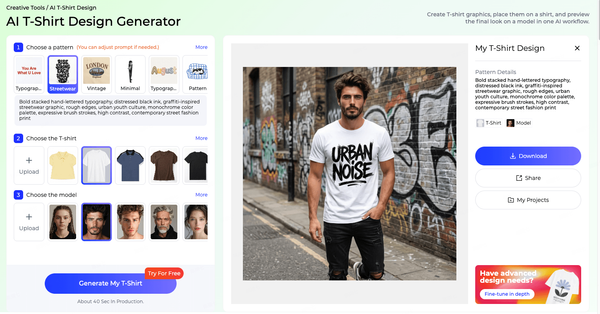
The cheapest round is the one you never schedule, and most first-round surprises are look questions nobody asked in advance: the colorway that dies against the trim, the print that reads at the wrong scale on the garment, the proportions that fight the size below. Settling those on screen is what the variation step is for. Style3D AI's fashion design variations tool takes a base design and produces color, proportion, and detail variants as images for review, so the team can kill or approve the look side before anything is cut. Done before round one, this strips the look questions out of the physical plan entirely, and the first sample's whole budget goes to the behavior questions only cloth can answer.
FAQ
Can a style go through only one sample round?
Yes, when every question except one behavior cluster has already been answered. Styles built on proven fabric, proven blocks, and a factory that has made the category before can legitimately converge in a single confirmation round. The test is the question inventory, not the count: one round is right when one round's worth of open questions remains.
Can a digital sample enter the factory quotation step?
For shape, seam count, and construction complexity, a clear render or 3D view is usually enough to open the pricing conversation. Anything fabric-dependent still needs the real cloth specification, because fabric choice changes both material cost and sewing time. Treat the digital file as the conversation opener, not the price basis.
What should the first physical sample verify above all?
The behavior question with the worst failure cost, which is usually fabric behavior: shrinkage against the spec, hand against expectation, and how the cloth accepts the construction you designed. Proportion can be re-checked on screen afterward; fit corrections still need a physical verification round, but a cheap one. A fabric that launders wrong cannot be corrected at any price you would want to pay.
At which round does shrinkage show up?
At whichever round first puts production fabric through a wash test. If no round includes a wash test, shrinkage shows up in customer returns, which is the most expensive round a style can have. Attach a wash cycle to the earliest physical round that uses bulk fabric, even if that round's nominal purpose is fit.
Why do factories resist when you cut rounds?
Some rounds protect the factory rather than you: the pre-production round proves their line can repeat the approved sample with bulk materials and their own operators. Removing it hands that risk back to them without their consent. Cut the rounds that answer your look questions twice; keep the ones that answer their process questions once.
When a digital sample and a physical sample disagree, which one wins?
The physical one, on anything it can actually measure. A render can only be right about what it was asked to show, while the cloth answers questions nobody asked it. Treat the disagreement as diagnostic: some assumption in the digital file, fabric physics or ease or seam allowance, needs correcting before the next round.
Where this leaves you
You will never generate the rounds away, because some questions only exist in cloth under stress, in a wash cycle, under a needle. What you can generate away is every round that was answering a look question with physical money, calendar time, and factory patience. Count questions, not rounds. Settle the look side offline, spend the physical budget on behavior, and the number of rounds takes care of itself — not because you cut it, but because you stopped paying for answers you already had.
Run the look questions before you book the rounds
Take one style off your current development calendar. List every question its sampling plan is supposed to answer, tag each as look or behavior, and pull the look questions off the factory's schedule: generate the colorways, the proportion variants, and the print-scale options, and settle them in review with your team. What remains is your real physical sampling plan, and it is shorter than the one on the calendar. Then hand the factory a file it can work from.
Written by