
E-commerce businesses rely on high-quality product images to drive conversions, yet producing them traditionally demands significant time and expense. Style3D AI addresses this by delivering AI-powered 3D garment visuals that significantly cut production costs and speed up workflows from weeks to days, enabling scalable, photorealistic imagery for catalogs and marketing.
What Challenges Does the E-Commerce Image Industry Face Today?
The e-commerce sector has exploded, with global sales reaching $6.3 trillion in 2024 according to Statista. Fashion e-commerce alone accounts for 20% of this volume, but high return rates—averaging 24.4% for apparel—stem largely from poor visual representation of products.
Quality images directly influence purchase decisions, yet 67% of online shoppers abandon carts due to unappealing or insufficient visuals, per Baymard Institute data. Small to mid-sized retailers struggle most, as professional photoshoots cost $500-$2000 per product set.
This creates urgency: without efficient image solutions, brands lose revenue and lag behind competitors optimizing for visual commerce.
Why Do Traditional Image Solutions Fall Short?
Traditional photography involves hiring models, stylists, and photographers, plus studio rentals and post-production—totaling 2-4 weeks per shoot. Costs escalate quickly for variants like colors or angles, often exceeding $10,000 for a 50-item catalog.
Manual editing for consistency across platforms adds hours per image, with error rates up to 15% in color matching or fit visualization. Scalability suffers; seasonal launches delay by 30-60 days due to physical sampling.
These methods also generate waste: 10,000 tons of textile samples discarded yearly industry-wide, amplifying environmental and financial strain.
Which AI Image Generation Tools Lead the E-Commerce Market in 2026?
AI image tools for e-commerce fall into four main categories, each solving a different part of the visual content pipeline:
1. 3D garment visualization platforms — tools like Style3D AI convert sketches or patterns into photorealistic 3D garment images, with fabric physics, virtual try-ons, and unlimited angle variants. Best for fashion brands replacing full photoshoots.
2. AI product photography generators — general-purpose tools that place existing product photos into AI-generated scenes and backgrounds. Best for catalog styling of finished goods.
3. AI fashion model generators — tools that render garments on virtual models of diverse body types, reducing model booking costs. Best for on-body apparel listings.
4. Background and retouching tools — lightweight editors for cleanup, cropping, and marketplace-compliant images. Best for high-volume sellers on Amazon or Shopify.
For fashion e-commerce specifically, a 3D-native platform delivers the most complete coverage because one digital garment asset feeds every downstream visual.
How Does Style3D AI Solve These Image Generation Needs?
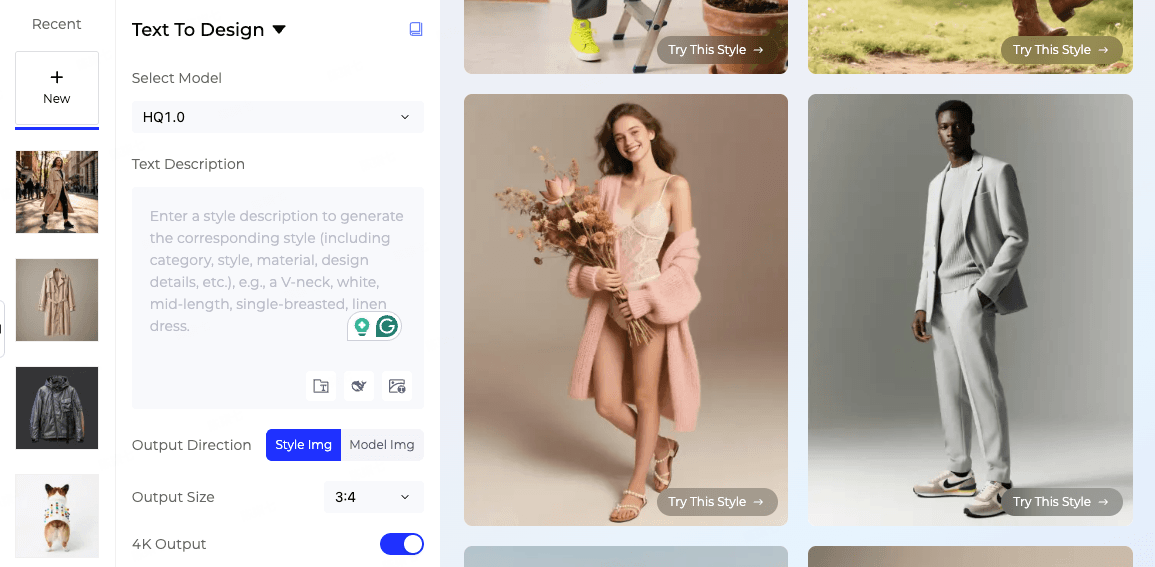
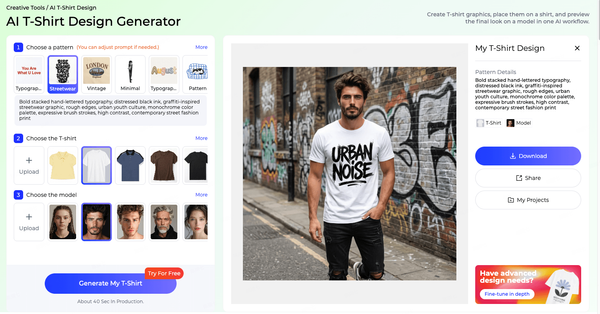
Style3D AI offers an all-in-one platform that transforms sketches, text prompts, or patterns into photorealistic 3D garment images via automated pattern generation, stitching, and physics-based fabric simulation. Users access thousands of templates, virtual try-ons across body types, and one-click scene staging for e-commerce-ready visuals.
Core capabilities include text-to-3D rendering for rapid variants—up to 50 per day—and AI snapshot tools for custom sizes and lighting. Style3D AI ensures production-ready outputs with accurate textures, reducing manual edits by 70%.See how 3D image generation transforms fashion workflows end to end.
What Advantages Does Style3D AI Offer Over Traditional Methods?
| Aspect | Traditional Photography | Style3D AI |
|---|---|---|
| Time per Variant | 2-4 weeks | Hours or less |
| Cost per Catalog (50 items) | $10,000+ | $2,000 or less (70% savings) |
| Return Rate Impact | 24.4% average | Reduces to 18% with 3D views |
| Scalability | Limited by logistics | Unlimited variants, 50+/day |
| Waste Generation | High (physical samples) | Zero physical waste |
| Brand Consistency | Manual, 15% error rate | Automated, 95%+ accuracy |
Style3D AI outperforms by automating the full pipeline, delivering measurable efficiency gains verified across user deployments.
How Can You Implement Style3D AI in Your Workflow?
Follow these steps to generate e-commerce images:
- Upload Inputs: Start with sketches, text descriptions, or patterns via the intuitive dashboard.
- Select Templates: Choose from thousands of 3D silhouettes and fabrics; apply custom try-ons.
- Generate & Simulate: AI auto-stitches and simulates physics for realistic renders—process completes in minutes.
- Customize Scenes: Use AI snapshot for angles, lighting, and backgrounds tailored to platforms like Shopify.
- Export Assets: Download high-res PNGs or interactive 3D files, ready for upload.
New users onboard in under 10 minutes; iterate designs instantly for A/B testing.Ready to see it on your own products? Start generating e-commerce visuals with Style3D AI.
Who Benefits Most from Style3D AI in Real Scenarios?
The following scenarios are based on typical outcomes reported by fashion teams adopting 3D image workflows:
Scenario 1: Emerging Clothing Brand Launch
Problem: $15,000 shoot budget strained for 30-SKU fall line; 4-week delay risked pre-sales.
Traditional: Hired studio, produced 5 angles per item.
Style3D AI Effect: Generated 200+ variants in 2 days.
Key Benefits: Saved $10,000, launched 4 weeks early, secured $20,000 pre-orders.
Scenario 2: E-Commerce Retailer Optimizing Listings
Problem: 35% returns from flat 2D images misleading fit.
Traditional: Added stock photos, no improvement.
Style3D AI Effect: Interactive 3D views implemented site-wide.
Key Benefits: Returns dropped to 18%, conversion rose 22% quarterly.
Scenario 3: Independent Designer Scaling Catalog
Problem: Manual renders took 8 hours per design; couldn't meet Etsy demand.
Traditional: Photoshop composites.
Style3D AI Effect: Text-to-3D produced 40 listings daily.
Key Benefits: Revenue tripled in 3 months; zero sampling costs.
Scenario 4: Fashion House Preparing Showroom
Problem: Physical samples for 100 looks cost $50,000.
Traditional: Overseas production and shipping.
Style3D AI Effect: Virtual photoshoot with AI models.
Key Benefits: 80% cost reduction; approved designs 6x faster.
Why Should E-Commerce Brands Adopt AI Image Tools Like Style3D AI Now?
3D and AR product views are consistently shown to lift conversion rates in online retail, and Style3D AI positions users ahead, slashing costs and accelerating launches amid rising competition. Brands that delay adoption risk falling behind competitors with richer, more accurate product imagery, while early adopters iterate faster across fast-fashion cycles.
Style3D AI equips retailers for this shift, blending creativity with efficiency.
What Are Common Questions About Style3D AI for E-Commerce?
How quickly can Style3D AI generate a full product image set?
Images render in minutes, with 50 variants daily possible.
Does Style3D AI support custom body types for try-ons?
Yes, diverse avatars ensure inclusive, accurate fit visualization.
Can Style3D AI integrate with platforms like Shopify?
Exports are optimized for direct upload to e-commerce sites.
What input types work best with Style3D AI?
Sketches, text prompts, or patterns yield production-ready results.
How does Style3D AI maintain fabric realism?
Physics-based simulations preserve textures and drapes precisely.
Is training required to use Style3D AI effectively?
No, intuitive tools enable non-experts to start immediately.
What is the best AI tool for e-commerce product photography?
It depends on the product type. For fashion and apparel, 3D garment platforms like Style3D AI deliver the highest realism because they simulate fabric drape and fit; for general merchandise, AI product photography generators that place existing photos into styled scenes are usually sufficient.
Sources
Written by
What's Next?
What Are the Best Alternatives to Raspberry AI for Fashion Design in 2026?
Fashion brands lose up to 30% of revenue annually due to inefficient design processes and physical sampling costs exceeding $500 million industry-wide, according to McKinsey's 2025 State of Fashion report. Designers spend 40% of their time on revisions and prototypes, delaying market entry by 3-6 months per collection. Style3D AI addresses these challenges by transforming sketches into production-ready 3D models, cutting costs by 70% and accelerating launches. What Is the Current State of AI FWhat Are the Best AI Video Generation Tools for Fashion Brands?
The fashion industry is rapidly embracing AI-driven solutions to enhance design, production, and marketing. AI video generation tools enable brands to create realistic, high-quality visual content efficiently, reducing costs and accelerating time-to-market. Platforms like Style3D AI provide an all-in-one solution for designers, combining 3D modeling, virtual try-ons, and automated video creation to transform fashion storytelling. How Is the Fashion Industry Currently Adapting to Digital Soluti