
What Is a Tech Pack? The Sections and What Each One Settles
A tech pack removes ambiguity. What each section settles, who owns it, and which omissions come back as the wrong sample.
A tech pack is the document that tells a factory what to make. Its job is to remove ambiguity — to answer, in advance and in writing, every question a person cutting and sewing the garment would otherwise have to guess at.
That framing explains why tech packs are structured the way they are, and why the common complaint about them is misdirected. People describe tech packs as bureaucratic. In practice, every section exists because somebody once left it out and received the wrong garment.
What a tech pack is for
Three things, in order of how often they matter.
It is an instruction. A factory reads it and builds from it, and anything not stated becomes a decision made by someone who has never spoken to you.
It is a costing basis. A quotation is priced against what the pack specifies, so changes after quotation are renegotiations. Vagueness in the pack becomes price movement later.
It is a record. When a sample comes back wrong, the pack is what determines whether it was a factory error or a specification error, and the two have very different remedies.
None of these require the pack to be long. They require it to be unambiguous, which is a different property and often achieved with less text rather than more.
What is inside
Section | The question it settles | Usually owned by |
Cover / style summary | Which style, season, and version this is | Product development |
Technical drawing | What the garment looks like and how it is constructed | Design |
Points of measure | How big it is, at every graded size | Technical design |
Bill of materials | What it is made from, down to the trim | Sourcing and development |
Construction details | Seam types, stitch types, finishing | Technical design |
Colorways | Which colors, and which parts take which color | Design and merchandising |
Artwork and placement | Prints, embroidery, position and scale | Design |
Labeling and packaging | Care labels, brand labels, how it ships | Compliance and operations |
Fit and sample history | What changed between samples, and why | Technical design |
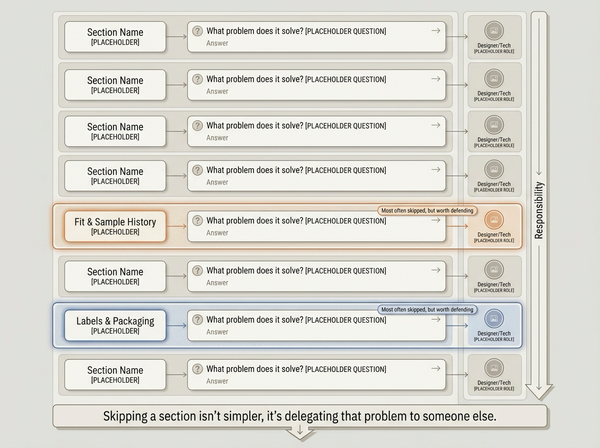
Two sections get skipped most often and are worth defending. Fit and sample history records what changed between rounds and why, which is what stops the same correction being made twice and what tells a new team member why an unusual measurement is deliberate. Labeling and packaging carries the content that regulators care about — fiber content, care instructions, country of origin — and it is the section where an omission becomes a compliance problem rather than a quality one.
The exact structure varies by company, and a small brand’s pack legitimately looks different from a large one’s. What does not vary is the set of questions. A pack that omits a section is not simpler; it has delegated that question to someone else.
The technical drawing, and what it does not carry
The drawing is the section people think of first, and it does less than most assume.
It shows the garment’s exterior appearance and construction: silhouette, seams, closures, pockets, topstitching, and the relationships between them. It communicates shape and construction logic faster than any amount of description.
It does not carry measurements, materials, colors or interior construction. A drawing showing a perfectly specified pocket says nothing about how big the pocket is, what it is made of, or how it is finished inside. Those live in other sections, and the drawing’s job is to be clear enough that those sections can reference it unambiguously.
Getting the drawing itself right is a discipline of its own, covered in what makes a technical flat usable downstream. Where the garment already exists and the drawing is being documented from it, extracting editable vector line art from the garment image is the practical starting point, with verification against the physical piece before it enters the pack.
One convention worth following: callouts. Any detail that needs explanation gets an enlarged view with a note. A drawing that requires the reader to infer a construction from a small line is a drawing that will be interpreted.
Measurements: the section that gets argued about
Points of measure are where most disputes originate, and the reason is usually not the numbers.
A point of measure has three parts: what is being measured, where exactly it is measured from and to, and what value it should be at each size. Teams reliably specify the third and skip the second. Chest width measured one inch below the armhole and chest width measured at the armhole are different measurements of the same garment, and a factory measuring differently from you will produce a sample that is correct by their reading and wrong by yours.
Tolerances belong here too. Fabric moves, and a garment that must hit an exact figure with no allowance is a garment that will be rejected on arrival for reasons nobody intended. What tolerance is reasonable depends on the fabric and the measurement, and it is a conversation with the factory rather than a number copied from a template.
Grading — how measurements change across the size range — is its own discipline and belongs to whoever owns fit in your organization. A pack that specifies only a sample size has specified one garment.
Materials and trims: where the delays live
The bill of materials is the least glamorous section and the one that most often causes a schedule to slip.
Every component gets named: the shell fabric, the lining, the interfacing, the thread, the zipper, the buttons, the labels, the hangtag. Named means identifiable — a supplier reference or a specification, not “matte black button.” Two black buttons from different suppliers are different components with different lead times and different prices.
Placement matters as much as identity. A trim listed without where it goes is half a specification, and the drawing is usually what resolves this, which is another reason the drawing has to be unambiguous.
Substitution policy is the part most packs omit. If a component is unavailable, does the factory wait, substitute, or ask? Silence means the factory decides, and they will decide in favor of the schedule.
Where tech packs fail
Ambiguity is the primary failure, and it hides in phrases that feel specific. “Standard finish,” “usual construction,” “as per previous style” all assume shared context that may not exist, particularly with a new factory or a new team member at an existing one.
Version drift is the second. A pack that circulates in several versions, with comments in email and changes agreed on calls, stops being a single source of truth. Whatever the factory has is what gets built, and a change agreed verbally and not reflected in the document has not been agreed at all.
Over-specification is the failure nobody warns about. A pack that specifies things the factory knows better — dictating a seam finish that is wrong for their machinery, for instance — invites either an expensive workaround or silent deviation. Specifying outcomes where you care, and leaving method to the factory where you do not, produces better results than specifying everything.
Language is a failure mode people underestimate. A pack is often read by someone working in their second or third language, sometimes through a translator, sometimes late in a shift. Idiom, abbreviation and internal shorthand all fail here, while short sentences, consistent terminology and a diagram survive. Using two different words for the same component across two sections is enough to produce two different components.
Unstated priorities are the last. When a pack cannot be fully satisfied — as happens — the factory has to choose what to compromise. A pack that says which requirements are absolute and which are preferences gets a better compromise than one that presents everything at equal weight.
What a tech pack cannot do
It cannot substitute for a sample. The first physical piece is where specification errors surface, and no amount of documentation shortens that loop. A pack reduces the number of rounds; it does not eliminate them.
It cannot make an unbuildable garment buildable. A specification can describe a construction that does not work in the intended fabric or at the intended price, and the pack will faithfully communicate an impossible request.
It cannot replace a conversation with the factory. The best packs are written by people who have discussed the style with whoever will build it, and the discussion surfaces constraints that no template prompts you to ask about.
It cannot be generated from an image. The drawing can come from a garment photograph; measurements come from measuring, materials come from sourcing, and construction comes from someone deciding. A pack assembled without those inputs is a document with the shape of a specification and none of the content.
Frequently Asked Questions
Is a tech pack the same as a spec sheet?
Usage varies. “Spec sheet” often means the measurement section specifically, while “tech pack” means the whole document including drawing, materials and construction. Confirm which one someone means before sending, since sending one when the other was expected wastes a cycle.
Who writes the tech pack?
Technical design or product development in most organizations, drawing on inputs from design, sourcing and compliance. Small brands often have one person doing all of it, which works as long as the questions still get asked rather than assumed.
How detailed does a tech pack need to be?
Detailed enough that nothing important is left to interpretation, and no more. Length is not the measure — a short pack that answers every question beats a long one that repeats a template. Add detail where an error would be expensive.
Do I need a tech pack for a small production run?
Yes, and arguably more, since a small run has less margin to absorb a wrong sample. What can shrink is the formality rather than the content, and the questions each section answers still have to be answered somewhere.
What is the most common omission?
Where measurements are taken from, followed by substitution policy on trims. Both feel obvious to the person writing the pack and are not obvious to the person reading it in a different factory, a different country and possibly a different language.
How do we handle changes after the pack is sent?
Version the document and reissue it, with the change marked. Agreements reached in email or on a call and not written into the pack are the single most common source of a sample that satisfies nobody, since each party remembers a different conversation.
Should the pack specify the construction method or the outcome? Outcome where you care about the result, method where you specifically need that method. Over-specifying method removes the factory’s ability to use what works on their equipment, and the deviation usually happens anyway without being reported.
The pack is a list of answered questions
The way to judge a tech pack is not by its length or its formatting but by counting what a reader would still have to guess. Every guess is a decision transferred to someone who cannot see your intent, working in a different context, under schedule pressure. Sections exist to close those gaps, and the ones teams skip are reliably the ones that come back as a sample nobody wanted. Write it to be unambiguous rather than complete, and check it by asking someone unfamiliar with the style what they would have to assume.
Written by