
Batch Processing Product Images: Where Single-Image Tools Break
A tool is judged on its best output and a pipeline on its worst. Which changes where the cost sits: not in processing the images but in finding the failures.
A tool that handles one image beautifully and a pipeline that handles a season’s catalog are different products, and the gap between them is not throughput.
A tool is judged on its best output; a pipeline on its worst
Evaluating a tool means trying it on an image and looking at the result. Everyone does this, and it selects for tools that produce excellent results on the images people choose to test with — which are, reasonably, representative images rather than difficult ones.
A pipeline is judged differently. It produces a set, the set goes live, and its quality is whatever the weakest image in it is. Nobody praises a catalog for the images that came out well; a catalog is noticed when something in it is wrong.
So a tool that gets almost every image right is excellent as a tool and may be unusable as a pipeline, because the ones it got wrong are now somewhere in a large set and have to be located.
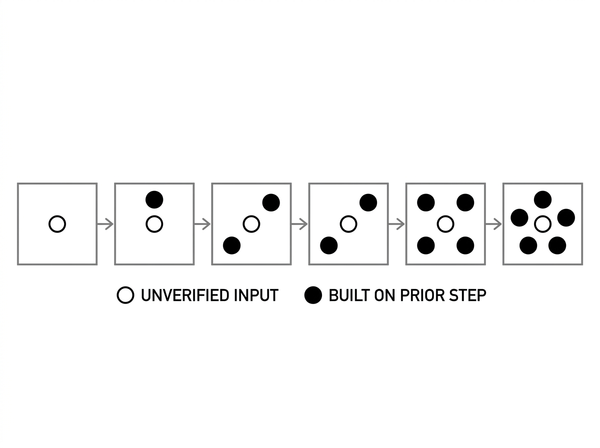
That is the actual difference between the first image and the two-hundredth. The first is a question about capability. The two-hundredth is a question about detection.
The asymmetry compounds with catalog size in an awkward direction. A larger catalog produces more failures in absolute terms and gives each one a smaller share of anyone’s attention, so the probability that a given failure is noticed falls exactly as the number of failures rises. Scale does not merely multiply the problem; it also degrades the mechanism that was catching it.
The cost moves from doing to finding
This is the reframing that changes how a batch process should be evaluated.
Processing is cheap and getting cheaper. Finding the failures is not, because it requires attention, and attention does not scale — a person reviewing a large set carefully will slow down, and a person reviewing it quickly will miss things. Neither outcome is a tool problem.
Which means the selection conversation is usually about the wrong variable. Teams compare per-image quality and per-image price, and the time that actually gets spent is review time, which is unaffected by either.
A tool that produces slightly worse results and reliably flags its own uncertain cases can be cheaper to run than a better tool that reports nothing, because the second one distributes its failures invisibly across the set.
That criterion rarely appears in an evaluation, partly because it is not what a demonstration shows. A demonstration shows the output. Whether the tool knows when it is unsure is only observable across a set that includes cases it should be unsure about, which is not what anyone brings to a trial.
Which images are hard, and can you tell in advance
Partly, and it is worth doing, because sorting by expected difficulty is the cheapest available improvement to a batch process.
Difficulty in cutout work concentrates in predictable places: edges that are bands rather than lines — hair, fringe, mesh, lace, anything sheer. Beyond that, low contrast between subject and background, garments whose color approaches the backdrop, and anything with fine internal structure.
Those properties are known before processing, from the product data rather than from the image. A batch can therefore be split: the straightforward majority runs unattended, and the predictable difficult cases are routed to a different treatment from the start.
What cannot be predicted is the individual surprise — the one image where something unexpected happened. A garment photographed slightly differently, a sample that arrived in an unusual finish, a file that came from a different source than the rest. That residue is small, unpredictable, and the reason sampling exists.
Consistency is a property of the batch
Here is the failure that no per-image review detects.
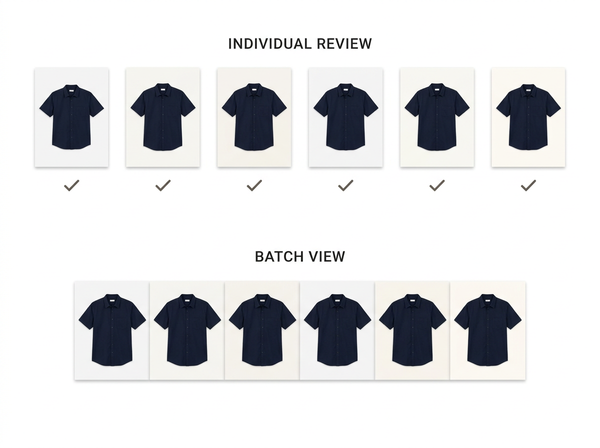
Two images can each be processed correctly and still not belong together. One has slightly more margin around the product than the other. One sits at a fractionally different white point. Each passes review on its own terms, because each is correct.
The set fails anyway, since a group of images is read as a group and the differences between them are what a viewer notices. A reviewer working through images one at a time is looking at the property that is fine and cannot see the property that is broken.
The only detection method is viewing the batch as a grid, at the size customers will see it. That takes seconds and it is not part of most review processes, because most review processes were designed around approving individual images.
Drift within a run
Long runs develop seams.
A batch processed over several days can span a tool update, a settings change made by someone solving a specific problem, or source material captured in two different sessions. Any of these produces a set with a boundary in it — images before the change and images after, consistent within each half.
Nothing in any individual image indicates when it was processed. The seam is only visible as an inconsistency between groups, and only if someone happens to view them adjacently.
The preventions are unglamorous: record the settings with the output, avoid changing them mid-run, and process material from one capture session together rather than interleaving sources.
Where a change genuinely has to happen mid-run, the cheaper response is usually to reprocess what came before it rather than to accept a set with two standards in it. Reprocessing is a machine cost; a permanent seam in a catalog is a cost that recurs every time someone views a category page.
The structure that works
Three stages, in this order.
Process everything, with the tool configured to flag cases it is uncertain about rather than silently producing its best attempt. This is the capability that distinguishes a pipeline tool from a good tool, and it is worth asking about specifically — an automated step that reports what it was unsure of makes review possible at scale, and one that reports nothing does not.
Review the flagged cases with full attention. This is where the difficult images end up, it is a small share of the batch, and it deserves the care that cannot be spread across everything.
Sample the unflagged cases randomly. Not the first twenty, not the ones with recognizable product names, not the ones that load first — randomly. Convenience sampling checks the images most likely to be fine, and the whole purpose of the sample is to estimate what is happening in the part nobody looked at.
That last point is the most common failure in practice, and it is invisible because a convenience sample produces reassuring results.
What to measure
• How many cases were flagged, since a rate that changes between runs indicates something changed in the input or the tool.
• How many flagged cases actually needed correction, which tells you whether the flagging is useful or is crying wolf.
• How many problems were found in the random sample, which is the only estimate available of what is in the unreviewed portion.
• Whether the batch was viewed as a grid, which is a yes-or-no process check rather than a measurement.
Tracking the first three over a few runs turns a batch process from something that either works or does not into something with a known behavior. It also makes the case for changing tools concrete, since a tool that flags better shows up immediately in the second measure — which is a far more useful basis for a decision than a side-by-side comparison of two outputs, and it costs nothing beyond writing down three numbers per run.
FAQ
How large does a batch have to be before this applies?
Whenever reviewing every output carefully stops being realistic, which for most teams is smaller than they expect. The threshold is about attention rather than about a particular count.
Should difficult categories be processed differently?
Routing predictable difficulty away from the unattended path is usually worth it, since those cases will need attention regardless and finding them afterward costs more than separating them beforehand.
Is manual work still necessary?
For the cases that automation flags and for categories where the difficulty is structural rather than incidental. The goal is directing manual effort rather than eliminating it, and a process that eliminates it entirely is one that has stopped detecting its failures.
How big should the random sample be?
Large enough that finding nothing is informative, which depends on how bad an undetected failure would be. A sample chosen for convenience is worse than no sample, since it produces confidence without evidence.
What if our tool does not flag anything?
Then review is the only detection mechanism, and the batch size has to stay within what can actually be reviewed. That is a legitimate arrangement and it caps how large a catalog the process can serve.
Does this apply to generated images as well as edited ones?
More strongly, since generated output fails in ways that look finished rather than broken, and finished-looking failures are exactly what a hurried review passes.
Where this leaves you
Ask how the failures in your last batch were found.
If the answer is that somebody noticed one, the process has no detection mechanism and the failures that nobody noticed are still live. If the answer is that the tool flagged them, the question becomes whether the unflagged portion was sampled — and sampled randomly, rather than wherever the reviewer happened to start.
The two-hundredth image is not harder than the first. It is in a place where nobody is looking.
View the batch as a grid
Before publishing your next processed set, put every image in one grid at thumbnail size and look at it for ten seconds. You are not checking any individual image — those were reviewed already. You are looking for the ones that do not match their neighbors: a different margin, a different white, a different crop. That inconsistency is invisible in a per-image review and obvious in a grid, and it is the failure most likely to be in a set that passed every check. See how batch cutouts and background handling work.
→ https://www.style3d.ai/image-editing-tools/background-remover
Written by