Extracting a Print From a Garment Photo
Six separate distortions sit between a printed garment and the artwork on it. Extraction produces an estimate of the original, and estimates have uses.
Pulling a print off a photograph of a finished garment produces something useful. It does not produce the artwork.
What comes out is an estimate of the original, and between the original and the photograph sit six distortions that arrived independently and do not undo each other.
What extraction actually produces
The artwork that was printed onto the fabric existed as a file: flat, at a known scale, in specified colors, with a defined repeat. That file is what a printer works from.
A photograph shows that artwork after it has been printed onto cloth, cut, sewn, put on a body or a form, lit, and captured through a lens. Every one of those steps changed it.
Extraction reverses as much of that as can be reversed and estimates the rest. The output is a reasonable proposal for what the original might have been, which is a different object from the original and has different uses.
Six distortions, arriving separately
Geometry. Fabric on a body is curved, folded, and gathered. A curved surface cannot be flattened without stretching something, so any flattening involves a choice about where to put the error.
Perspective. Parts of the garment further from the camera are smaller. A repeat that is uniform on the cloth is not uniform in the photograph.
Shading. Folds produce light and shadow, so a single printed color appears at many different values across one garment. Nothing in the image distinguishes a darker area of print from a shadow falling on a lighter one.
Resolution. The print occupies a portion of the frame, so its effective resolution is a fraction of the photograph’s — and the parts on curved or receding surfaces have less again.
Occlusion. Seams, gathers, pockets, and the wearer’s own arms cover parts of the design.
Color. White balance, the fabric’s own way of taking light, and the difference between how ink sits on cloth and how it appeared on screen all shift what is recorded.
Each is separate. Correcting one does not address the others, and a tool that handles geometry well can still return colors that were never in the design.
They also interact in one unhelpful direction. Correcting geometry means stretching parts of the image, which spreads the available resolution more thinly exactly where the surface was most curved — so the regions that needed the most correction end up with the least detail to correct with. Nothing about this is a defect in any particular tool; it follows from there being a fixed amount of information in the photograph.
The repeat is rarely visible in one piece
This is the distortion with the largest consequence and it is the one people expect least.
A printed textile is built on a repeat — a unit that tiles across the cloth, and the size and structure of that unit are design decisions. To recover the artwork you need one complete repeat.
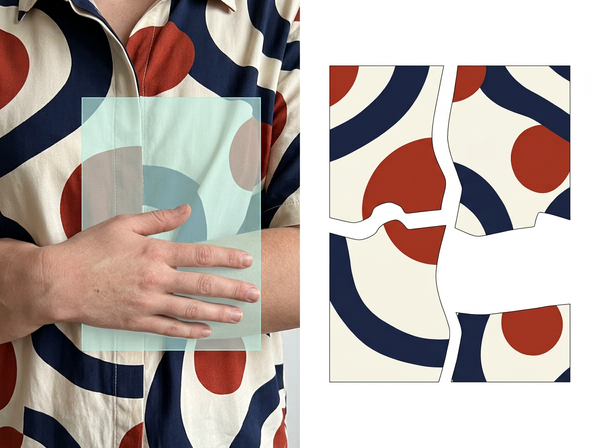
A photograph of a finished garment frequently contains no complete repeat anywhere. The unit is larger than any uninterrupted area of fabric in the frame, or it is crossed by a seam, or a fold runs through it, or an arm covers part of it. What is visible is several partial repeats in different orientations, at different scales, under different lighting.
Which means the repeat is reconstructed from fragments rather than read from the image. Something has to decide what the unmatched portions contain, and the decision is an inference from the visible parts — reasonable, frequently correct, and not the same as having seen it.
The reconstruction is most reliable where the design is regular and least reliable where it is not. An engineered print with deliberate variation across the panel has no repeat to recover at all.
Which produces a diagnostic worth applying before anything else: look at the photograph and try to find one complete unit. If you can point to it, extraction has a good chance of being accurate. If you cannot find one anywhere in the frame, whatever comes out was assembled rather than observed, and should be treated accordingly.
Color is the least recoverable property
Geometry can be partly corrected. Shading can be partly compensated. Color cannot be recovered in the same sense, because the photograph never contained it.
What the image records is the color of ink on a particular fabric, under particular light, through a particular camera, after whatever processing the file has been through. Three of those four are unknown when you receive a photograph.
The practical implication is that extracted colors are a starting point for a conversation rather than a specification. Anyone treating them as values to match is matching a photograph of a garment rather than the design that produced it.
What the output is good for
Genuinely useful, and worth stating clearly.
As reference, it captures the character of a design — the scale of the motifs, the density, the color relationships, the general feel. That is most of what a mood or direction conversation needs.
As a starting point for new artwork, it gives a designer something to work from rather than a blank page, which is a real acceleration on work that was going to be original anyway.
As an analysis of structure, it reveals how a repeat is constructed, how motifs are distributed, and how the scale relates to a garment — all of which are informative regardless of how precisely the artwork itself was recovered. For anyone learning how prints are built, or assessing why one design reads as busy and another as calm, that structural reading is the substance rather than a consolation.
What it cannot be used for
Production artwork, in any case where the print will be reproduced. The distortions are individually small and collectively enough that a file derived this way will not print as the original did — and the discrepancy will be uniform across the run rather than appearing in a few pieces, since every garment is being printed from the same imperfect file.
Color matching, for the reasons above. Where an extracted palette is used as a target, what is being matched is a photograph of a garment under one lighting condition, and the mill will hit that target faithfully.
Anything requiring an exact repeat, since the repeat was reconstructed. A design that appears seamless in an extracted preview can reveal a mismatch when it is actually tiled across a length of fabric.
There is also a question that sits outside the technical one: extracting a print from someone else’s product is a matter of rights, and where that boundary lies is for whoever handles those questions in your organization to determine, before the output is used for anything.
If the print is yours, look for the original first
When the design belongs to you, extraction is usually the wrong route and the right one is unglamorous.
The original file exists somewhere — with the designer who made it, the studio that produced it, the mill that printed it, or in an archive nobody has searched. Finding it takes an afternoon and produces the actual artwork rather than an estimate of it.
Where the original is genuinely gone, extraction becomes the input to a recreation rather than a substitute for one. The output is a brief: this is roughly the scale, this is roughly the palette, this is how the motifs relate. Someone then makes the artwork again as a clean file with a defined repeat and specified colors.
That reframing matters commercially. A recreation is a design job with a known cost and a usable result. An extraction treated as a file is a design job that nobody scoped, discovered at the point where the print does not tile — which is generally after a sample has been printed, at which stage the cost includes the sample as well as the design work.
FAQ
Can a flat lay photograph solve this?
It removes most of the geometric distortion and much of the shading, which helps considerably. Resolution, color, and occlusion by seams remain, and a flat lay of a finished garment still contains seams.
What if I photograph the fabric before it is cut?
That is a substantially better input — flat, unoccluded, evenly lit — and it is what to do when the option exists. It still does not recover the file, since color and resolution limits apply to any photograph.
How much does image quality matter?
It affects resolution and color and does nothing about geometry or occlusion. A higher-resolution photograph of a folded garment is a higher-resolution photograph of a folded garment.
Can the repeat be verified?
By tiling the extracted unit and looking for mismatches at the joins, at a size larger than the original photograph. Mismatches that are invisible in a small preview become obvious across a length.
Is an extracted print good enough for a mockup?
For showing a direction, generally yes. For a mockup that will be approved and sent to production, the file that goes to the printer needs to be the artwork rather than the estimate.
What about prints with photographic elements?
Those are the hardest, since the extraction has to separate the printed image from the photographic capture of it, and both are photographs. Results tend to be usable as reference only.
Where this leaves you
Treat the output as a description of a design rather than as the design.
Descriptions are useful. They communicate scale, palette, density, and character, and they do it faster than words. What they are not is a file — and the gap between them is invisible in a preview and unmistakable on a printed length, which is the worst possible place for it to become apparent.
Tile it before you trust it
Take any extracted repeat and tile it out to several times the size of the photograph it came from. Look at the joins. Mismatches that are invisible in a small preview — a motif that does not quite line up, a spacing that drifts — become obvious across a length, and a length is what gets printed. If it tiles cleanly, you have a usable starting point. If it does not, you have a reference, which is still worth having as long as nobody mistakes it for artwork. See what print extraction produces.
→ https://www.style3d.ai/graphic-print-design/graphic-extractor
Written by