
What Generated Product Copy Can and Cannot Claim
Generated descriptions can only describe what an image shows. Fiber, weight, origin, care and sizing come from documents. How to split the two.
A copy generator reads an image and returns sentences. Every one of those sentences is a statement about appearance, including the ones that are shaped like specifications. That shape is the problem worth attention: a line about fiber content and a line about how a fabric catches light come out of the same process, in the same register, with the same confidence, and only one of them has anything behind it.
Teams usually catch the obviously wrong outputs. Nobody publishes a description that names the wrong garment. What gets published is the fluent, plausible, entirely unsourced sentence that sits between two accurate ones and inherits their credibility.
A description makes two kinds of sentence
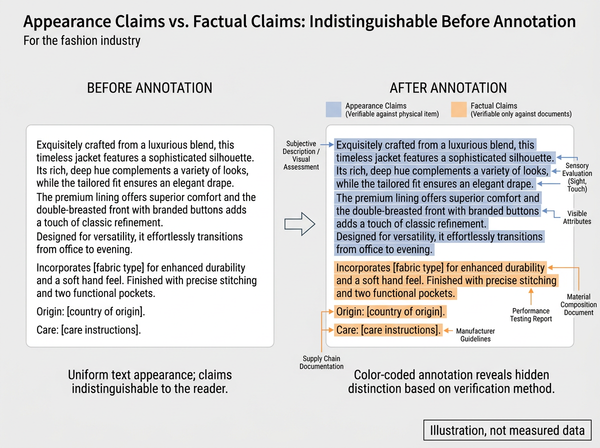
Read any product description and the lines sort into two piles. One pile describes how the garment looks and behaves as an object being seen: the silhouette it holds, how a print reads at that scale, how the surface catches light, the way the collar sits. The other pile states what the garment is: what it is made of, what it weighs, where it was made, how it should be washed, what the sizing is based on, what it is certified for.
The first pile is a consequence of the object being what it is, so a picture of the object contains it. The second pile exists independently of appearance. Someone measured it, tested it, or was told it by a supplier, and no amount of looking at the garment will produce it. This is the same division that runs through generated imagery, and it does not soften when the output is text instead of pixels.
Generation has access to the first pile and none of the second. What makes copy different from images is that text can imitate the second pile perfectly while having access only to the first.
What generation actually does well
Appearance language is genuinely hard to write at volume, and it is where a generator earns its place. Describing the same jacket for a hero paragraph, a category snippet and a marketplace field means saying one thing three lengths, and doing it consistently across a catalog is more tedious than difficult.
It is also good at structure. A description that always covers silhouette, then surface, then styling, in that order, is easier for a buyer to scan and easier for you to review, and a generator will hold that order across a catalog more reliably than a rotating group of writers.
Where it helps most is as a first pass on visual vocabulary. A writer who has the sample in hand but is looking at a blank field will get further from an appearance draft than from nothing, provided the draft is treated as vocabulary rather than as content.
The facts that are never in the picture
Claim | Where it actually comes from | What a generated version is |
Fiber content and blend | Supplier documentation, confirmed against a mill or lab statement | A guess derived from how the surface looks in one image |
Fabric weight and hand | A measured figure from your own testing or the supplier spec sheet | A visual impression of thickness, which lighting alone can change |
Country of origin | Production records | Invention, with no visual basis of any kind |
Care and washing | Supplier instruction, confirmed against the trim and label | Convention borrowed from garments that look similar |
Sizing basis and fit intent | Your own grading rules and fit session notes | An inference from how the garment sits on one photographed body |
Certifications and material claims | The certificate itself, current and in your name | A phrase pattern that resembles the ones certified products use |
Every row in the right-hand column reads like a specification and none of them is one. That is the whole risk in one table.
Claims in this group also carry regulatory and platform-policy weight, and the weight varies by market and by channel. Treat any line that touches composition, origin, care, sizing basis, environmental attributes or performance as owned by whoever holds compliance in your organization, and verify it market by market and platform by platform rather than reusing a description because the garment is the same.
Fluency is the risk
A wrong sentence that reads badly gets rewritten. A wrong sentence that reads well gets approved, and then it travels. Product descriptions are the most-copied text an apparel business produces: the same paragraph lands in a marketplace listing, a wholesale sheet, an ad, an email and a comparison feed, usually pasted by someone who was not in the room when it was written. Nobody re-checks a sentence at the fourth copy. The original review is the only one that happens.
This is why the useful test is not whether a sentence is correct. It is whether the sentence is the kind of sentence that could be checked. “Falls straight from the shoulder without collapsing at the waist” is checkable against the sample by anyone holding it. “Brushed cotton with a soft hand” is checkable only against a document, and if you cannot name the document, the sentence is not a claim you own.
The same argument produced the conclusion in an earlier piece that a tech pack cannot be generated from an image: the facts a tech pack carries were never in the picture. A product description carries a smaller set of the same facts, to a larger audience, with far less review.
What generated copy cannot do
• It cannot supply any fact that was not in the image or in the brief you wrote, and a fluent sentence is not evidence that a fact arrived from somewhere.
• It cannot tell you which of its sentences are fact-shaped, because it has no separate representation of the difference while writing them.
• It cannot inherit a claim safely from a similar product, since the resemblance that makes the borrowing plausible is exactly the resemblance that makes it wrong.
• It cannot carry the answerability for a published claim, which stays with your organization no matter which tool produced the wording.
There is a quieter limit as well. Generated copy describes the image it was given, so an image that flatters the drape produces copy that overstates it, and the description then agrees with the photograph while both disagree with the garment. Copy written from a sample is the only version that can catch an image error, which is a reason to keep the sample in the writing process even when the images are excellent.
A review pass that catches fact-shaped sentences
Split the review in two, because the two piles need different checks and mixing them is how spec-shaped sentences survive. The first pass reads only for category: mark every sentence that states something not visible in the photograph, without judging whether it is true. The second pass takes only the marked sentences and asks, for each one, which document it came from.
Keep the answers somewhere stable. A short register — claim, source document, who owns it, when it was last confirmed — is more useful than a style guide, because it converts a recurring argument into a lookup. It also survives staff changes, which style knowledge does not.
The marketing copy generator in Style3D AI works from the image plus whatever you put in the brief, so the practical move is to put your confirmed facts into the brief rather than leaving them to be filled in. A generator given the fiber content will use it; a generator not given it will write a sentence in its place, and that sentence will read exactly like the one you would have supplied.
Structure the template so the facts have slots. A description skeleton with placeholders for composition, care and sizing basis makes an unfilled slot visible at review, whereas a generator asked to produce a complete paragraph will always produce a complete paragraph. Missing information should look missing.
Common questions
Can we let the generator write the whole description if a person reviews it afterward?
A reviewer catches errors they can check, and a fact-shaped sentence about origin or composition is not checkable by reading. Review works on appearance language and fails on the rest, so the split matters more than the presence of a reviewer. Give the generator the facts and let it write around them.
What if the supplier’s own copy already includes those claims?
Supplier copy is a source, but it is a source you should record rather than absorb. Note which document each claim came from and when it was confirmed, because you are the one publishing it and the supplier’s marketing language may itself be inherited from somewhere else. A claim you cannot trace is a claim you cannot defend.
Is it safe to reuse a description across marketplaces?
The garment is the same, but requirements around composition, care, origin and material claims differ by market and by platform. Route reused descriptions through whoever owns compliance rather than treating a copy-paste as a formatting task. The appearance half usually travels; the fact half is what needs checking each time.
How should we handle claims about sustainability or performance?
Treat them as the strictest category on the page, since they combine regulatory attention with a strong incentive to overstate. Every such line should trace to a certificate or a test result held in your name and current at the time of publication. If the document names a scope, the sentence has to stay inside it.
Our writers are already producing copy from images. Does that change anything?
The mechanism is the same, and so is the fix: write from the sample and the specification, then use the images to check the appearance language. A person working only from images will produce the same fact-shaped guesses a generator does, at lower volume and with more confidence.
Where does this leave translated or localized descriptions?
Translation moves the fact half into a new market, which is where its requirements can change, so a translated description is a new publication rather than a copy of an existing one. Have the appearance half localized for readability, and have the fact half re-confirmed for that market before it goes live.
What you are signing when you publish
A product description is a set of claims made by your business, and the tool that produced the wording has no bearing on who answers for them. Generation is good at the part of that document that describes what a buyer can already see, and it is structurally incapable of the part that a buyer cannot verify and therefore has to take on trust. Splitting the description along that line is not a workflow preference. It is the only way the second half of the page stays worth anything.
Sort your descriptions into two piles
Take a listing you published recently and mark every sentence that states something not visible in the photograph. For each mark, name the document it came from — a supplier sheet, a test result, your own grading notes. Sentences with no document behind them are the ones to rewrite or remove first, and the list you produce doing this is the start of a claim register you can reuse on every listing after it.
→ Marketing copy generator: https://www.style3d.ai/image-editing-tools/ai-marketing-copy-generator
Written by