
When to Shoot a Flat Lay and When to Generate One
A photographed flat lay records the garment. A generated one proposes it. Which uses can take a proposal, and which need the record.
Almost every piece of production advice about generated apparel imagery ends at the same place: the result is limited by the garment image you started with. That usually means a flat lay. It is the most reused asset an apparel business owns and the one most often shot in a hurry, by whoever was free, on whatever surface was clear.
The tooling has now made the question harder rather than easier, because a flat lay can also be generated from a photograph of the garment on a body. That is a useful capability and a genuinely different object from a photographed flat lay, and the difference decides where each one can be used.
Two things are called a flat lay
One is a production asset. It exists to be an input: to a try-on, a color change, a print application, a detail crop. Nobody outside the company sees it, and its only job is to represent the garment completely and neutrally.
The other is a published image. It sits on the product page or a category tile, it is styled, cropped and lit for the page, and its job is to make a shopper understand the garment at a glance. Styling that helps the second job — a sleeve folded to suggest movement, a hem arranged into a curve, a crop that centers the yoke — actively damages the first, because every one of those choices removes or alters information a downstream process needs.
Teams get into trouble by keeping one library. The published flat lay is the one that is easy to find, so it becomes the input, and its styling gets baked into everything generated from it afterward.
What makes one usable as an input
• The garment sits square to the camera and fills the frame, since foreshortening changes the silhouette every downstream process will read as the garment’s shape.
• The light is even across the whole piece, because a hot corner gets read as a property of the fabric rather than a property of the lighting.
• The garment is arranged in the shape it actually holds, not pinned or stretched into the shape you wish it had, which is a record of a garment that does not exist.
• Nothing sits on top of it and nothing overlaps it, as clips, pins, props and folded-back sleeves will either be reconstructed as part of the garment or removed by a guess.
Two more conditions are worth stating in prose because they get argued about. The background needs to separate from the garment in value, not only in color: low separation turns the edge into an estimate, and the edge is where every later operation begins. And closures should be in the state the garment is sold in, since a jacket photographed open and a jacket photographed closed are two different silhouettes, and only one of them matches the listing.
Contact shadow where the fabric meets the surface is useful information and should stay. A drop shadow falling across the garment from a light stand is not, and it will survive into every image made from that file.
A photographed flat lay records, a generated one proposes
An earlier piece drew the distinction between a drawing that records an existing garment and one that proposes a new one, and argued that the two look similar on the page while answering to completely different standards. The same split applies here, and it is the most useful thing to hold on to.
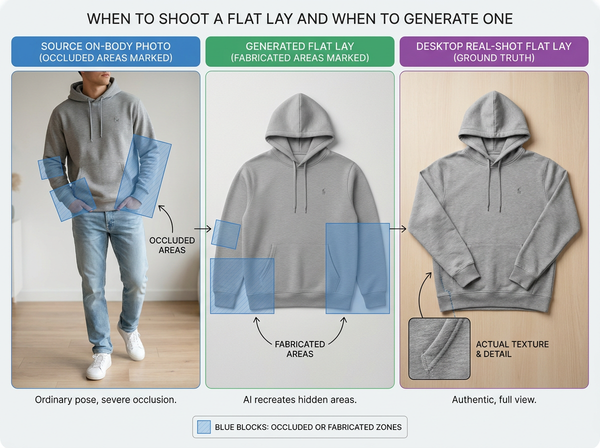
A photographed flat lay is a record. The garment was on the table, the shutter fired, and the shape in the file is the shape the garment holds. A flat lay generated from an on-body photograph is a proposal: this is what the garment probably looks like laid out, given how it appeared on a body in one pose. Much of that proposal is well founded, because the front of the garment was visible and its proportions are recoverable. Some of it is not, and the parts that are not are predictable — they are the regions the body and the pose concealed.
Arms hide the side seams and the underarm. A hand in a pocket hides the pocket. The lower back and the inside of a collar are absent from a front-facing image entirely. Whatever appears in those regions of a generated flat lay was constructed, and it will be constructed in the direction of the tidy, regular version, which is the direction generation always errs in.
When to generate from an on-body image, and when not
Use | Shoot or generate | Reason |
A published flat lay for a page that already has on-body images | Generate | The shopper is reading shape and color, both recoverable from the on-body shot |
An input to a try-on, swap, recolor or print application | Shoot | The next process will treat invented regions as fact and build on them |
Evidence of construction, closures, back detail or interior | Shoot | None of it was visible on the body, so none of it can be recovered |
Backfilling a catalog of older styles that are no longer in the building | Generate | The garment is gone; a proposal is the only option, and the page should not lean on it |
Meeting a marketplace format requirement for an existing listing | Generate | The requirement is about presentation, not about new evidence |
A style whose whole point is its shape when off the body | Shoot | Shape is the claim being made, and a proposal cannot support a claim |
The second row is the one that costs money when it goes wrong. Generation stacks: an invented underarm in a generated flat lay becomes the starting point for a swap, which becomes the starting point for a set of angles, and by then nothing in the chain is checkable against anything except the file above it. The failure modes in a garment swap are largely inherited from the garment image it was given, so a proposal at the top of the chain is a proposal repeated at every level of it.
The flat lay tool in Style3D AI takes an on-body photograph and returns the garment laid out flat, which means it is working from what that photograph happened to show. A pose with the arms away from the body gives it more to work from than a pose with the arms crossed, and choosing the source image is most of the work.
What a flat lay cannot do
• It cannot show drape, because a garment on a table has surrendered its shape to the table, and the folds you see are the surface’s contribution as much as the fabric’s.
• It cannot show fit, since fit is a relationship between a garment and a body and there is no body in the frame.
• It cannot show weight or hand, which are the two properties buyers most often ask about and the two least visible in any photograph.
• It cannot substitute for detail shots, because the scale that captures the whole garment is not the scale that resolves a stitch, a trim or a fabric texture.
A flat lay is also a poor place to judge color, even though it is where color usually gets judged. The garment lies flat under one light, without the folds and self-shadowing that a shopper will see on a body, so a flat lay reads a shade cleaner and flatter than the garment ever looks in wear. That is convenient for cataloging and misleading for approval.
Reviewing one before it becomes an input
Look at the edge first. Everything downstream begins by separating the garment from the surface, and an edge that a person has to squint at is an edge a process will get wrong quietly. Then look for anything that is not the garment: a clip, a pin, a hand, a shadow crossing the fabric, a fold arranged for the camera.
For a generated flat lay, review by region rather than as a whole picture. Find the parts of the source photograph that were hidden by arms, hands or pose, then look at those same parts in the output — that is where the invention is, and it is the only part of the image worth arguing about. The rest of it is recovered from something that was visible.
Check against the garment, not against the source image. A generated flat lay and the on-body photograph it came from will agree with each other by construction, so comparing the two confirms whatever was inferred instead of testing it. If the garment is in the building, put it on a table.
Common questions
Can a generated flat lay be used as an input if we check it first?
Checking finds the errors you can see, and the invented regions are plausible by design, so a review catches the obvious failures and passes the subtle ones. The deeper issue is that the next process treats everything in the file as equally factual, including the parts you approved as reasonable rather than verified. Use a photographed file when a process will build on it.
Our product page uses on-body images only. Do we need flat lays at all?
You need them as production assets even if you never publish one, because most image operations start from a clean garment image and the alternative is starting from a pose. Shoot them once, keep them out of the published library, and label them so nobody styles them later.
What surface should we shoot on?
Choose for separation and neutrality rather than for looks: the surface should differ from the garment in value, hold no texture that reads as fabric, and reflect nothing colored back into it. A surface that flatters the garment in the frame is usually one that has contributed color or sheen to it, which is exactly what you do not want in an input file.
How do we handle garments that will not lie flat?
Structured pieces, heavy outerwear and anything with a built-in shape need support underneath rather than flattening on top, and pinning them into a flat shape produces a record of a garment nobody will receive. Where the shape cannot be laid out honestly, shoot the garment as it holds itself and treat that as the input.
Can we regenerate flat lays for a past season instead of pulling stock?
That is one of the cases where generating makes sense, since the garments are gone and no photograph of them laid flat exists to be taken. Treat the results as presentation images rather than as evidence, and keep them out of the input library so nothing new gets built on them.
Who should own the flat lay library?
Whoever owns the downstream image operations, because they are the party that discovers the cost of a bad input. Ownership by the studio tends to optimize for how the file looks, and ownership by merchandising tends to optimize for the page. The input library needs an owner whose standard is completeness rather than appearance.
What the file at the top of the chain decides
A flat lay is not a picture of a garment so much as a claim about what the garment is, made once and then inherited by everything produced from it. A photographed one makes that claim from evidence. A generated one makes it from an inference that was sound where the garment was visible and invented where it was not. Both are legitimate images. Only one of them should sit at the top of a chain of generations, and the reason to keep them in separate libraries is that nobody downstream can tell them apart by looking.
Sort your flat lay library in two
Open the folder your team pulls garment images from and split it: files photographed on a table, and files generated or styled for a page. Anything that will be an input to a try-on, a recolor or a print application should come from the first group only. If a style has no photographed flat lay and the sample is still in the building, that is the shoot worth scheduling this week, before more work is built on a proposal.
→ Flat lay: https://www.style3d.ai/ai-photoshoot/clothing-flat-lay
Written by