
What Gets Invented When You Extend a Photo
One shoot, every format. Which parts of an extended image were photographed, which were produced, and why the crop line across a hem changes the answer.
One shoot now has to serve a square tile, a tall portrait crop, a wide banner and the full-height vertical format that phones want. The photograph was framed for one of those, and the rest have to come from somewhere. Extending the image outward is the fastest answer, and it works well enough that the question of what the new area actually contains rarely gets asked.
It contains nothing that was photographed. That is not a criticism of the tool, which is doing exactly what it says. It is the whole basis for deciding when to use it.
Reframing is a decision, extending is a claim
A photographer framing a shot makes a series of decisions about what belongs in the picture: how much room above the head, where the floor starts, how far the background runs. Cropping into that frame later stays inside those decisions. Extending outward does something categorically different — it states that the scene continued in a particular way beyond the edge, and the only evidence for that statement is the part of the scene that was recorded.
Sometimes that evidence is enough. A plain sweep continues as a plain sweep, a wall stays a wall, a soft gradient keeps falling off in the same direction. These are the cases where extending is reconstruction, and the earlier argument about consequences and content covers why: the continuation follows from what is visible.
Sometimes the evidence is not there at all, and the case that matters most is the one that looks least dramatic.
The line that decides everything
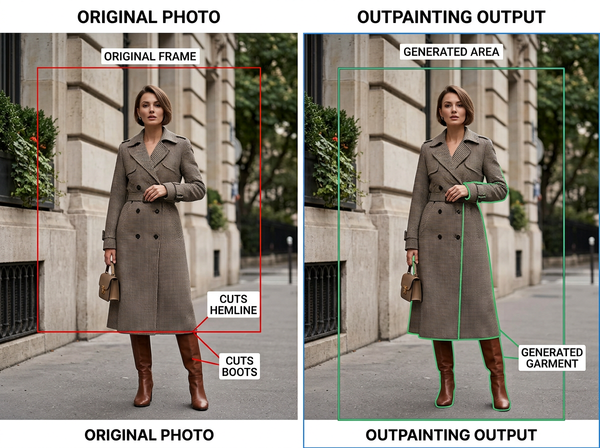
Ask one question before anything else: does the edge of the frame cut through the garment?
If the crop line runs across empty backdrop, extending gives you more backdrop. If it runs across the hem, the sleeve, the trailing end of a coat or the model’s legs where the trousers continue, then extending means generating garment. Not fabric texture in the abstract — this garment, its length, its sweep, the way it ends. Those are properties a buyer is trying to determine from the picture, and the extended version invents them in the direction generation always errs in: cleaner, more regular, better behaved.
This is the same problem as filling a region inside the frame, with one difference that makes it worse. A fill has surroundings on every side and can interpolate between them. An extension has evidence on one side only, and everything beyond that is extrapolation with nothing to check it against.
The failure hides at small sizes. A square tile in a grid gives no one the chance to notice that the coat now ends slightly lower than the coat in the warehouse, and the tile is exactly where a shopper forms their first impression of the shape.
Direction is not neutral
Direction | What has to be produced | Risk |
Upward, above the head | Headroom, backdrop, the top of a wall or ceiling falloff | Low, provided the light does not change character |
Sideways, into open space | More backdrop, sometimes an arm or a prop that was clipped | Moderate; watch for background elements being duplicated |
Downward, below the frame | Floor, the contact between model and ground, shadows, feet, footwear, the bottom of the garment | High, and the most common source of unusable output |
All four sides at once | Every category above, plus a perspective the camera never established | High; the geometry has no anchor |
Downward is where most extended images go wrong, and it goes wrong in a specific way that reviewers should know by name. A standing figure cropped at the calf will be given feet. Those feet will be plausible, they will be wearing something, and that something is not a product you sell. If the shoe is part of the look or part of the listing, an extended image has quietly put an invented product into your catalog.
Duplication is the other characteristic failure. Extending sideways past a light, a plant, a doorway or a floor mark often produces a second one, because the pattern that continues most confidently is the one already in the frame. Location backgrounds are more prone to this than studio ones, and it reads as an obvious error once you know to look for it.
Light is the quieter one. An extension continues the falloff it can see, so a backdrop that was already darkening toward the edge will keep darkening, and a wide extension can end in a corner deeper than anything on the actual set. The reverse case is harder to spot: a lamp or a window just outside the original frame left no trace the tool can use, so the new area arrives evenly lit where the real room had a bright edge. Neither error looks like an error until the extended file sits next to another image from the same session, which is when the set stops matching itself.
When you do not need generation at all
A large share of aspect-ratio work is not an extension problem. If the background is a plain sweep or a solid color, the correct operation is adding canvas of that color and repositioning the subject on it. Nothing is invented, the file stays checkable, and the result is often better than a generated version because it has no risk of drifting in tone across the join.
The outpainting tool in Style3D AI takes an image and a target shape and produces the surrounding area from what the image contains, which is the right operation for a location shot or a textured backdrop and a heavier one than a plain background needs. Reach for generation where the scene is complex enough that continuing it by hand would itself be invention.
The other case with no generation in it is the one nobody wants to hear: shooting for the widest format you publish and cropping down from there. Formats change, platforms add new ones, and a library shot loose enough to be cropped in several directions absorbs those changes without a single new pixel being made up.
What extending cannot do
• It cannot recover anything outside the frame, since nothing outside the frame was ever recorded.
• It cannot lengthen a garment without inventing the garment, which makes any extension across a hem a statement about the product rather than about the scene.
• It cannot guarantee that the perspective it produces agrees with the lens that took the picture, because the geometry beyond the edge has no anchor in the file.
• It cannot turn a badly framed photograph into a well composed one, as composition is a set of relationships decided at the moment of exposure.
There is a compounding case worth flagging as well. An extended image used as an input to another operation carries its invented region forward as though it were photographed, and the further down the chain it travels, the fewer people remember which part of the picture came from a camera.
Reviewing an extended image
Look at the extension by itself. Mask the original frame, or lay the original on top at reduced size, so the only thing in front of you is the part that was produced. This takes seconds and is the single most effective habit here, because in the assembled image the eye reads the whole thing as one photograph, which is precisely what it was designed to do.
Then run three checks. Confirm whether the original crop line crossed the garment anywhere. Follow the floor, the horizon and any straight line in the background across the join. Count anything that appears twice.
Verify the garment against the garment. Where an extension has produced a hem, a sleeve end or footwear, the physical sample settles it and the source image cannot, since the source image is precisely what does not contain that region.
Common questions
A marketplace requires a square image and ours is tall. What is the right move?
Try repositioning inside a wider crop first, then adding plain canvas if the background allows it, and only then generating an extension. Each step in that order invents less than the one after it. Where the tall image crops through the garment at the sides, the square version is a reshoot rather than an edit.
Which direction is safest to extend?
Upward into empty space above the subject, since headroom is the region least likely to contain anything a buyer is judging. Sideways is usually workable in a studio and risky on location because of duplication. Downward should be treated as a reshoot flag rather than a setting.
Our model is cropped at the ankles. Can we extend to show full length?
The tool will produce feet and shoes, and neither is evidence about anything you sell. If footwear appears in the listing or in the styling credits, an invented pair is a claim you cannot support. Extend downward only into floor, and only when no part of the figure is near the edge.
Can we use an extended image as the source for a try-on or a recolor?
Keep extended files out of the input library, for the same reason generated flat lays belong out of it: the next operation cannot distinguish invented regions from photographed ones. Use the original frame as the input and extend the output afterward, so the invented area is added last and never inherited.
The extension looks perfect. Does the rule still apply?
Convincing and correct are different properties, and a well-made extension is convincing by construction. The test is not appearance but whether the region was recoverable from what the camera saw. Where it was not, the quality of the result is a measure of the tool rather than a measure of the truth.
How do we stop this coming up every season?
Give the studio the list of formats you publish and shoot the widest one with room on the sides and below, then crop down for the rest. This costs framing discipline at the shoot and removes an entire category of editing decisions afterward. It also survives the next platform requirement, which is the part that pays for itself.
What the edge of the frame means
A photograph’s edge is not an arbitrary boundary. It is the line where the evidence stops, and everything on the far side of it is produced by inference no matter how carefully. Extending into empty scene keeps that inference within reach of what was recorded, which is why it usually works and usually goes unremarked. Extending into the product moves the inference onto the thing the picture exists to describe. The two operations share a button, a name and a review queue, and only one of them is safe to run without asking what was on the other side.
Find the ones that cross the garment
Pull the images your team extended for a format change this season and check each one for a single thing: whether the original crop line ran across the product. Those are the files to re-do from the source frame. While you are in there, look at every extension that went downward — if a pair of shoes appeared in one, that image is making a claim about a product you never photographed.
→ Outpainting: https://www.style3d.ai/image-editing-tools/ai-image-outpainting
Written by