
Generating Product Views: Which Angles Can Be Inferred
A generated back view is plausible and sometimes specifically wrong. Which angles follow from the front, which are invented, and which to shoot.
A listing needs a back view. You have a front shot. Generating the back takes seconds and produces something that looks like the back of your garment.
Whether it is the back of your garment is a different question, and it is not a question about image quality. Everything visible in that view was inferred, because the information was never in the file. The useful skill is knowing which angles can be inferred safely and which cannot.
What the photograph does and does not contain
A front-facing photograph records the front. It also carries indirect evidence about other surfaces — the silhouette at the edges hints at depth, a shoulder seam that wraps tells you something about the shoulder, a hem visible at an angle suggests how the garment ends.
That indirect evidence is real and limited. It constrains the possibilities without determining them, which is why a generated back view is usually plausible and sometimes specifically wrong.
The distinction that matters is between an angle that is mostly constrained by what was photographed and one that is mostly invented. A slight rotation of a front view stays close to recorded information. A full back view is a different surface entirely, and everything on it — a yoke, a vent, a back closure, a printed graphic — exists only if the model produced it.
What can be inferred and what cannot
Angle or feature | Inference reliability | Why |
Small rotation from the shot angle | High | Mostly recorded information, slightly re-rendered |
Back of a simple, symmetrical garment | Moderate | Construction typically mirrors the front |
Back with a yoke, vent or seam detail | Low | These are choices, not consequences of the front |
Back closure or zip | Low | Nothing in a front view indicates it exists |
Back graphic or print | Effectively zero | Content, not construction |
Hood shape and interior | Low | Volume and lining are not derivable from a flat front |
Side view | Low to moderate | Must agree with both front and back simultaneously |
Underside of a hem or cuff | Low | Rarely visible in the source at all |
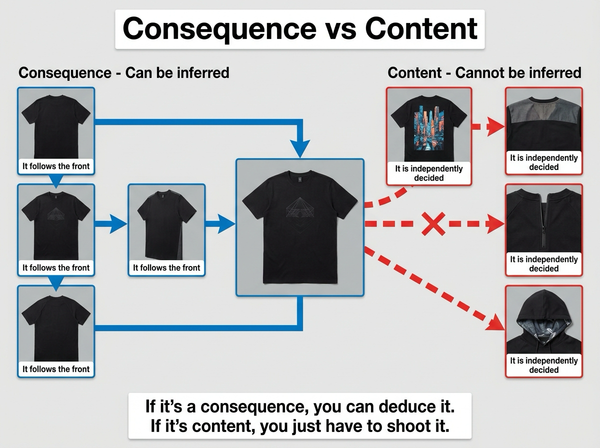
The pattern is that construction which follows from the front can be inferred, and construction which was decided independently cannot. Garments where the back is a plain panel behave well. Garments where the back carries its own design do not.
Why any of this happens the way it does, and which failures are recoverable, is covered in how an image-based garment change is actually computed.
Symmetry is the hidden assumption
Most generated views rest on an assumption nobody states: that the garment is symmetrical and conventional.
That assumption holds for a large share of product, which is why the approach works often enough to be trusted. It fails quietly on asymmetric hems, single-sided details, wrap fronts, unbalanced closures and anything where a designer deliberately broke symmetry — which is frequently the feature the garment is selling.
The failure is quiet because the output remains internally consistent. A generated side view of an asymmetric dress will be a coherent side view of a symmetrical dress, and a reviewer comparing it to the front will find nothing that contradicts what they can see.
The check is to list the garment’s asymmetries before generating and then look specifically at whether the output preserved them. Reviewing without that list means reviewing against the same assumption the generation made.
Fabric behavior is a second hidden assumption worth naming alongside it. A generated view has to decide how the garment hangs at that angle, and it decides using the drape that usually accompanies garments of that appearance. A stiff cotton and a fluid viscose can look similar from the front and behave nothing alike from the side, so a generated side view of a drapey garment often comes back looking more structured than the piece actually is — flattering, and wrong in the direction a customer notices on arrival.
The side view is harder than the back
This surprises people, and the reason is structural rather than technical.
A back view has to be plausible on its own. A side view has to agree with the front and the back at the same time — the side seam is where both panels meet, so the silhouette, the armhole, the hem level and any wrapping detail all have to reconcile across two surfaces.
Where the back was itself generated, the side view is being reconciled against an invention, so any error in the back propagates into the side and the two now agree with each other and not with the garment.
Practically, this means the order matters. If a back view is being generated, it is worth verifying before a side view is derived, and the sequence of generation should be recorded so that a later correction to one view flags the others as needing regeneration.
Where this stops being a quality question
Marketplaces generally require that product images represent the actual product. A generated view that differs from the physical garment is not a rendering flaw in that context; it is an inaccurate representation, and the obligation sits with the seller rather than with any tool.
This matters more for some views than others. A slightly wrong drape on a lifestyle angle is unlikely to trouble anyone. A back view showing a plain panel where the garment has a contrast yoke is a description of a product you do not sell, and it will be discovered by the customer at the point of delivery.
Confirm the current image policy for each marketplace you list on before publishing generated views, since these requirements are revised and differ by platform. Where a view will be a customer’s main evidence about a feature — a back graphic, a closure, a hood — treat it as requiring a photograph rather than an inference.
When to shoot the extra angle
The decision is not “generate or shoot” in general. It is which specific angles, on which garments, need to be photographed.
Photograph the back where it carries any design content — a graphic, a distinctive yoke, a vent, a contrast panel, a back closure. These are the features a generated view is least able to produce and most likely to be judged on.
Photograph the side where the silhouette is the point, since that is the view that communicates volume and how a garment stands away from the body.
Photograph the back of anything returned frequently. Where a category already has a return problem, adding an inferred view to the evidence a customer is deciding on is the wrong place to save a shoot, regardless of how well the generation usually performs.
Photograph any angle showing a feature the copy mentions. If the description says something about the back, a customer will look at the back, and an inferred view is a poor place for that scrutiny to land.
Generated views earn their place on the ordinary angles of ordinary garments: the additional three-quarter view, the slight rotation, the back of a plain tee. Which garments fall into that category is a question about construction rather than about the tool, and it follows the same logic as deciding which garment types survive image-based generation.
Where the range and the angles have been sorted that way, generating the additional views covers the volume while photography covers the exceptions, which is a more defensible split than applying either approach uniformly.
What generated views cannot do
They cannot show a feature that was never photographed. This is the whole limitation restated, and it applies absolutely rather than approximately — a back graphic cannot be recovered, only invented.
They cannot be verified against the source image. Checking a generated back against the front confirms only that the two are consistent, which they will be. Verification requires the physical garment.
They cannot maintain agreement across a set without being managed. Multiple views generated independently agree with the source and not necessarily with each other, and a listing gallery where the views disagree is more visible than any single view being slightly wrong.
They cannot substitute for photography where a customer’s decision rests on the view. That is a judgment about which features drive purchase for your product, and no property of the output changes it.
Frequently Asked Questions
Can I generate a back view from a front photo?
For a plain, symmetrical garment, usually well enough to be useful. Where the back carries a graphic, a yoke, a vent or a closure, no — none of those are derivable from the front, so what you get is a plausible garment that is not yours.
Why is the side view often worse than the back?
Because it has to agree with two surfaces at once. The side seam is where front and back meet, so the silhouette, armhole and hem all have to reconcile. Where the back was itself generated, the side is reconciling against an invention.
How do I check a generated view?
Against the physical garment, not against the source photograph. Comparing generated to source only confirms internal consistency, which is guaranteed and tells you nothing about accuracy.
Is it acceptable to use generated views on a marketplace listing?
Platform rules require the images to represent the actual product, so accuracy is the standard rather than method. Check each platform’s current policy, and treat any view showing a feature the customer will be judging as needing a photograph.
What about asymmetric garments?
Treat them as needing photography for any angle where the asymmetry is visible. Generation assumes symmetry unless the evidence in the source overrides it, and the asymmetry is often the design point.
Do the generated views agree with each other?
Not automatically. Each is generated against the source, so a set can be individually plausible and collectively inconsistent. Generate views in a defined order, verify each before deriving the next, and review the set together.
Which angles are safest to generate? Small rotations from the shot angle, and the back of garments whose back is a plain panel. Those stay close to recorded information. Everything else is a judgment about how much of that view is content rather than consequence.
Consequence or content
The useful test before generating any view is to ask whether what will appear in it follows from what was photographed or exists independently of it. A plain back panel follows; a printed back does not. A slight rotation follows; a hood interior does not. Where the answer is that the view is mostly consequence, generation is doing interpolation and the result can be trusted with normal review. Where the view is mostly content, generation is doing invention, and the only honest options are to photograph it or to leave the customer without that angle.
Sort your angles before you generate any
Go through the range and mark which garments carry design content on the back — a graphic, a yoke, a vent, a contrast panel, a back closure — and which have a plain back panel. The first group needs photography for that angle; the second is safe to generate. Do the same for side views wherever the silhouette is the selling point. Then check any generated view against the physical garment rather than against the source photograph, since generated and source will always agree with each other.
→ Generate Views — Style3D AI
Written by