
Design Variations Are Not a Range
Twenty versions of a jacket is not a range. Roles, slots, and why two similar-looking variations can differ by a full round of fit work.
Generate twenty versions of a jacket and you have twenty jackets. You do not have a range, and the difference is not a matter of quantity.
A range is a structure. It answers questions about price, volume, who buys what and why one style exists alongside another. Variations answer none of those. They multiply appearance, which is the cheapest thing to multiply and the least likely to be what a season is short of.
What a range is actually made of
Most ranges resolve into a small number of roles, whatever a company calls them internally.
Core styles carry volume and repeat across seasons. They change slowly, and their job is reliability rather than interest.
Franchise styles are recognizable pieces a brand returns to, updated rather than replaced. They carry identity.
Seasonal styles express the delivery’s point of view and have a short life by design.
Statement pieces exist to communicate, sell in small numbers, and make the rest of the range legible.
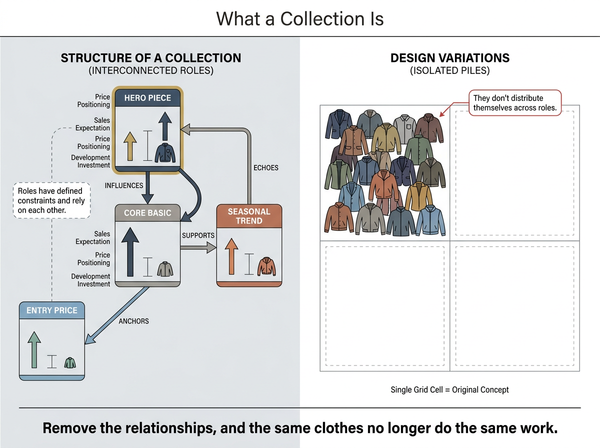
Each role has different volume expectations, different price positions and different development effort. A set of variations has none of this structure attached, so twenty jackets do not distribute themselves across the roles — they all sit in whichever slot the original occupied.
The roles also constrain each other, which is the part that makes a range a structure rather than a list. A statement piece works because the core styles around it are quiet; a franchise style earns its update because it has a history to update. Remove the relationships and the same garments stop doing the same job, which is why a strong style lifted out of one range often underperforms in another.
Variation changes appearance; development answers questions
The distinction worth holding is that a variation is a different look and a development is a different answer.
Development asks what price this style has to hit, which fit block it sits on, what fabric platform it shares with the rest of the range, which size range it runs in, and how it is meant to be worn alongside the styles beside it. Those questions have answers that are not visible in an image, and generating another image does not move any of them forward.
This is why a season can feel busy and stall. Producing options is fast and feels productive; the decisions that actually release a style into development are slow, involve other departments, and are not helped by having more options waiting.
The useful discipline is to notice which activity is happening. Exploring within a slot that has already been defined is productive. Generating across an undefined range is deferral wearing the costume of work.
Which variations are cheap and which are not
This is the part that is invisible in the output and decides most of the cost.
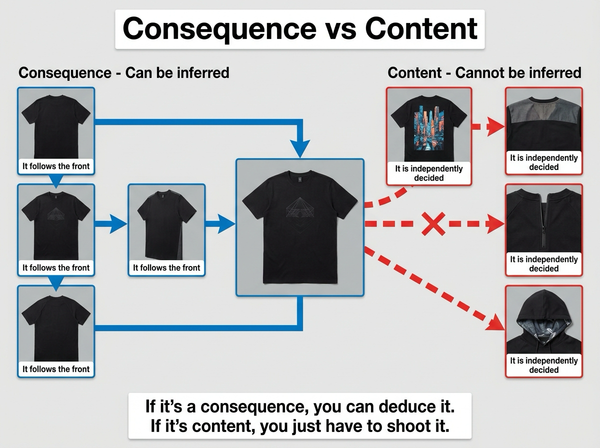
Two variations that look equally different can have completely different consequences. One that changes a color, a print or a trim while sitting on the same pattern block and the same fabric is nearly free — it shares development, shares minimums, and shares fit approval. One that changes the silhouette or the length is a new style wearing a family resemblance: new pattern work, new fit sessions, its own sample rounds.
An image does not show which of these you are looking at. A generated set will happily mix both, and a range assembled from it can commit to far more development than anyone intended while appearing coherent.
The practical habit is to sort a generated set by what it shares rather than by how it looks. Where a style shares a block, it belongs in one bucket; where it does not, it goes in another and gets counted against the development budget rather than against the option count.
Where a variation set is being generated from an existing style, exploring variations from a piece you already have starts from something whose block, fit and costing are known, which makes the cheap and expensive directions easier to separate than starting from an image with no history.
The order in which variations arrive matters
A generated set arrives all at once, which is not how a range is normally built, and the difference changes the decision.
Developed sequentially, each style is judged against what has already been committed — this one exists because the range lacks a mid-price outer layer, that one because the first sold through. Judgment accumulates, and each decision inherits a reason.
Arriving together, every option is judged against the others rather than against the range. The set becomes its own frame of reference, and the question quietly changes from “should this style exist” to “which of these is best”. Those are different questions, and only the first one has a wrong answer that matters.
The correction is to bring the range into the review rather than reviewing the set alone. Placing generated options next to the styles already committed restores the comparison that decides whether any of them is needed, and it is a two-minute step that most teams skip because the generated set looks self-contained.
The volume trap
More options do not produce a better range, and past a point they produce a worse decision.
Twenty variations of one style deepen a single slot rather than filling a range. The team then spends its judgment choosing between near-neighbors, which is a low-value decision, while the gaps in the range go unexamined because nothing generated drew attention to them.
There is a comparison effect as well. A set of twenty options makes people choose the best of that set, and the best of a mediocre set is still mediocre — but it feels chosen rather than settled for, because the process felt rigorous.
There is a related effect on effort. Options are cheap to produce and expensive to evaluate, so a large set moves cost from creation to review without reducing the total — and review capacity is usually the scarcer of the two. Teams that measure their output in options generated are measuring the half that got cheaper.
The corrective is to define the slot before generating for it. What role does this style play, at what price, against which other styles. With that decided, variations become a way to explore one question well. Without it, they are a way to avoid asking.
Building a family rather than a pile
Where variations genuinely help is in building a family — a group of styles clearly related, deliberately differentiated, and sharing what should be shared.
That works when the shared elements are chosen rather than incidental. A family that shares a fabric platform across four styles has a real commercial logic: better minimums, one approval, coherent presentation. A family that merely looks similar has the appearance of that logic and none of its benefits.
Deciding what to hold constant is therefore the design decision, and it is worth making explicitly. Hold the fabric and vary the silhouette, hold the silhouette and vary the fabric, hold both and vary the detail — three different families from the same starting point, with three different cost profiles and three different stories on a rail.
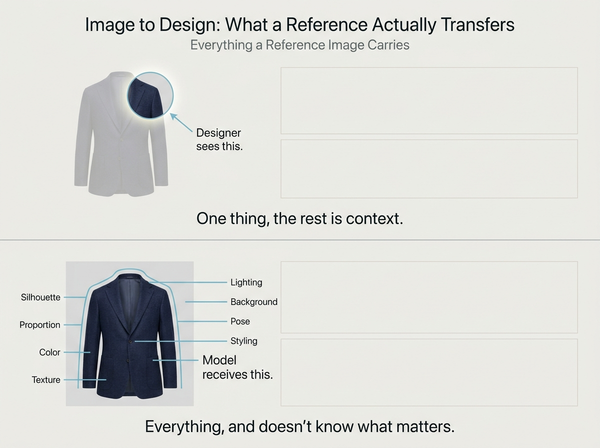
This is also where a reference-led approach and a description-led approach pull in different directions. Working from an existing style tends to hold construction constant, as covered in what a reference actually transfers, while working from descriptions tends to vary everything at once, which is discussed in what a prompt can specify. Neither is better; they suit different points in the process.
What variation generation cannot do
It cannot identify a gap. A range’s weakness is usually something absent — a price point, a length, a category — and nothing about generating variations on what exists points at what does not.
It cannot assign roles. Which style is core and which is a statement piece is a merchandising decision made against volume plans and margin, none of which is in an image.
It cannot tell you the development cost. Two visually similar options can differ by an entire round of pattern and fit work, and that difference does not appear until someone with development knowledge looks at them.
It cannot judge against a plan it cannot see. Volume targets, category budgets and last season’s sell-through are the context that makes one option obviously right, and none of it is available to the generation step.
It cannot substitute for editing. A range gets its shape from what is removed, and generation makes adding easy while doing nothing for the harder discipline of taking away.
Frequently Asked Questions
How many variations should I generate? Enough to explore one defined question, which is usually a handful rather than dozens. If the slot has not been defined — role, price, what it sits beside — more variations postpone that decision rather than informing it.
Why does my range feel repetitive even though every style is different? Because differentiation by appearance is not differentiation by role. Styles that look distinct but occupy the same price, the same use and the same customer moment read as repetitive regardless of how varied they look on a screen.
How do I know if a variation is expensive? Ask what it shares. A change of color, print or trim on the same block and fabric is close to free; a change of silhouette or length is a new style with its own pattern and fit work. The image will not tell you which one you are looking at.
Can variation generation help with line planning? Indirectly at best. Planning decides how many styles at what price in which categories, and those numbers come from commercial data. Variations help once a slot in that plan is defined, not before.
What should I do with a large generated set? Sort it by what each option shares with the original rather than by preference, then discard everything that does not fit a defined slot. Sorting by preference first tends to select for novelty, which is the property least connected to whether a style should exist.
Is it useful for updating a carryover style? This is one of its better uses, since the slot is already defined and the block is known. The question is narrow — how should this style evolve — which is exactly the kind of question a set of variations answers well.
Does generating variations make a range less coherent? It can, when the shared elements are incidental rather than chosen. Coherence comes from deciding what to hold constant across a family; a set that varies everything slightly produces styles that resemble each other without sharing anything useful.
Define the slot, then vary within it
The failure is not that variations are unhelpful. It is that they answer a question about appearance while a range is assembled from answers about role, price, volume and what a style shares with its neighbors. Generating first and structuring afterwards produces a set of options nobody can choose between on any principled basis, because the principle was never established. Decide what a style is for, what it sits beside and what it holds constant — then variations become a way of exploring that decision rather than a substitute for making it.
Sort by what it shares, not by how it looks
Before generating, define the slot: what role the style plays, at what price, and beside which other styles. After generating, sort the set by what each option shares with the original — same block and fabric with a changed color or trim in one bucket, changed silhouette or length in another — and count the second bucket against your development budget rather than your option count. Then decide what the family holds constant, since that choice is what turns a group of similar styles into a coherent one.
→ Design Variations — Style3D AI
Written by