Image to Design: What a Reference Actually Transfers
A reference image carries everything, including what you didn’t mean. What transfers, where reference becomes copy, and why your archive wins.
You upload a coat you like and ask for something in that direction. What comes back has the same collar and a completely different proportion, or the right proportion and none of what you liked about it.
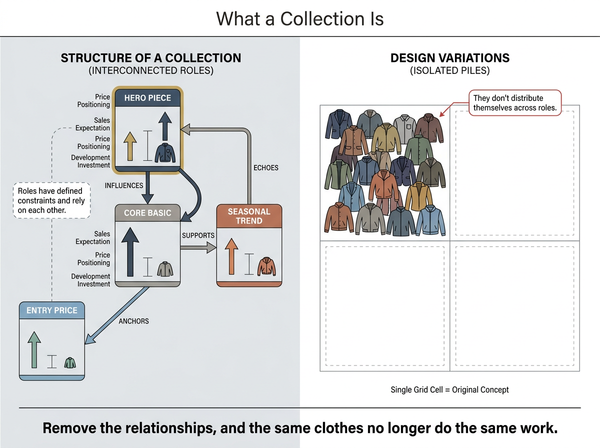
Nothing malfunctioned. You knew which part of that image mattered; the model had no way to know. A reference image is not an instruction — it is a large amount of visual information with no indication of which parts are the point.
A reference carries everything, including what you did not mean
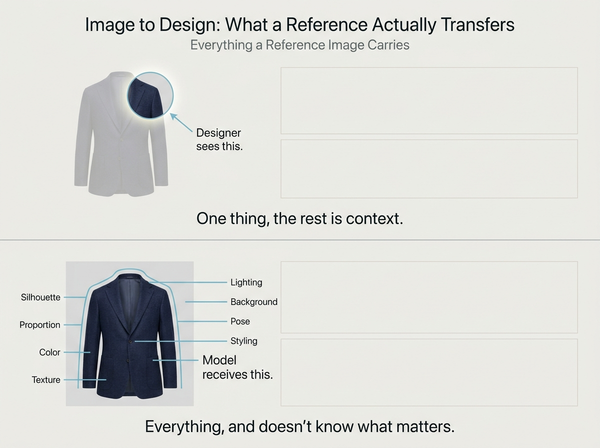
When a person looks at a reference, they see it through an intention. A designer holding up a jacket means the shoulder line, or the way the pocket sits, or the weight of the fabric — one thing, usually, with the rest of the image as context.
A model receives all of it at once: silhouette, proportion, color, texture, styling, pose, background, lighting. Some of that gets carried into the output, and which parts get carried is not something the image itself communicates.
That explains the two common disappointments. Output that copies the obvious feature while missing the subtle one you cared about, and output that reproduces something you were not even looking at — a color relationship, a styling detail, the general mood of the photograph rather than the garment in it.
The practical response is to state the intention separately rather than expecting the image to carry it. Naming what the reference is for — the shoulder, the length relationship, the closure treatment — turns a vague visual instruction into something closer to a brief, and it also forces the designer to decide what they actually mean.
What transfers reliably and what does not
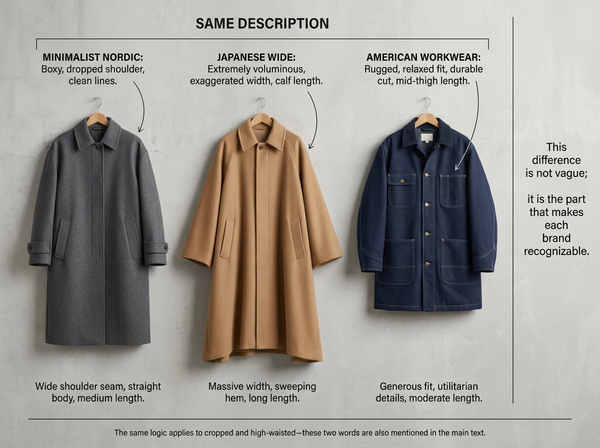
Silhouette and overall proportion transfer well, since they are the strongest signal in the image and survive most of the interpretation.
Distinctive construction details transfer moderately. A specific collar, an unusual closure, a defined pocket shape will usually appear in some form, though often as an approximation rather than the specific version in the reference.
Fabric behavior transfers poorly. How something falls, its weight and its hand are properties the photograph shows indirectly through drape, and the output tends toward the generic version of that material category.
Fit intention barely transfers at all. Whether a garment is meant to sit close, skim or hang away is a fit decision expressed in patterns, and a reference photograph shows one instance of it on one body in one pose.
Scale relationships between elements are the quiet exception in this list: they transfer inconsistently and matter more than people expect. A pocket sized correctly against a body reads as considered, and the same pocket carried over at a slightly different relative size reads as off without anybody being able to name why.
Understanding this ordering makes references more useful, because it tells you what to supply another way. If the fabric behavior is the point, the reference needs support from a description or a physical sample; if the fit is the point, a reference image is close to the wrong tool.
Where a reference becomes a copy
This is the section that matters commercially, and it needs to be read as risk description rather than as legal advice.
The general position in most markets is that a garment’s silhouette and basic construction are not protected the way a graphic is. Two brands can make a similar trench coat, and the industry has always worked that way.
What does carry risk is specific and identifiable: a print or graphic, a logo or mark, a distinctive pattern, a design element a house has established as its signature, and in some jurisdictions the overall look a brand has made recognizably its own. Feeding an image containing any of these into a generation step and publishing what comes out is a different act from being influenced by a competitor’s proportions.
The practical line most teams can work with is whether the resemblance is the selling point. A garment that borrows a proportion is normal practice. A garment whose appeal depends on a customer recognizing what it resembles is the version that generates complaints, takedowns and occasionally worse — and the generation step does not change that calculus in either direction.
Where a reference contains a mark, a licensed graphic or a signature element, the decision belongs with someone qualified to make it before the style enters development, not after it is costed.
Your own archive is the underused reference
The most valuable reference library for a brand is usually its own past product, and it is the one teams reach for least.
Using previous seasons as references does something a competitor image cannot: it carries the house’s proportions, its detail language and its fit intentions, which are precisely the properties that make a brand recognizable and are almost impossible to describe in words. A model working from your own archive produces variations that already look like you.
It also removes the rights question entirely, which makes it the obvious place to start rather than a fallback.
The workflow this supports is continuous rather than seasonal: an archive style as the reference, generating variations from it to explore where it could go next, and the strongest directions taken forward. Brands with a recognizable handwriting tend to have been doing a manual version of this for years.
Record which reference produced which design
Six months after a season is designed, nobody remembers which image a style came from. That gap matters more than it sounds.
If a question is ever raised about resemblance, the useful answer is a record: this style came from our own archive piece from two seasons ago, or this came from a mood image with no garment in it. An organization that can show what it worked from is in a different position from one that cannot reconstruct it. The record is cheap to keep at the moment of generation and effectively impossible to rebuild later.
It also has an ordinary working benefit. When a style performs well, knowing what it came from tells you where to look for the next one, and when a design direction repeatedly fails, the reference set is often the thing that needs changing rather than the execution.
The habit is small: store the reference alongside the output, note in a line what the reference was for, and keep both with the style. Teams that adopt it usually do so after an uncomfortable conversation, and the ones that adopt it beforehand spend a few minutes per style instead.
When an image is the wrong input
References are not always the right instruction, and reaching for one reflexively costs time.
Where the intention is a proportion relationship rather than a look, a description or a sketch communicates it more directly, and the differences between describing and referencing are covered in what a text prompt can and cannot specify.
Where the intention is fabric behavior, a physical sample communicates in a second what no image communicates at all.
Where the intention is a fit standard, neither an image nor a description reaches it, since fit lives in patterns and measurements rather than in appearance.
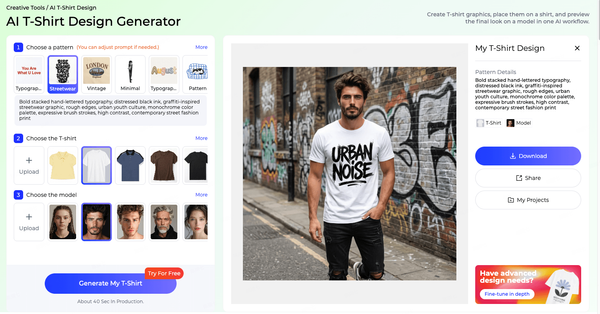
And where the reference is a photograph of a garment on a body, remember that a substantial part of what you are responding to may be the model, the styling or the photograph rather than the garment. Testing that by looking at the same garment flat is a quick way to find out whether the thing you liked is available to be designed toward.
What image-to-design cannot do
It cannot tell which part of the reference you meant. This is the central limitation and the source of most disappointing output, and the remedy is to state the intention rather than to find a better image.
It cannot make a garment reproducible. Output is an image, and the construction visible in it was generated rather than decided, so the same verification a generated design always needs applies here — where starting from a reference leads into development, someone who knows construction still has to review what the image proposed.
It cannot resolve rights. Nothing in the process assesses whether the reference contains protected material or whether the output resembles it too closely, and neither the input nor the output is screened.
It cannot transfer fit or hand. The two properties customers most reliably notice in a finished garment are the two a reference photograph carries least, which is worth remembering when an output looks right and the first sample does not feel right.
Frequently Asked Questions
Why does the output miss the part of the reference I liked?
Because the image does not indicate which part that was. Everything in it is available to be carried, and what actually carries is weighted toward the most prominent features. State the intention in words alongside the reference rather than searching for a clearer image.
Can I use a competitor’s product photo as a reference?
Being influenced by silhouette and proportion is normal industry practice; reproducing a print, a mark or a signature element is not, and the generation step does not change that distinction. Where a reference contains anything identifiable, get the decision made by someone qualified before the style enters development.
What kind of reference works best?
A flat or form shot of the garment rather than a styled photograph, since it removes the model, the styling and the background from what can be carried. Multiple references showing the same intention from different garments also help, because the common element is what the intention actually is.
Should I use my own past styles as references?
Yes, and more teams should. Archive references carry your proportions and detail language, which no description reaches, and they remove the rights question. It is the natural starting point rather than a conservative option.
Why does the output look right but the sample feel wrong?
Because fabric behavior and fit are the two things a reference photograph carries least. An image can be accurate about appearance and silent about hand, weight and how a garment sits, which is what a first sample then reveals.
How many references should I use?
Enough to isolate the intention, which is usually more than one. A single image conflates everything about that garment; two or three sharing only the feature you care about make the common element clearer than any single reference does.
Does using a reference make the output less original?
It makes it more anchored, which is different. Whether that is a problem depends on the reference: anchored to your own archive it produces continuity, anchored to a competitor it produces resemblance, and the choice of reference is doing most of the work either way.
Say what the reference is for
An image on its own is an ambiguous instruction, and the ambiguity is where the time goes. Naming the one thing the reference is supposed to communicate — the shoulder, the length relationship, the way the closure sits — converts it from a mood into a brief, and has the side effect of forcing the intention to be decided rather than assumed. Choose the reference deliberately too, since it carries far more than the feature you were looking at, including a rights position and a resemblance nobody chose.
Name the one thing the reference is for
Before uploading, write down the single property you want carried — the shoulder line, the length relationship, the closure treatment — and supply it alongside the image rather than expecting the picture to communicate it. Prefer flat or form shots over styled photography, since those remove the model, styling and background from what can transfer. Where the reference is not your own archive, check whether it contains a print, a mark or a signature element before the style goes into development rather than after it is costed.
→ Image to Design — Style3D AI
Written by