Text to Design: What a Prompt Can Actually Specify
Garment words are relational, not absolute. What a text prompt can specify, where it earns its place, and when to switch methods.
Type “oversized wool coat, dropped shoulder, belted” and you get a coat. It will be oversized, the shoulder will be dropped, there will be a belt. The description was followed.
Whether it is the coat you meant is a separate question, and the gap between those two things is not a prompting skill problem. It is that garment language describes appearance, and a garment is a construction. The words carry less than they feel like they carry.
Garment words are relational, not absolute
Almost every useful word in fashion vocabulary is a comparison to an unstated norm.
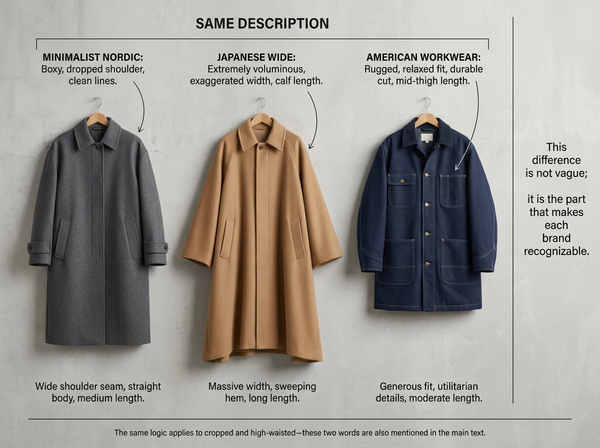
“Oversized” means larger than the expected fit for that garment type, on that body, in that market, this season. None of those are in the prompt. “Cropped” means shorter than standard, and standard has moved several times in the last decade. “High-waisted” is relative to a natural waist that varies by body and by how the garment is intended to sit.
A model resolves these against whatever it has seen most, which is a reasonable default and is not your house’s default. Two brands using identical language mean measurably different garments, and the difference is exactly the part that makes each brand recognizable.
This is why prompt refinement hits a ceiling. Adding adjectives narrows the range but cannot pin a proportion, because the vocabulary itself has no numbers in it.
The same problem appears inside a team, which is a useful thing to notice. Two designers in the same room reading the same brief produce different garments for exactly this reason, and the usual remedy is a reference image or a physical sample rather than more words. A prompt has no access to either remedy, so it lands wherever the general usage of those words points.
What comes back is an appearance
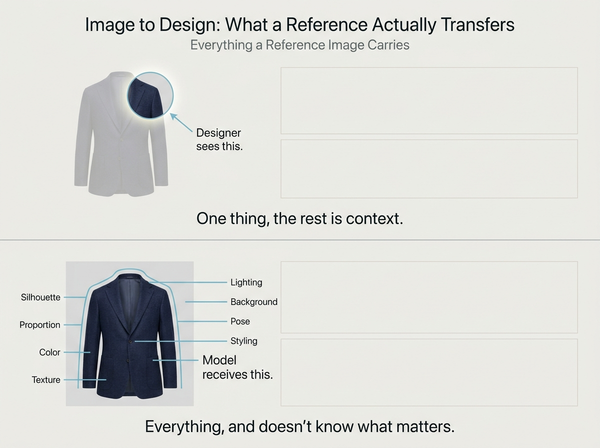
The output is an image of a garment. Everything visible in it — seams, closures, the way a panel meets another panel — was generated because it typically accompanies garments of that description, not because anyone decided it.
That distinction matters more than it first appears. A generated coat will have a shoulder seam somewhere, a facing implied at the front edge, a hem finished some way. None of those were chosen. They are what usually appears, and the difference between what usually appears and what your garment should have is where development time gets spent.
The consequence for process is worth stating plainly: an output from a text prompt is a proposal, not a specification. That distinction and what it does to downstream work is covered in the difference between a drawing that records and one that proposes, and it applies from the first image onward.
Where it earns its place
Divergence, and it is genuinely valuable there.
The expensive part of early design is not drawing; it is the number of directions a person can hold in mind and evaluate before committing. Generating twenty coats in an afternoon and rejecting nineteen is a different activity from sketching three and choosing one, and it changes what the team is choosing between.
It is also useful for making a vague brief concrete enough to argue about. A merchandiser saying “something softer for spring” and a designer hearing something specific is a familiar misunderstanding, and putting six images on a screen resolves it in minutes rather than at first sample.
And it is useful for the direction nobody would have drawn. A prompt returns interpretations a designer would not have reached for, some of which are wrong in interesting ways, and interesting wrongness is a legitimate input to a design process.
Volume changes the review as well as the output. When looking at twenty options rather than three, people judge differently — comparatively rather than absolutely — and comparative judgment surfaces preferences that a team could not articulate beforehand. That is a real benefit, and it is also worth guarding against, since a set of twenty mediocre options can produce a confident choice that would have lost to any of the three sketches nobody made.
Prompts return what already exists
A model’s sense of what is current comes from what it was trained on, which is necessarily the past. Ask for something contemporary and you get a competent version of what was contemporary in the material it learned from.
For a business selling continuity — basics, uniforms, core styles — that is fine and arguably useful, since the target is what already reads as normal. For a trend-led business it is a structural limitation rather than a quality issue. The output will be plausible, well-resolved and slightly behind, and nothing in the prompt fixes it because the constraint sits in the training rather than in the instruction.
The practical response is to treat the output as a floor rather than a proposal. What comes back is roughly the consensus version of the description, which is useful as a reference point for pushing away from. Designers who use it that way — generate the obvious answer deliberately, then design against it — get value from exactly the property that frustrates people trying to generate novelty.
That reframing also settles a common argument. The complaint that outputs look generic is accurate and is not a flaw to be prompted around; it is what a statistical consensus of a description looks like. Where genuine novelty is the requirement, generating from a description is the wrong end of the process to expect it from.
Where it wastes time
Trying to specify. Once a direction is chosen, continuing to prompt toward an exact garment is slower than drawing it, and the result is less controlled.
This is the most common failure pattern, and it is easy to fall into because early prompts produce large improvements and late prompts produce small random ones. The moment a designer is regenerating to move a pocket, the tool has been carried past its usefulness.
The transition point is worth naming as a rule: prompt to find the direction, then switch to a method that lets you make decisions. Working from a sketch into a rendered garment is one such switch, since a sketch carries the proportion and the construction intent that a prompt cannot.
Writing prompts that produce useful divergence
Since the value is in the range rather than the precision, the useful prompt is one that produces genuinely different results rather than variations on the same result.
Describing a wearer, an occasion or a context tends to produce more variety than stacking garment adjectives, because it leaves the garment decisions open while constraining the intent. Describing a fabric behavior — how something falls, how heavy it sits — often produces more useful difference than naming the fabric, since the behavior is what the silhouette responds to.
Naming a reference style rather than a reference brand keeps the output usable, and there is a rights reason for that as well as a creative one: outputs that closely resemble an identifiable house’s signature carry exposure that a generic description does not.
Where a house has its own vocabulary — an internal name for a specific fit or length — that word means nothing to a model. Translating it into descriptive terms before prompting is a small step that removes a large source of confusion.
What a text prompt cannot do
It cannot specify proportion. Fashion vocabulary has no measurements in it, so anything that depends on precise relationships between lengths and widths has to be established another way.
It cannot make construction decisions. Seams, facings and finishes appear in the output because they typically appear, and someone who knows construction has to decide whether each one belongs.
It cannot encode a house’s fit. What makes a brand’s garments recognizable is a set of proportions and details that live in patterns and fit standards, none of which a description reaches. A prompt can produce something in the right mood and the wrong hand.
It cannot originate. Output is a recombination of what the description evokes, which makes it a good starting point and a poor source of the thing that makes a collection distinctive.
It cannot replace the reference of a physical garment. Where a fit or a feel is being targeted, a sample on a table communicates more in a second than any description does, which is why the next stage of the process usually involves one.
Frequently Asked Questions
Why do my prompts stop improving after a few attempts? Because the vocabulary runs out before the precision does. Adjectives narrow a range and cannot fix a proportion, so once the direction is right, further prompting produces random variation rather than progress. That is the point to switch methods.
How specific should a prompt be? Specific about intent, loose about the garment. Naming a wearer, an occasion or a fabric behavior produces more useful variety than stacking garment adjectives, which tends to produce near-identical results with small differences.
Does it understand our internal terminology? No. House names for fits, lengths and details mean nothing outside your organization, so translate them into descriptive language before prompting. This is also a useful exercise, since it forces the internal term to be defined.
Is it safe to reference a brand in a prompt? Reference a style rather than a house. Outputs closely resembling an identifiable brand’s signature create exposure, and a descriptive prompt reaches the same creative territory without attaching the risk to it.
What should happen to the output next? It goes to someone who knows construction, who decides which of the generated details the garment should actually have. Treating the image as a specification rather than a proposal is where development cycles get lost.
Why do the results look generic? Because a description resolves to the consensus version of that description, and consensus is what generic means. It is a property of the method rather than a prompting failure. Use it deliberately — generate the obvious answer, then design away from it.
Does this replace sketching? It replaces some of the early exploration, not the decision-making. Sketching carries proportion and construction intent that a description cannot, so most teams end up using both — prompts to open the field and drawing to close it. Once a direction is chosen, a method that lets you specify moves faster and gives a result you control.
Prompt to open, draw to close
The useful mental model is that a text prompt is a search across possibilities rather than an instruction to a maker. It is very good at showing you directions you had not considered and very poor at producing the garment you already have in mind, because the language it runs on describes how clothes look rather than how they are made. Teams that use it for the first job and switch methods for the second get the benefit without the frustration. Teams that keep prompting toward an exact garment are using a divergence tool to converge, which is slow in a way no amount of skill fixes.
Prompt to explore, then switch
Use text prompts while you are still choosing a direction — describe a wearer, an occasion or how a fabric should behave rather than stacking garment adjectives, since that produces genuine variety instead of near-identical results. The moment you find yourself regenerating to move a detail, stop and switch to a method that lets you specify. Then hand the chosen output to someone who knows construction and have them mark which generated details the garment should actually keep.
→ Text to Design — Style3D AI
Written by