
Designing a Print: The Decisions That Come Before Drawing
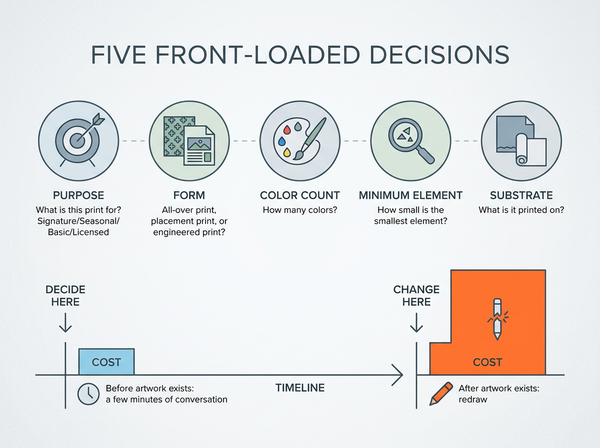
Purpose, form, color count, detail floor, substrate. Five decisions that cost minutes early and a redraw once artwork exists.
Most advice about print design starts once the artwork exists — check this, fix that, prepare the file. By then the expensive decisions have already been made, usually without anyone noticing they were decisions.
Five of them determine more about how a print performs than any amount of refinement afterwards: what the print is for, what form it takes, how many colors it has, how small its smallest element is, and what it will be printed on. Each is cheap to settle at the start and costly to change once artwork exists, because changing any of them means redrawing rather than adjusting.
What the print is for
A print carries a commercial job, and the job sets the constraints.
A brand signature print will be reused across seasons, recolored, rescaled and applied to garments that do not exist yet. It needs to be built for reuse: modular, tolerant of scale change, and not dependent on one particular color relationship.
A seasonal print exists to make a specific delivery feel current. It can be more specific, more fashion-led, and it does not need to survive being rescaled onto a jacket eighteen months later.
A basics print — the small repeat that makes a plain garment slightly less plain — succeeds by being unobtrusive at conversational distance, which is a different target from either of the above.
There is a fourth job worth naming because it behaves differently from all three: the licensed or collaboration print, where the artwork arrives from outside and the decisions below were made by someone else. The work there is to establish which constraints are negotiable and which are fixed by the licensor before production planning starts, since discovering that a mark cannot be resized or recolored after the range is costed is a familiar and avoidable expense.
These are genuinely different briefs. Designing a seasonal statement and then trying to make it a signature is what produces the print that gets rescaled badly for three seasons and quietly retired.
What form the print takes
This is the decision most often skipped, and it determines which set of problems you will spend the season solving.
An allover print covers the garment continuously, which means the design has to survive tiling and its scale relationship to the panel becomes the dominant variable. Those constraints are covered in how a repeat behaves at garment scale, and they apply from the first sketch rather than at file preparation.
A placed print sits in a defined position at a defined size, which means the design has to work as a self-contained composition and the specification questions in what a placement instruction has to state apply from the start.
An engineered print is positioned relative to the garment’s construction — a border at a hem, a design that runs across a panel and stops at a seam. It combines both sets of problems and adds cutting constraints, which is why it costs more and is used deliberately rather than by default.
Choosing late is the failure. A design drawn as a composition and then converted into a repeat rarely tiles well, and a repeat cropped into a placed graphic usually looks like a crop.
How many colors, decided before the first mark
Color count is a design decision that gets treated as a production discovery.
Designing in an unrestricted palette and reducing afterwards does not produce the same result as designing within a limit. Reduction merges colors that were carrying different jobs, and the design loses a layer of hierarchy that has to be rebuilt by hand. Designing to a limit from the start forces the hierarchy to be carried by fewer, stronger relationships, which usually produces a better print and always produces a cleaner file.
The number itself comes from the process and the budget rather than from the design, so it is worth asking before starting rather than after. What matters at the design stage is treating it as a constraint to work within, in the same way a composition works within a canvas.
Where a print will run in multiple colorways, the count becomes a system requirement rather than a per-design choice, since every version has to carry the same structure.
The smallest element you will allow
Every print has a detail floor: the size below which an element will not reproduce reliably. It is set by the process, the substrate and the print size, and it is knowable before drawing.
Deciding it first changes how a design gets built. A print with a stated minimum element size develops a legible hierarchy, because the designer is choosing what deserves to exist at that scale. A print drawn without one accumulates fine detail that looks excellent on screen, disappears in production, and leaves the design looking emptier than intended.
There is a related decision about where detail is allowed to concentrate. A design can carry fine detail in one area and remain coarse elsewhere, which reproduces more reliably than uniform fineness and usually reads as more considered. Deciding that the detail lives in the center of a motif rather than at its edges, for instance, protects it from the edge behavior described further down.
The trap is that fine detail is where a design often feels most refined during the drawing. Removing it late feels like losing quality; never adding it produces a design that was resolved at the right scale from the beginning.
This interacts with the size decisions above. A detail floor that works for a large front placement is too fine for the same artwork used small, which is another reason the form and scale decisions belong before the drawing rather than after.
What it will be printed on
Artwork is drawn on a screen and printed on cloth, and cloth participates.
A textured or heavily woven surface breaks up fine detail and softens edges, so a design intended for it should carry its structure at a coarser scale. A smooth surface holds detail and shows every flaw in the artwork. A pile or brushed fabric does both unpredictably.
Absorbency changes edge behavior, with ink spreading more on some fabrics than others, which affects how close two elements can sit before they visually merge. Stretch changes the print in wear, since a design printed flat on a jersey distorts where the garment stretches over the body — most visibly across the chest and shoulders.
None of this requires the fabric to be finalized before design starts. It requires knowing whether the print is being designed for a known fabric or designed to be fabric-agnostic, because the second demands a design that holds up with fewer assumptions built in.
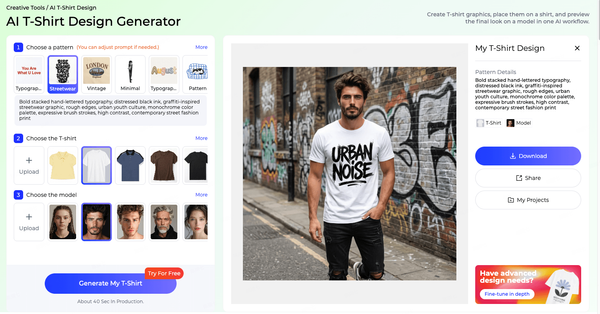
Where a design is being explored against a garment early, generating print artwork against a chosen application makes these constraints visible while they are still cheap to act on.
Designing for a second life
The last decision is whether the print has a future beyond this delivery.
A design built for reuse separates its elements rather than flattening them, keeps its color roles distinct so recoloring does not require rebuilding, and avoids depending on one specific scale. That discipline costs a little at creation and saves a great deal when the print is revived.
A design built for one delivery can be more specific and more committed. There is nothing wrong with that as long as it is the choice rather than the accident, and as long as nobody plans to reuse it.
The failure is the middle: a print made without either intention, which then gets asked to do the reuse job and requires a rebuild that costs more than the original.
What deciding early cannot do
It cannot substitute for a physical sample. Substrate behavior, ink spread and how a print reads in wear are all things that get confirmed on cloth, and early decisions reduce the number of sample rounds rather than removing them.
It cannot make a print commercially successful. These decisions make a design producible, consistent and reusable. Whether anybody wants it is a different question that no constraint answers.
It cannot lock the process. Suppliers change, methods change, and a design built rigidly around one process may need rework when production moves. Designing to the tighter of two plausible constraints is usually cheaper than designing to one exactly.
It cannot resolve the rights position. What the design contains — recognizable characters, marks, or a distinctive style — carries risk regardless of how well any of these decisions were made, and that assessment belongs with someone qualified rather than with the design process.
Frequently Asked Questions
Should I decide the garment before designing the print?
Ideally the garment type and the print’s form, even if the specific style is not settled. Allover, placed and engineered prints are different design problems, and choosing after drawing usually means redrawing rather than adapting.
How do I pick a color count before I know the design?
Ask the process and the budget rather than the design. The number is a constraint the design works within, like a canvas size, and a design built to four colors from the start is generally stronger than one reduced to four afterwards.
What if I do not know the fabric yet?
Then design fabric-agnostic deliberately: coarser structural detail, more tolerance in the spacing between elements, and no reliance on a smooth surface holding fine lines. Note the assumption so whoever selects fabric later knows what the design needs.
Is designing to a detail floor limiting?
It removes options and improves outcomes, in the way most constraints do. Fine detail that will not reproduce is not an option you actually had; deciding the floor first means the design’s hierarchy is built at a scale that survives.
How do I know if a print should be reusable?
Ask whether anyone will want it next season. If the answer is maybe, build it modular and keep the color roles separate — the cost at creation is small and the alternative is rebuilding it later under time pressure.
Can these decisions be made after a first draft?
Some can be adjusted; form and color count usually cannot. Converting a composition into a repeat, or reducing an unrestricted palette, tends to require redrawing rather than editing, which is why they belong at the start.
Who should make these decisions?
Design and product development together, with input from whoever will produce it. Left to design alone they get made implicitly; left to production alone they get made as restrictions rather than as creative constraints, and the result is usually worse than either.
Constraints first, then the drawing
The difference between prints that move smoothly through a season and prints that generate rework is rarely craft. It is whether the constraints were known before the artwork existed or discovered afterwards. Purpose, form, color count, detail floor and substrate are five short conversations, and each one held early replaces a redrawing held late. Nothing in that list restricts what a print can look like — it establishes what it has to survive, which is the information a designer needs before starting rather than after finishing.
Hold the five conversations before you draw
Settle what the print is for (signature, seasonal or basics), what form it takes (allover, placed or engineered), how many colors it has, the smallest element you will allow, and whether it is designed for a known fabric or to be fabric-agnostic. Each takes minutes to decide and hours to change once artwork exists. Write the answers where the designer can see them, since a constraint nobody recorded gets rediscovered as a rejection.
→ AI Print Generator — Style3D AI
Written by