
Seamless Pattern: Where a Repeat Gives Itself Away
A seamless pattern can tile perfectly and still look wrong worn. Gridding, accidental diagonals, and judging scale at garment size.
A repeat that tiles perfectly can still look wrong on a garment. The tile joins invisibly, the software reports no errors, and the printed fabric shows a grid across the chest that nobody saw in the design file.
Tiling and looking right are separate problems. The first is geometry and is largely solved. The second is about scale, density, direction and how the repeat meets a garment that gets cut into panels — and none of it is visible while you are looking at a single tile on screen.
What seamless actually requires
A repeat is a rectangular tile that joins to copies of itself on all four edges. Anything crossing the right edge must continue at the identical position on the left, and the same for top and bottom.
That is the whole technical requirement, and it is the easy part. Software handles it, and a tile that fails this test announces itself immediately as a visible break line.
What software does not check is whether the result reads as a continuous surface or as a grid of tiles. Those are different outcomes from the same technically correct file, and the difference is compositional rather than mathematical.
Repeat structures and what each costs
Structure | How it tiles | Tends to produce |
Straight (block) | Tiles align in rows and columns | Obvious grid unless the motif is dense or irregular |
Half-drop | Every other column shifts down by half the tile | Breaks vertical alignment; the standard fix for gridding |
Brick | Every other row shifts sideways by half | Same effect on the horizontal axis |
Mirrored | Alternate tiles flip | Hides edges well, creates visible symmetry axes |
Random-scatter within a tile | Motifs placed to avoid alignment | Most convincing, slowest to build, hardest to correct |
Choosing between them is easier to do than to reason about, since the same motif can grid badly in one structure and read as continuous in another. Testing a motif across structures while building the repeat settles in minutes what a description cannot settle at all.
Half-drop is the default for a reason. Straight repeats align motifs into rows and columns that the eye finds instantly, especially at a distance — which is exactly the viewing condition for a garment.
Mirrored repeats solve the edge problem and introduce a new one. The mirror creates a symmetry line that reads as a seam even where there is none, and on a body it tends to draw attention to the center front.
How a repeat gives itself away
Three tells, in order of how often they appear.
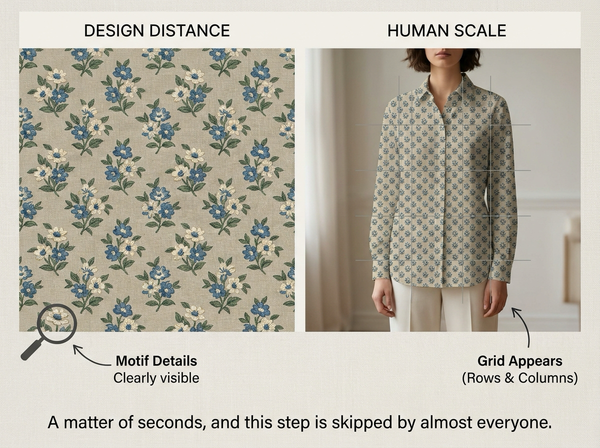
The grid is the most common. Motifs at consistent spacing form lines the eye connects, particularly when the garment is seen from across a room rather than at design distance. Checking at reduced size — zoom out until the swatch is roughly the size a person would appear at — reveals this in seconds and is skipped almost universally.
The recognizable element is the second. One motif that is visually distinct — larger, higher contrast, a different color — becomes a marker that lets a viewer see the repeat length. Distinctive elements need either to be common enough not to stand out or to appear once per tile in a position that varies.
The diagonal is the third and subtlest. Elements accidentally aligned across tiles produce a diagonal line running through the fabric that nobody placed and everybody sees. This is a placement problem inside the tile rather than a tiling problem, and it survives every check that looks only at the edges.
Color clustering is a fourth tell worth adding to the list. Where one color happens to gather in part of the tile, tiling multiplies that gathering into blotches spread across the fabric at regular intervals. The individual tile looks balanced; the tiled surface has patches. Checking the color distribution across a block of tiles rather than within one is the only way to see it, and it is a different check from looking for a grid.
Repeat size against garment size
A tile has a physical dimension when printed, and a garment panel has a physical dimension when cut. Their relationship decides what the customer actually sees.
Where the repeat is large relative to the panel, a small size may show only a fragment of the design. The extra small and the extra large in the same style then look like different products, because one shows the composition and the other shows a corner of it.
Where the repeat is small, the pattern reads as texture rather than as a design, which may be exactly what is wanted or may waste the artwork entirely.
The check is to view the repeat at true printed scale against the actual panel dimensions of your smallest and largest sizes, not against a square swatch. This is where applying the pattern to the garment shape answers a question a flat swatch cannot: what the design looks like on the piece, at the size, in the position it will actually occupy.
Density and scale on a body
Artwork is designed at a comfortable working distance and worn at conversational distance. Those produce different impressions of the same pattern.
Dense patterns that look rich on screen frequently read as noise on a body, resolving into an overall tone rather than a design. Sparse patterns that look elegant as a swatch can look accidental across a garment, with large empty areas the composition never anticipated.
Neither is a mistake in the artwork. Both are mismatches between design conditions and viewing conditions, and both are caught by the same habit: look at the pattern small, at garment scale, before committing.
The swatch approval trap belongs here too. A pattern printed on a small test swatch at whatever scale fits the swatch is not the pattern anyone will wear, and approving it that way approves a relationship between motif and viewer that will not exist in production. Where a physical sample is being approved, it needs to be printed at the intended scale even if that means a larger and more expensive test piece, because scale is the property most likely to be wrong and the one a small swatch hides completely.
Scale also interacts with the garment’s own structure. A pattern that works across a flat panel behaves differently over a gathered skirt, a pleated section or a draped area, where the fabric folds and the visible pattern compresses. Structured, flat garments show a repeat as designed; anything with volume shows a compressed and interrupted version of it.
Direction is a cutting constraint, not a styling choice
A directional pattern — one with an obvious top and bottom — carries a cost that appears at cutting rather than at design.
Non-directional patterns allow panels to be laid out in either orientation on the fabric, which lets the cutting layout be packed efficiently. A directional pattern forces every panel the same way up, which uses more fabric per garment.
That cost is real and it belongs to whoever plans the cutting, not to the designer’s file. What matters at design stage is knowing the choice has a consequence, so a direction that adds nothing to the design can be removed deliberately rather than defended after a costing.
Some patterns are directional in ways that are easy to miss: a floral where every stem points the same way, a texture with a consistent light direction, a scatter that happens to lean. Rotating the tile and asking whether it still reads correctly is a quick test.
What tiling does not solve
Tiling makes a fabric continuous. It does not make a garment continuous, and this is the distinction that surprises people most.
A garment is cut into panels and sewn together, so the pattern is interrupted at every seam. Whether it continues across that seam is a separate discipline — matching — that happens at cutting, requires the panels to be positioned deliberately on the fabric, and consumes additional material. A seamless repeat does not produce a matched garment; it produces fabric that could be matched if someone chose to.
Nor does tiling decide placement. Where a design should sit on a garment, whether it runs allover or as a positioned print, and how it relates to the body are placement questions rather than repeat questions, and repeating a design across a whole surface does not answer any of them.
Tiling also says nothing about whether the file will print. Resolution at printed size, color mode and the number of colors in the design are production requirements covered in what a print file has to satisfy, and a beautiful repeat can fail every one of them.
Frequently Asked Questions
How do I know if my repeat is too obvious?
Tile it, then zoom out until the swatch is about the size a person would occupy in your field of view across a room. Gridding, diagonals and any distinctive recurring motif become visible immediately at that scale and are nearly invisible at working distance.
Should I use a half-drop or a straight repeat?
Half-drop unless you specifically want the grid. Straight repeats align motifs into rows and columns that read as structure, which suits geometric designs and works against organic ones. The choice is easier to make by testing both at garment scale than by reasoning about it.
What repeat size should I use?
Judge it against your smallest and largest panel dimensions rather than in the abstract. A repeat that shows one full composition on a medium may show a fragment on the smallest size, and the two garments will look like different products on a listing page.
Does a seamless pattern mean the seams will match?
No, and this is a common and expensive assumption. Matching happens at cutting, requires deliberate panel placement and uses more fabric. A seamless file makes matching possible; it does not make it happen.
Can I avoid directional patterns entirely?
Where the design permits, it saves fabric at cutting. Where direction is part of the design, keep it and let costing account for it. What to avoid is a pattern that is directional by accident, since it carries the cost without contributing anything.
How does the pattern behave on a gathered or pleated garment?
It compresses and interrupts, showing less of the repeat than a flat panel does. Designs relying on a large composition tend to disappear on volume-heavy garments, while smaller and more textural repeats survive better.
Should I design the repeat before or after choosing the garment?
Whichever, but do not finalize it before knowing the panel sizes and the silhouette. The repeat’s scale relationship to the garment is the thing most likely to require rework, and it is cheap to check early.
Judge it at the distance it will be seen
Almost everything that goes wrong with a repeat is a scale error rather than a technical one. The tile joins correctly, and the design was evaluated at a distance and a size nobody will ever view it at. Looking at the pattern small, on the actual panel, at the smallest and largest size you sell, catches gridding, diagonals, density mismatch and accidental direction in one pass. The mathematics is handled; the judgment is what remains, and it is made by changing how you look rather than what you draw.
Check the repeat at garment scale before finalizing
Tile your pattern and view it at true printed size against the panel dimensions of your smallest and largest sizes rather than as a square swatch. Then zoom out to roughly the size a person occupies across a room and look for three things: rows or columns forming a grid, accidental diagonals running through the fabric, and any single motif distinctive enough to reveal the repeat length. Rotate the tile to check whether the design is directional by accident.
→ Seamless Pattern — Style3D AI
Written by