How to Make a Flat Sketch: Two Routes, Two Sets of Risks
A flat sketch either documents a garment that exists or proposes one that doesn’t. The two look identical and need very different checking.
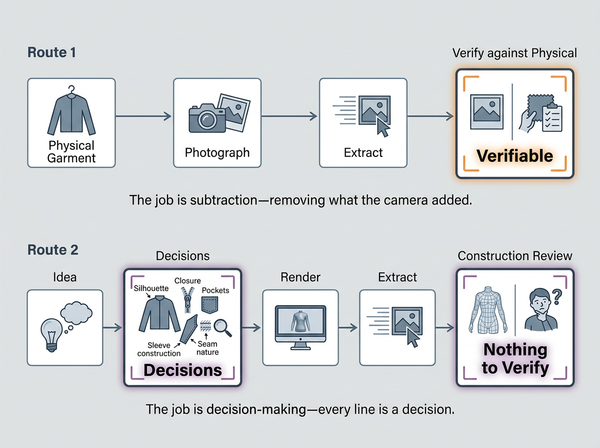
There are two ways to arrive at a technical flat, and the choice is made for you by circumstance rather than preference. Either the garment exists and you are documenting it, or it does not and you are proposing it.
Those produce drawings that look identical and carry completely different weight. One is a record of something that can be checked against a physical object. The other is a set of claims about a garment nobody has made yet. Treating the second like the first is how a development cycle gets wasted on a sample that was never buildable.
Route one: extracting from a garment that exists
You have a sample, a production piece, or a competitor’s garment on a table. The flat’s job is to describe it accurately.
This route is faster and safer, because there is a physical object to verify against at every step. Every line in the drawing either corresponds to something you can put your finger on or it does not, and that check is unambiguous.
The preparation that matters is the photograph. Shoot the garment flat or on a form rather than on a body, since a worn garment introduces drape that has to be removed later. Light it evenly and from a consistent direction, because shadows become lines. Press it, or at least smooth it, since every crease is a candidate for being drawn as a seam. Shoot the front and the back from the same distance and angle, so the two views agree without correction.
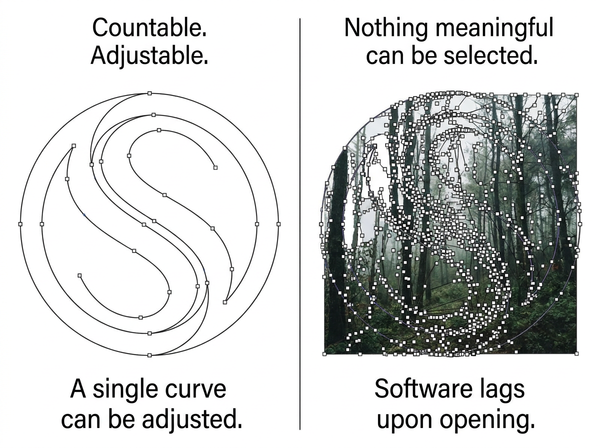
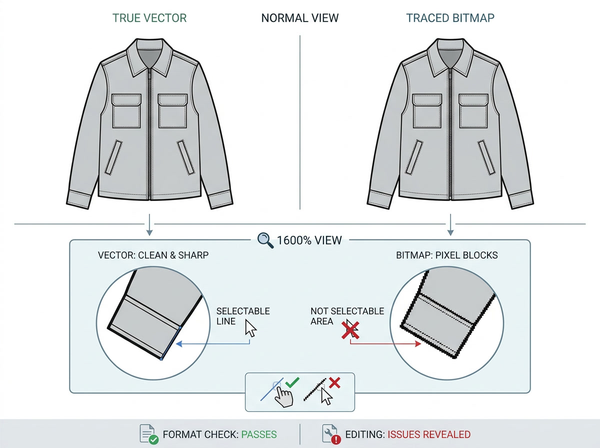
Most of the work in this route is subtraction: identifying what the camera added and taking it back out. Where the destination is a CAD file or a printed spec, pulling the line art out as editable vector is the step that decides whether the next person can edit the drawing or has to rebuild it. The failure modes and the checks that catch them are covered in what makes a flat usable downstream, and they apply to everything produced this way.
Route two: drawing from an idea
The garment does not exist. There may be a sketch, a mood reference, a description, or a modification of an existing style. The flat’s job is to specify something buildable.
Nothing here can be verified against an object, so every line is a decision rather than an observation. Where does the shoulder seam sit, how deep is the armhole, does the pocket sit above or below the waist seam, is that a princess line or a dart. In route one those questions are answered by the garment. Here somebody has to answer them, and if the drawing does not answer them, the factory will.
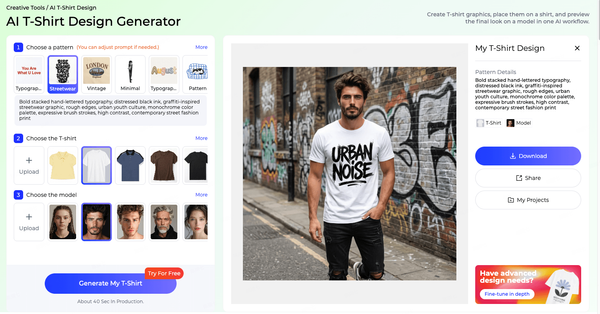
That is the practical risk, and it is invisible on the page. A drawing can be ambiguous and still look complete. Working from a sketch into a rendered garment first helps by forcing the ambiguities into visible form — a rendered garment has to resolve where the seams go, so you can see whether the resolution is what you intended.
It also introduces a specific hazard, which is the next section.
Record or proposal: the distinction that changes everything
A flat that documents an existing garment and a flat that proposes a new one look the same. They should not be treated the same, and the difference is worth marking explicitly on the file.
A record can be verified. Somebody can hold the sample next to the drawing. Disagreements get resolved by measuring.
A proposal cannot. There is nothing to measure against, so every construction detail rests on whoever drew it. If that person was a designer working from experience, the drawing carries their judgment. If it came out of a generation step, the construction details carry no judgment at all — they are what usually accompanies garments of that kind, which is not the same as what your garment should be.
Both are legitimate inputs to development. What causes damage is when a proposal circulates without being labeled as one, and a downstream reader assumes the construction was decided rather than inferred. Marking the status on the drawing costs nothing and prevents a category of expensive misunderstanding.
The hybrid route, and what it can launder
The common workflow now is a hybrid: start from a sketch or a description, generate a rendered garment, then extract the flat from that render.
It works, and it has a specific failure mode. The render resolves ambiguities by generating plausible construction, and the extraction then converts that plausible construction into clean technical line art. What began as an assumption arrives looking like a specification, with the confidence of a drawing and none of the verification behind it.
Nobody in the chain intends this. The designer knows the garment does not exist; the extraction is doing its job faithfully; the drawing is accurate to the render. The assumption simply loses its label as it moves.
The remedy is a review step by someone who knows construction, before the flat goes anywhere. They are not checking whether the drawing matches the render — it will. They are checking whether every seam, dart and closure in it is something the garment should actually have, and marking the ones that were decided by the pipeline rather than by a person.
Preparing the input, whichever route you take
For route one, the input is a garment and a camera, and preparation is physical: press it, form it, light it evenly, shoot both views consistently. An hour of setup removes several hours of line correction later, and the correction work is more error-prone than the setup.
For route two, the input is a description, and preparation is decision-making. Before generating anything, settle the things a drawing has to state: the silhouette, the closure type, the pocket style and placement, the sleeve construction, whether seams are structural or decorative. A generation step will fill any of these you leave open, and it will fill them plausibly rather than correctly.
There is a useful discipline in writing those decisions down before generating rather than reading them off the output afterwards. A decision recorded in advance can be compared against the result; a decision inferred from the result is indistinguishable from something the pipeline chose, and by then nobody remembers which was which.
Route two has one more preparation worth doing: identify the nearest existing garment. A reference piece you can hold — even one that is wrong in several ways — converts a number of open questions into answered ones and gives the reviewer something concrete to reason against.
Choosing by what the drawing has to do
The routes are not equally suited to every use, and the destination should decide.
For a line sheet or an internal review, either route works, since the drawing is communicating proportion and style rather than construction. Proposals are entirely appropriate here.
For a development handover, route one is strongly preferred where any physical reference exists — an earlier season’s version, a fit sample, a bought reference. Route two is workable but requires the construction review described above.
For a costing exercise, the distinction matters more than people expect. A quotation built from a proposal is a quotation for whatever construction the drawing implied, and if that construction was inferred rather than chosen, the price is attached to decisions nobody made deliberately. Costing from a documented flat, or from a proposal a person has reviewed line by line, avoids renegotiating later.
For a factory package on a garment with no physical precedent, the drawing needs a person who has made garments involved regardless of route. This is the case where an unlabeled proposal does the most damage, because the factory has nothing to compare against either.
What neither route does for you
Neither supplies measurements. A drawing describes shape and construction; points of measure come from a sample or a size specification, and a flat without them is not a spec.
Neither decides construction on your behalf in a way you should trust unexamined. Route one observes construction that exists; route two produces construction that is typical. Only a person decides construction that is right for this garment.
Neither describes the inside. Linings, facings, seam finishes and interfacing are invisible in both a photograph and a render, and they have to be specified separately whichever route produced the exterior drawing.
Neither removes the need for a sample. The first physical piece is where errors in either kind of drawing surface, and no amount of drawing quality shortens that loop.
Frequently Asked Questions
Which route is faster?
Route one, in almost every case, because verification is quick when there is an object to check against. Route two feels faster since there is nothing to photograph, and then spends the saved time in review and in the first sample.
Can I extract a flat from a rendered image rather than a photo?
Yes, and the mechanics are the same. What differs is the status of the result: a flat from a render describes a garment that does not exist, so the construction in it is proposed rather than observed, and it should be labeled that way.
Do I still need a designer if the drawing is generated?
For anything going into development, yes. The generation step resolves construction questions by producing what is typical, and someone has to check whether typical is correct for this garment. That check is the job, not the drawing.
What if I only have a photo of a garment on a model?
It works with more correction. A worn garment shows drape, body shape and asymmetry that a flat should not include, so budget more time for removing what the pose added. A flat-lay or form shot is worth arranging where you can.
Should the flat come before or after the rendered garment?
After, in the hybrid route, since the render is what resolves the ambiguities the flat then records. Going the other way — flat first, render second — is a valid design process, but then the flat is the decision and the render is illustration.
How do I mark a flat as a proposal?
Whatever your team will actually see: a status field in the file name, a stamp on the drawing, a note in the handover. The mechanism matters less than the habit, and the point is that a reader downstream knows whether the construction was observed or inferred.
Can I mix routes across a range?
Commonly, and it is worth tracking which is which. A range where some styles are documented from samples and others are proposed from renders carries two different levels of certainty, and treating them uniformly in development planning is where schedules slip.
Know which drawing you are holding
Both routes produce a technical flat, and the drawings are indistinguishable once they leave the person who made them. What separates them is whether the construction shown was observed on a real garment or inferred from what garments usually look like. That difference determines how much checking the drawing still needs, who has to do it, and what happens if nobody does. Label it, and the rest of the process can behave sensibly.
Decide the status before you draw
Ask one question before starting: does this garment exist? If it does, photograph it flat or on a form, evenly lit and pressed, and treat the work as documentation — every line gets verified against the piece. If it does not, settle the silhouette, closure, pockets and sleeve construction before generating anything, then have someone who has made garments review every seam in the result and mark which ones the pipeline decided rather than a person.
→ Extract Technical Drawing — Style3D AI
Written by