Flat Sketch: What Makes One Usable Downstream
A flat sketch can look right and fail every downstream use. Vector or pixels, line weight hierarchy, and the seam that isn’t there.
Getting line art out of a garment photo is the easy part now. Getting line art that a patternmaker can work from, a factory can read, and a merchandiser can approve is a different question, and it is the only one worth asking.
A flat that looks right on screen can fail every downstream use simultaneously: lines that are pixels rather than paths, one line weight for everything, a left sleeve that does not match the right, and a seam across the chest that does not exist on the actual garment. None of that is visible when you are looking at a clean drawing on a white page.
Three consumers, three sets of requirements
A technical flat gets used by different people who need different things from it, and “good” means something different to each.
The patternmaker needs structure. Where are the seams, which are structural and which are decorative, where do darts sit, which panels exist. Aesthetic quality is irrelevant; ambiguity about a seam is not.
The factory needs unambiguity. Every line has to mean one thing, construction details have to be distinguishable from styling details, and anything shown must be something they can actually build. A drawing that requires interpretation will be interpreted, and not always the way you expected.
The internal reviewer needs legibility at a glance, across a range on a single page, so proportion and consistency between styles matter more than any individual drawing.
The mistake worth avoiding is optimizing for the third and shipping to the first two. A flat that looks tidy in a line sheet can be unusable in development, and the gap only shows up when someone tries to work from it.
Paths or pixels
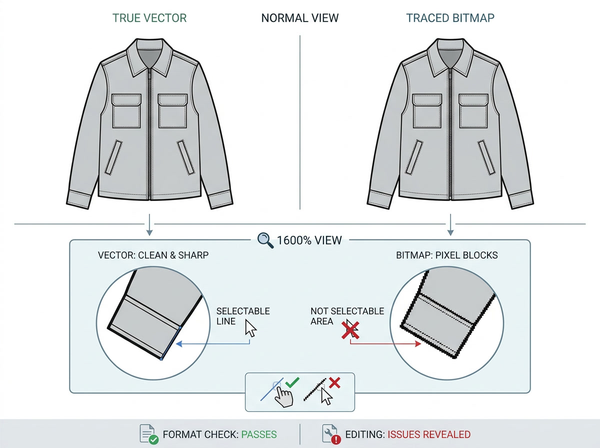
The first question about any extracted flat is whether the output is genuinely vector — a set of mathematical paths that can be selected, moved, and rescaled — or a raster image that happens to look like line art.
The difference is invisible on screen at normal size and decisive in use. Vector lines stay crisp at any size and can be edited individually: move a pocket, change a hem, adjust a line weight. Raster line art becomes soft when scaled and can only be edited by painting over it, which nobody does twice.
Check by zooming in hard on a line end. A vector path stays sharp; a raster line breaks into pixels. Check also whether individual lines can be selected as objects, since some outputs are vector containers wrapping a traced image, which is the worst of both — the file says vector and behaves like a picture.
Where the workflow ends in a CAD system or a printed spec, extracting the drawing as editable vector line art is not a nice-to-have. It determines whether the next person can work or has to redraw.
Redrawing is the hidden cost worth quantifying for your own team. When a flat arrives as a picture, the next person either works around it or rebuilds it, and rebuilding is the same labor the extraction was meant to remove. A workflow that produces beautiful uneditable flats has moved the work rather than reduced it, and that tends to show up as a complaint about the drawings rather than as a line in anyone’s cost model.
Line weight is information, not styling
In a technical flat, line weight carries meaning, and a drawing where every line is the same weight has thrown that information away.
The convention most teams use distinguishes at least three levels. The outer silhouette is heaviest. Structural seams — shoulder, side, armhole, princess lines — sit at a medium weight. Topstitching is shown as a broken or dashed line, lighter, because it is surface treatment rather than construction. Fold lines and internal guides are lighter still, and often shown differently again.
That hierarchy is how a factory reads a drawing quickly. Flatten it and the drawing still looks like the garment while ceasing to describe how the garment is made — a topstitch line and a seam line become the same instruction, and they are not the same thing at all.
Extraction from a photograph rarely produces this hierarchy on its own, because a photograph does not label which line is which. Assigning weights is a judgment step that follows extraction, and it is where most of the professional value in a flat actually sits.
Symmetry is checkable, and usually wrong
A garment photographed on a body or a hanger is never perfectly symmetrical. Fabric falls, the shoulder drops, a sleeve hangs slightly forward. An extraction reproduces what it sees, so the resulting flat inherits all of that.
For a technical drawing, that is a defect. A flat represents the garment as constructed, not as photographed, so both halves must agree unless the design is genuinely asymmetric. Pocket heights, cuff widths, collar points and hem levels all need to match across the center front.
The fix is straightforward once you know to look: draw or extract one half, mirror it, and reconcile any genuine asymmetry deliberately. The failure mode is not catching it at all, because a slightly uneven flat still reads as correct to anyone not measuring.
Center front and center back lines are worth marking explicitly for the same reason. They are the reference everything else is positioned against, and a flat without them leaves every measurement ambiguous.
The invented seam
This is the failure that costs the most and gets caught the least.
Extraction produces lines where it sees edges and shadows. A fold in the fabric, a crease from packaging, a shadow under a chest pocket — each can be read as a line and drawn as one. The output is a clean flat showing a seam that does not exist on the garment.
That is not a drawing error. It is a specification error, and it travels. A factory reading a panel seam that is not there will either build it, ask about it, or ignore it, and only the second outcome is harmless. In development, the cost is a sample that comes back wrong; in production, it is worse.
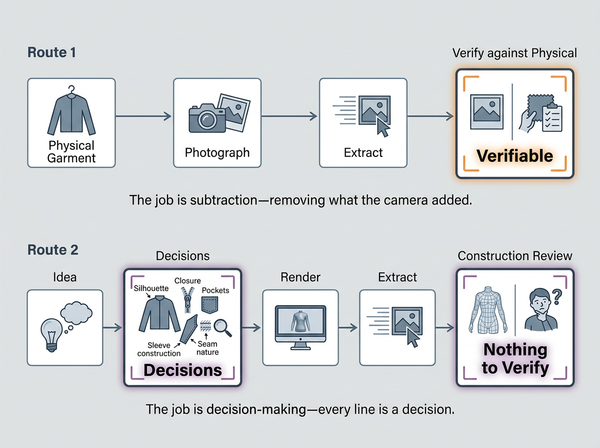
The check is to compare the flat against the physical garment rather than against the photograph. The photograph contains the shadow that caused the problem, so comparing the two will confirm the error rather than reveal it. Where no sample exists, someone who knows the construction has to verify every line before the flat goes anywhere.
Fixing this is usually faster upstream than downstream. Where the garment image itself has a distracting fold or an unclear detail, correcting the garment image before extraction removes the cause rather than editing the symptom out of the line art afterwards.
Front and back have to agree
A flat is a set — front and back, sometimes side and detail views — and the views have to describe the same object.
Side seam lengths must match between front and back. Hems must sit at the same level. Shoulder seams must meet. A shared detail like a yoke has to appear consistently in both. These agreements are trivial to state and routinely broken when views are extracted independently from different photographs shot at different angles.
Detail callouts are where extraction helps least and matters most. A zipper type, a bartack, a specific closure, a topstitch spacing — these need to be shown enlarged and annotated, and no extraction from a photograph will decide that they need annotating.
Interior construction is the other gap. Linings, facings, pocket bags, seam finishes and interfacing are all invisible in a photograph of the outside of a garment, and all of them have to be specified somewhere. A flat extracted from a product shot describes the exterior completely and the interior not at all, which is fine as long as nobody assumes the drawing is the full specification.
What extraction cannot do
It cannot tell you what is a seam and what is a shadow. Every line it produces is a response to a visual edge, and the model has no access to the garment’s construction, so verification against the physical piece is required rather than optional.
It cannot assign line weight meaningfully. Weight is a statement about construction, which is information the drawing is supposed to carry and the photograph does not contain.
It cannot produce a pattern. A technical flat is a drawing of the garment’s appearance and construction from the outside; a pattern is the set of flat pieces that get cut and sewn to make it. Deriving one from the other requires patternmaking, and no extraction from a photograph does it. Treating a flat as a step toward a pattern is a category error worth naming clearly, because the two are often discussed in the same sentence.
It cannot supply measurements. Points of measure — chest width, hem sweep, sleeve length — come from measuring a sample or from a size specification, and a drawing without them is a picture rather than a spec.
Frequently Asked Questions
Is a flat sketch the same as a technical drawing?
The terms overlap in practice. “Flat sketch” often implies the proportional drawing used for line sheets and presentations, while “technical flat” or “technical drawing” implies the version carrying construction detail for development. Same drawing type, different level of rigor, and it is worth being explicit about which one you are asking for.
Can I extract a flat from a photo of a garment on a model?
Yes, with more verification. A worn garment shows drape and body shape that a flat should not include, so more of the output needs correcting toward the as-constructed shape. A flat-lay or a garment on a form gives a cleaner starting point.
What line weights should I use?
Follow whatever your factory already reads, since consistency with their expectation matters more than any particular convention. Where nothing is established, distinguish at least silhouette, structural seam and topstitch, and apply it identically across every style in the range.
How do I know if the output is really vector?
Zoom in on a line end and see whether it stays crisp or breaks into pixels, then try selecting a single line as an object. Some files are vector wrappers around a traced raster image, which passes a format check and fails every practical test.
Does a flat need to be to scale?
It needs correct proportion rather than true scale. What must be accurate is the relationship between parts — sleeve to body, pocket to panel — since measurements come from the spec rather than from the drawing.
What is the fastest way to check a flat before sending it?
Compare it to the physical sample, not to the photograph, then check symmetry across center front, then check that front and back agree at the side seams and hem. Those three passes catch most of what actually causes problems downstream.
Should I start from a sketch instead of a photo?
Where the garment does not exist yet, you have to. Working from a sketch into a rendered garment first and extracting the flat from that is one route, and it carries the same verification requirement — the flat still describes a garment nobody has made, so every construction line in it is a proposal rather than a record.
Draw the garment, not the photograph
The line that separates a usable flat from a decorative one is whether it describes the garment as constructed or the photograph as taken. A photograph contains folds, shadows, drape and asymmetry, none of which belong in a technical drawing, and an extraction faithfully reproduces all of them. The work that makes a flat usable is the work of removing what the camera added and supplying what it could not see: which lines are seams, which are stitching, and what the garment looks like when it is made rather than when it was shot.
Verify against the garment, not the photo
Extract one flat and run three checks before it goes anywhere. Compare every line to the physical sample and delete any that came from a fold or a shadow rather than a seam. Mirror the drawing across center front and reconcile anything that does not match. Then confirm the front and back agree at side seam length and hem level. If you have no sample, get someone who knows the construction to walk the lines before the file leaves your team.
→ Extract Technical Drawing — Style3D AI
Written by