
Points of Measure: Turning Fit Into Something Checkable
A measurement point turns a judgment into something two parties can disagree about productively. Which is a different job from describing how a garment fits.
“It doesn’t fit” cannot be acted on. It cannot be verified, disputed, or corrected, because it does not say anything a second person can check.
A measurement point is what turns that sentence into something two parties can work with.
What a point of measure converts
The same observation, bound to a named location on the garment, becomes a different kind of statement. It says where, it says by how much, and it says against what.
That changes the conversation from an assessment into a claim. A claim can be re-measured. It can be agreed with, or disagreed with on evidence. It can be routed to whoever is able to act on it, and it can be checked again after they have.
None of that is available for an unbound judgment, which is why fit discussions without measurement points tend to circle. Two experienced people can look at the same garment, both be right about what they are perceiving, and have no mechanism for resolving the difference.
This is the actual function of the list in the technical documentation: not to describe how the garment fits, but to make fit into something that can enter a dispute resolution process at all.
The list is shaped by what is easy to measure
Here is the bias worth knowing about, because it is present in most lists and nobody put it there deliberately.
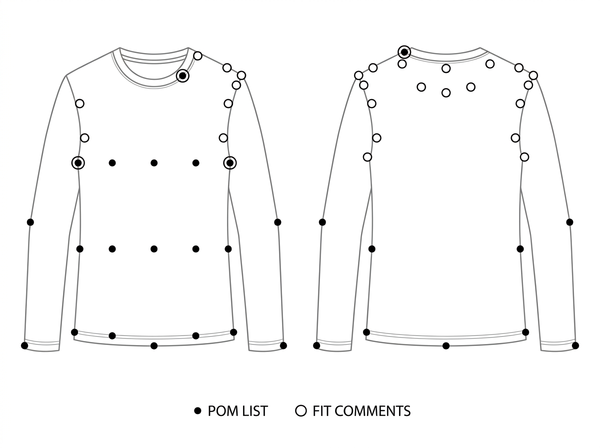
Measurement points arrive in a list partly because they matter and partly because they are straightforward to take. Chest across, body length, sleeve length — these are read on a flat garment with a tape, quickly and repeatably, by anyone.
The measurements that most reliably predict whether a garment will be satisfying to wear are frequently harder to take. Armhole geometry, shoulder slope, back width across the blades, rise on trousers. These require more care, more consistency between measurers, and sometimes a garment positioned rather than flat.
So lists tend to be dense where measurement is convenient and sparse where it is difficult — which is not the same distribution as where fit succeeds or fails. The result is over-coverage of properties rarely in dispute and gaps at exactly the places fit comments keep arriving.
Reviewing a list against the fit comments of the last few seasons is a quick way to see whether this has happened to yours.
The bias also perpetuates itself. A point that is not on the list produces no data, so it never appears in any analysis of where fit goes wrong, so nothing prompts anyone to add it. The gaps are self-concealing in exactly the way that makes them survive across seasons and across blocks.
Every point is a place the garment can be rejected
A longer list is not automatically a better one, and the reason is commercial rather than technical.
Each measurement point is a location where the garment will be checked and can fail. Adding points adds coverage and adds occasions for rejection, rework, and negotiation.
That is why the length of the list is something factories and brands have positions on, and why those positions differ. A factory carries the cost of every point that fails; a brand carries the cost of every property that was not checked. Both are reasonable, and the discussion is usually framed as being about thoroughness when it is about who absorbs which risk.
Naming that explicitly makes the conversation shorter. A list agreed as a risk allocation is more stable than one negotiated point by point on grounds of importance, because importance is arguable and allocation is a decision.
It also changes what a good outcome looks like. The aim is not the longest list a factory will accept, and it is not the shortest a brand will tolerate. It is a list where every point covers something that has gone wrong before, and nothing on it is there because it was on the last one.
Tolerance is part of the point, not separate
A measurement point without a tolerance specifies a number that will not be achieved.
Production varies. Fabric relaxes, cutting drifts, sewing differs slightly between operators, and the same garment measured twice by the same person can differ. A specification that names a target and no acceptable range is asking for an exactness that no process delivers, which means in practice that either everything fails or the tolerance exists informally in somebody’s head.
Tolerances also belong per point rather than globally. A garment can accept considerable variation at the hem and very little at the neck opening, and applying one range across every point either over-constrains the forgiving measurements or under-constrains the critical ones.
Deciding which points are tight and which are loose is a design judgment about where fit actually lives in that garment, and it is one of the more useful conversations a technical designer and a factory can have early. It is also one that rarely happens, because a tolerance column arrives pre-filled from the previous style and nobody treats a filled field as a question.
The point is the routing interface for fit comments
Fit comments travel only if they attach to something.
A comment recorded against a named point arrives at production as an instruction: this measurement, this direction, this amount. It can be applied to the pattern, checked on the next sample, and closed.
The same observation recorded as a description arrives as an interpretation problem. Someone downstream decides what was meant, applies their reading, and produces a sample that addresses their interpretation rather than the original observation — which is how a comment gets repeated across several rounds while everyone believes they are responding to it.
Points of measure are therefore the interface between the fitting room and the pattern table, and a comment that cannot be attached to one is a comment that has no route.
Where the list comes from
The list originates from the pattern rather than from the garment.
Each point corresponds to a dimension the pattern produces, so the list and the pattern have to agree — measuring a garment at a location the pattern does not control produces a number nobody can act on. Systems that hold pattern work and measurement together make that correspondence explicit rather than leaving it to be maintained by hand.
Lists also propagate. A new style usually inherits the list from a similar existing style, which is efficient and carries forward whatever bias the original had. A block that has been in use for years may be carrying a measurement list assembled for a garment it no longer resembles.
Reviewing the list when a block is revised, rather than only when a style is new, catches this.
What no point of measure can capture
The mechanism only handles distances. Everything about a garment that is not a distance is outside it.
Drape is not a distance. Hand is not a distance. How a garment moves, how it feels after several hours, whether a collar stays where it was put — none of these reduce to a measurement between two locations.
Which means a garment can pass every point on the list and still be wrong. That is not a failure of the list; it is the boundary of what the method covers, and it is the reason a physical fitting exists alongside a measurement check rather than being replaced by one.
The same boundary appears in imagery. An image settles appearance rather than fit, and it carries no measurements at all — so a garment approved from images has been approved on the properties this list does not cover, using a method that cannot cover the ones it does.
FAQ
How many points should a list have?
Enough to cover where fit is decided in that garment type, which varies considerably between a t-shirt and a tailored jacket. Counting is the wrong frame; matching the list to where comments actually arrive is the useful one.
Who decides the tolerances?
Technical design proposes and the factory confirms what is achievable in the specified fabric, since tolerance depends on the material as much as on the process. A tolerance set without that conversation is a target rather than an agreement.
Should the list be the same across a range?
Consistent within a garment type, so that comparisons across styles are meaningful. Applying one list to structurally different garments produces points that are irrelevant on some styles and gaps on others.
What happens when a measurement is out of tolerance?
That is a question about the agreement rather than about the number — whether it is accepted, corrected, or renegotiated should be settled before it happens rather than case by case under time pressure.
Do points of measure apply to knitwear?
They do, and the tolerances need to be wider and the measuring conditions more carefully specified, since knitted fabric relaxes and stretches. The list works; the assumption of a stable dimension does not transfer.
Can measurement checks replace a fit session?
They check different things. A measurement check verifies that the garment matches the specification, and a fit session verifies that the specification produces a garment worth wearing.
Where this leaves you
Compare your measurement list against the last few seasons of fit comments.
Where comments keep arriving at locations the list does not cover, the list is not doing its job — those observations have no route to production and are being re-interpreted each time they are raised. Where the list has points that no comment has ever concerned, those are places the garment is being checked and can be rejected, for a property nobody was worried about.
Read the comments, then read the list
Pull the fit comments from your last few seasons and mark which measurement point each one attaches to. The ones that attach to nothing are the gaps in your list, and they are the comments that keep coming back because they have no way to reach the pattern. The points that no comment has ever referenced are the opposite problem: coverage you are paying for in rejections without buying any information. See what technical documentation has to carry before it reaches production.
→ https://www.style3d.ai/ai-fashion-design/extract-technical-drawing
Written by