From 2D to 3D Clothing: What the Conversion Can Infer
“2D to 3D” names two different operations. One computes a garment from pattern pieces; the other infers one from a picture. Only one of them can be verified.
“2D to 3D” is one phrase covering two operations that have almost nothing in common. One of them starts from the instructions for making a garment. The other starts from a picture of a finished one. They produce results that look similar on screen and mean entirely different things.
Knowing which one you are running determines what you are allowed to do with the output.
Two operations sharing one name
Pattern pieces to 3D | Image to 3D | |
What goes in | A construction description: panels, seams, measurements | One projection of a finished object |
What comes out | The computed consequence of that description | A proposal for what might have produced that view |
Can it be checked? | Yes — against the pattern it came from | Only against the one view it was given |
What it is for | Simulating, fitting, sampling | Concepting, presenting, visualizing |
The pattern route is the one that supports production decisions, because the input already contains the garment’s construction. Systems built around pattern-based 3D — Style3D Atelier among them — start from panels and seam lines for exactly this reason.
The image route is doing something else. It is looking at a result and proposing a cause. That is a legitimate and useful operation, and it is not the same operation, and the trouble starts when a team treats an output of the second kind as if it were an output of the first.
What a flat image actually contains
A photograph is one projection of a three-dimensional object, taken from one position, under one lighting setup, at one moment.
Present in that projection: the silhouette from that angle, the surface appearance of whatever faces the camera, and visible evidence of how the material behaved — folds, where they break, how light falls across them.
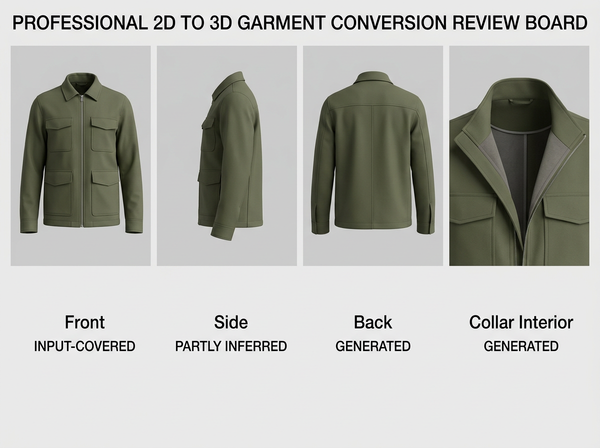
Absent from it: the back. The inside. Where one panel ends and the next begins, wherever a seam is hidden by a fold or falls outside the frame. Material thickness at every edge. How many layers there are. What the garment does when the body underneath it moves.
None of that absent information is hard to obtain. It is simply not in the file, and no amount of processing recovers what was never captured.
What can be inferred, and why
There is a clean rule for separating the recoverable from the invented: if something visible is a consequence of the thing you want to know, you can estimate the thing from the evidence. If it exists independently of what is visible, you cannot.
Drape is a consequence of weight, so a garment hanging heavily supports an estimate that the material is heavy. Fold radius is a consequence of bending stiffness, so sharp creases support an estimate that the fabric is crisp. The outline of a neckline constrains what family of collar could produce it. Sleeve volume constrains the range of sleeve constructions that could hang that way.
Each of those is an estimate with an error range attached, and here is the part worth holding onto: the error range does not appear in the output. A model that is fairly confident and a model that is guessing produce results that look identical. The estimate arrives without its uncertainty.
What has to be invented, and why it looks the most finished
Everything on the list of absent information still ends up in the result, because a 3D garment cannot have a missing back. The system has to put something there.
What it puts there is the most likely version — most likely according to the distribution it learned from, which is a distribution of other garments, not of yours. The back of your jacket becomes the back that jackets like this usually have. The inside of the collar becomes a plausible inside. Where two panels meet becomes a seam positioned where such seams commonly sit.
Now the counterintuitive part. Rotate a converted garment and the back will often look cleaner than the front. This is not an accident and it is not a compliment to the model. The front had to reconcile itself with an actual image, and reconciliation produces friction — small mismatches, edges that do not quite agree, places where the evidence pulled in two directions. The back had no evidence to argue with, so nothing interfered with generating a tidy, coherent, entirely unfounded surface.
The confidence of the output is uncorrelated with the evidence behind it. The regions that look most resolved are the ones nobody constrained.
What the result is genuinely good for
Concept work benefits immediately. A shape in three dimensions communicates a proportion in a way a flat image does not, and getting a room to react to a silhouette early is worth real money in a development calendar.
Presentation benefits too. A converted garment placed in a 3D scene, lit, and rendered gives marketing and merchandising a usable asset without a physical sample existing. For visual purposes, an invented back is not a defect — nobody is going to cut it.
Reference and exploration benefit. Moving an archive image, a competitor reference, or a mood image into three dimensions to test how a shape sits on a body is a fast, low-stakes way to answer a question that would otherwise wait for sampling. Tools that turn a flat garment image into a 3D form are doing their most defensible work here, where the output is being looked at rather than built from.
The common thread is that all three uses treat the output as a proposal. None of them treat it as a record of an existing garment or as an input to production. That distinction is not a technicality — it decides whether an invented back is irrelevant or dangerous. In a lookbook it is irrelevant. In a folder a pattern maker opens, it is a specification for something nobody designed.
How to read a converted garment
Reviewing one of these outputs is a specific skill, and it runs opposite to how people normally look at renders.
• Look at the back before the front, because the front is the part that had evidence and the back is where you learn what the system does when it has none.
• Check whether seams sit where construction would put them — along panel boundaries that could actually be cut and sewn — rather than wherever the surface happened to change.
• Treat perfect symmetry as a warning rather than a sign of quality, since real garments carry asymmetries from cutting and pressing that a generated surface has no reason to reproduce.
• Open every opening. Cuffs, plackets, necklines, and vents are where the inside becomes visible, and the inside is pure invention.
None of these checks tell you the output is wrong. They tell you which parts of it you are looking at.
What has to be added before it touches production
A converted garment describes a target. Production needs a method, and the method does not come with it.
Someone has to make a pattern. This is the same conclusion that applies to technical drawings, one step further down: if a technical drawing still requires pattern making to become a producible garment, an inferred 3D surface — which carries less construction information than a technical drawing, not more — certainly does. The conversion has not skipped a step in the process; it has produced something that enters the process earlier than a technical drawing does.
The practical consequence is a rule about libraries. Converted garments belong wherever proposals live, labeled as proposals, and they should never travel into a production folder alongside records of garments that actually exist. The two look the same in a thumbnail grid, and once they are mixed, the only person who can tell them apart is whoever made them.
FAQ
Is the pattern-based route always better?
It is better for anything with a downstream consequence, because its input describes construction and its output can be verified against that input. The image route is better when there is no pattern to start from, which covers most concepting and reference work. They serve different moments rather than competing.
How much does the input image quality matter?
It changes how much of the front is supported by evidence and does nothing about the back or the inside. A sharper image improves the estimates in the regions the camera saw. The invented regions stay invented at any resolution.
Would multiple photos from different angles solve this?
More views convert more of the invented regions into inferred ones, which is a real improvement. What stays invented is the inside, the layers beneath the outer surface, and anything hidden by a fold in every available view. Multiple angles narrow the gap without closing it.
Can I get a pattern out of a converted garment?
Not one you can cut from. A pattern encodes construction decisions — where panels divide, how much ease sits where, what seam allowances apply — and none of those decisions exist in the source image. Flattening a generated surface produces shapes, and shapes are not pattern pieces.
Where should converted garments be stored?
In a proposal library, never in the same place as records of real garments. Once a proposal is filed next to a photograph of an actual sample, it becomes indistinguishable in a browse view, and someone eventually uses it as a reference for a decision it cannot support.
How should this be labeled internally?
Name the source in the filename or the metadata, so that anyone opening it later knows whether it came from a pattern or from a picture. That single distinction determines what the file may be used for, and it is not recoverable by looking at the model.
Where this leaves you
Before using a converted garment for anything, ask which operation produced it.
If it came from pattern pieces, it is a computed result and you can check it against its own input. If it came from an image, it is a well-argued guess about the front and a confident fabrication about everything else. Both are useful. Only one can be verified, and the one that cannot be verified is also the one that will look, on the screen in a review meeting, entirely convincing from every angle.
Rotate it before you trust it
The next converted garment that crosses your desk, turn it around before you look at the front. Whatever you see on the back is what the system produces with no evidence at all, and that tells you how much of the rest to take at face value. Then decide where the file goes — proposal library or production folder — and label it before anyone else opens it. Explore how image-based 3D conversion works and what it hands you.
Written by