
Fabric Parameters a Simulation Needs Before It Can Be Trusted
Six measurable properties decide whether a simulated garment drapes like the real one. Here is what each governs, where the numbers come from, and what they miss.
The list is short. Six properties decide whether a simulated garment hangs like the real one, and a mill already knows two of them.
That is the encouraging part and the misleading part at once. Short list, low barrier — except that the four properties nobody has on a spec sheet are the four that separate a garment that drapes correctly from one that merely drapes.
Why the list is short and still difficult
Most of what a person means by “fabric” contributes nothing to how a garment falls. Color is a decision that belongs to a completely separate track and has no mechanical consequence. Print scale, fiber content as a marketing claim, the mill’s story about the yarn — none of it reaches the solver.
What reaches the solver is mechanical behavior. Cloth has to be described as a structure rather than a surface, and a structure is characterized by how it responds to force: how hard gravity pulls on it, how far it gives, how tightly it folds, how it slides against itself.
The difficulty is not conceptual. It is that four of the six numbers require measurement equipment, and most apparel organizations have never needed them before, because a physical sample answered the question by existing.
The six properties
Property | What it governs | What goes wrong when it is wrong | Usually available? |
Weight | How hard gravity pulls on every panel | Silhouette volume — too full or too collapsed | Yes, on the mill spec |
Thickness | Layer stacking, seam bulk, collision offset | Layers interpenetrate or float apart | Yes, on the mill spec |
Tensile / stretch | Extension under load, per direction | Knit fit reads wrong; ease lands elsewhere | Rarely |
Shear | Diagonal distortion of the weave | Bias panels behave like straight-grain ones | Almost never |
Bending | The radius a fold takes | Sharp creases become soft rolls, or the reverse | Rarely |
Friction | Slip between layers and against the body | Linings twist, or drag when they should glide | Almost never |
Read the right-hand column and the shape of the problem appears. The two properties everyone has are the two that describe the material at rest. The four nobody has are the ones that describe what it does when a body is inside it.
Two of them do most of the work
If a team can only measure two properties before starting, the two are weight and bending.
Weight sets the magnitude of the force acting on every panel, and it is the single input that most visibly changes a silhouette. Bending sets the radius of every fold, which determines whether the material breaks into defined creases or rolls into soft ones — the difference between a crisp poplin and a fluid crepe at identical weight.
Everything else modifies a result those two have already largely determined. Stretch, shear, and friction adjust the outcome; weight and bending produce it.
The ordering flips in two situations, and both are common enough to plan for. For knits, stretch moves up to first — a knit simulated without measured stretch data is not approximate, it is unrelated. For anything cut on the bias, shear moves up, because bias behavior is shear behavior and a garment cut that way amplifies every error in that one number.
Where the numbers come from
Three sources, three levels of reliability, and it is worth being blunt about which is which.
Source | What it reliably gives | What it does not give |
Measured on the actual material | All six, for the specific lot tested | Nothing — this is the reference standard |
Mill specification sheet | Weight and thickness, usually | Bending, shear, friction; stretch only sometimes |
Preset library in the software | A coherent generic member of a fabric family | Anything specific to your material |
Measurement requires hardware, which is what fabric digitization systems exist to provide. Style3D Fabric pairs scanning with bending and tensile testers that measure weight, thickness, stretch, and bending properties, feeding those values into a digital material record rather than having someone type them in from a supplier email.
The preset library deserves a specific caution beyond “it’s generic.” Preset libraries are populated with well-behaved materials — stable constructions that simulate cleanly. Production fabric is messier than that. So the substitution runs consistently in one direction: the simulated garment behaves better than the real one will. Folds sit more evenly, hems fall more obediently. Nobody rejects an image for looking too resolved, which is precisely why this error survives review.
Direction: the property most often flattened
Fabric is not the same material in every direction, and most parameter entry screens have one field per property.
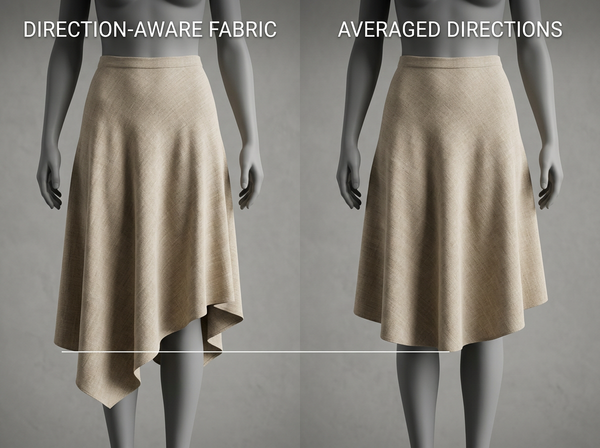
A woven behaves differently along the warp than along the weft, and differently again on the bias — that is not a subtlety, it is the entire basis of bias cutting. A knit stretches differently along the wale than along the course, often by a wide margin. The moment someone averages those into a single “stretch” value, the anisotropy is gone.
What makes this the quietest error in the whole chain is that it does not produce a broken result. It produces a perfectly plausible garment that is not your garment. A bias skirt entered with averaged values still hangs, still swings, still photographs well. It simply falls into a different shape than the one that will arrive from the factory, and nothing in the output signals that a directional property was collapsed.
Anywhere a system offers per-direction entry, use it. Where it does not, know which direction the single number represents, and treat bias-cut styles as outside the range of what that entry can support.
What the parameters do not capture
The six numbers describe how a material responds to force in the moment. Several things that matter to a garment are not that.
• Hand — the tactile impression of a fabric between the fingers — is not a mechanical parameter, and no combination of the six reconstructs it.
• Recovery over time is absent: whether a knit returns to shape after being worn for hours, or grows and stays grown.
• Behavior after processing is absent: what pressing, fusing, or washing does to the properties that were measured before any of that happened.
• Interlining and fusible structure are absent entirely, which matters more than the rest combined for tailored garments — the structure of a fused front is not a property of the face fabric, so measuring the face fabric perfectly still tells the solver nothing about it.
That last one is the reason a tailored jacket remains harder to trust in simulation than a simple woven dress, and it is a gap in the data model rather than in any particular tool.
Building a library that stays useful
Measure per material, not per style. A material measured once serves every garment that uses it, which is what makes the investment reasonable — the cost is per fabric, and the return is across the range.
Ownership follows from that. Fabric data belongs with whoever owns the material relationship, which is normally sourcing rather than design, because they are the ones who know when a quality is being reordered, substituted, or dropped.
Naming determines whether any of it survives. A record called “navy twill” is unusable within a season. Mill name, quality code, and lot identifier make a record findable and make it obvious when a re-measure is due — and it is due whenever the mill changes, whenever the quality is reworked, and whenever a substitution is accepted in sourcing without the design team hearing about it.
FAQ
Can I estimate the missing four properties instead of measuring them?
You can, and the result is a simulation whose accuracy you have no way to characterize. An estimate produces the same confident output as a measurement, with no marker distinguishing them. If estimating is the only option, record that the values were estimated so that anyone reading the result later knows what they are looking at.
How often does a material need re-measuring?
When something about the material changes — a new mill, a reworked quality, a substitution, or a lot that sourcing flags as different. Re-measuring on a calendar wastes effort; re-measuring on change catches the cases that matter.
Do these properties transfer between similar fabrics?
Two fabrics with the same fiber content and similar weight can have quite different bending behavior, because construction and finish affect it as much as composition does. Treating one as a stand-in for the other is a preset library with extra steps.
Which property causes the most visible errors in practice?
Bending, for most woven garments. Weight errors change the volume of a silhouette in ways people notice and question; bending errors change where and how folds form, which looks normal enough that nobody questions it and yet reads as a different fabric to anyone who knows the material.
Is there a minimum viable set for a team just starting?
Weight and bending on your ten highest-volume materials will do more for simulation quality than a complete parameter set on one material. Coverage across the fabrics you actually use beats depth on a fabric you use once.
Who should sign off that a material’s data is correct?
Whoever would be accountable if a fit were approved from a simulation built on it. Making that person explicit early prevents the situation where fabric data enters the library through several hands and nobody in particular is answerable for it.
Where this leaves you
Two numbers you already have, four you probably do not — that is the actual gap between a simulation you can look at and one you can decide from.
The gap is closable, and it closes per material rather than per style, which makes it a finite piece of work rather than an ongoing tax. What does not close is the part where an unmeasured material produces output indistinguishable from a measured one. There is no warning label on a guess. The only thing standing between the two is whether somebody went and measured the cloth.
Measure three fabrics, not thirty
Pick the three materials your range depends on most and find out what is actually known about them — whether anyone has measured bending and stretch, or whether every digital garment made from them has been running on a preset. Three measured materials will change how much you trust your simulations more than a full library of estimates ever could. See what fabric digitization captures and how measured values enter a material record.
Written by