
Building an Avatar From Real Fit Model Measurements
Physical fittings correct themselves because the person is in the room. Digital fittings do not. What that means for how you build and maintain an avatar.
The avatar is the only part of a garment simulation that represents a person, and in most organizations it is the part nobody owns.
That a generic avatar produces ease numbers measured against a body that does not exist is by now a familiar point. What follows from it is less familiar: which measurements actually matter, where they come from, how they quietly expire, and who is supposed to notice when they do.
What the avatar is standing in for
An avatar is not standing in for “a body.” It is standing in for the specific body your fit sessions run on.
That distinction matters because the fit model is already a choice. A brand picked one person, or a set of dimensions, to represent its customer, and every pattern in the range was corrected against that choice. The avatar is an abstraction of an abstraction, and it only works if the second abstraction points at the first.
When it does not — when the avatar came from a size chart and the fit sessions run on a live model — the digital and physical processes are correcting against different references. Both will produce coherent results. The results will disagree, and the disagreement surfaces at a fitting where somebody has to decide which one to believe. This is the same gap that separates appearance from fit in two-dimensional try-on imagery, arriving one layer deeper in the process.
Which measurements change the drape
A size chart is built for grading. It records the girths a range needs in order to step through sizes. What makes a garment hang level is somewhere else entirely.
Measurement | Why the garment cares | On a typical size chart? |
Bust, waist, hip girth | Sets the ease at the three points most patterns are cut to | Yes |
Shoulder slope | Everything hangs from here; a wrong slope tilts the whole garment | No |
Front and back waist length | Governs whether a hem sits level or dips at one side | No |
Shoulder width and neck base | Determines where an armhole lands and how a collar sits | Sometimes |
Posture — pelvic tilt, head carriage | Shifts where volume collects and where a hem breaks | No |
Limb girths at defined heights | A sleeve cares where the arm is wide, not only how wide | Rarely |
The pattern is consistent enough to state plainly: the measurements that most affect how a garment falls are the ones a size chart has no reason to contain, because grading does not need them and hanging does.
Scan or tape
Both, for different jobs.
A scan captures shape rather than a list of numbers. It gets the surface between the measuring points, which is where posture and asymmetry live, and it does it quickly enough to be repeatable. What it also captures is one moment — a particular breath, a particular stance, the way a person stands when someone tells them to stand still. Two scans of the same person on the same day are not identical.
Tape measurements are sparse and slower, and they have one property a scan does not: they are the same measurements your points of measure use. When a simulated garment is later compared against a physical one, the comparison happens at those points, so having the body described in the same vocabulary as the garment removes a translation step where errors hide.
The practical arrangement is to scan for the shape and tape for the reference numbers, then check that the two agree at the points where both exist. Disagreement there is worth resolving before any garment is simulated on the result.
The measurements that expire
Here is the part that catches teams, and it has nothing to do with software quality.
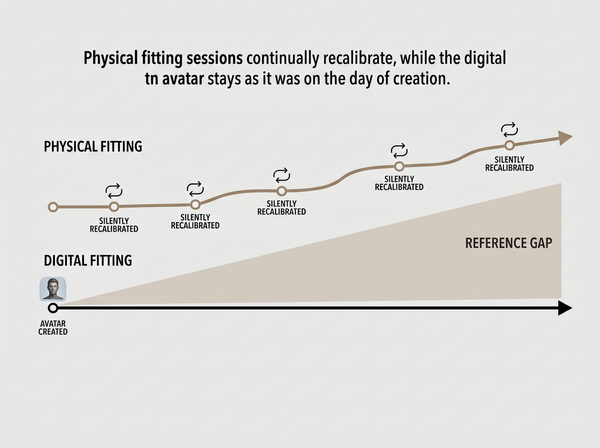
A fit model’s body changes. In physical fitting this has never been a problem, because the person is in the room. If their waist has moved, the garment on them shows it immediately, the technical designer responds to what they see, and the process absorbs the change without anyone registering that a change occurred. Physical fitting is self-correcting.
An avatar is not. It records one person as they were measured on one day, and after that day nothing in the system will ever mention that the record and the body have separated. The simulation keeps producing confident results against a reference that is quietly no longer accurate. There is no error, no warning, no drift in the output — the avatar is exactly as correct as the day it was built, about a person who has moved on.
The consequence is that avatar maintenance has to be triggered by events rather than by a calendar. Re-measure when the fit model changes, when a different person takes over fit sessions, when the brand revises its target customer, or when physical and simulated fits start disagreeing in a consistent direction. That last signal is the useful one: consistent one-way disagreement between a simulation and a fitting usually means the body reference has drifted, not that the garment is wrong.
One avatar is one size
A garment simulated on one avatar is correct for that avatar and silent about every other size in the run.
Grading is a set of decisions about how bodies change across a range, and those decisions live in the technical documentation rather than in any body model. Grading rules are a document, and a simulation does not derive them, verify them, or carry them.
What helps in practice is building avatars at the ends of the run rather than at every step. The base size tells you whether the pattern works. The extremes tell you whether the grading holds — and the extremes are where a grading decision that was reasonable in the middle stops being reasonable, because proportions do not scale linearly with girth.
Posture is a choice about which failure you will see
An A-pose is a measuring convention. Nobody wears clothes in one.
Simulating in the measuring pose gives clean access to girths and lengths, and it hides everything that depends on the body moving. A fitted shoulder and a narrow armhole reveal their problems when an arm comes forward. A trouser rise reveals its problems when the wearer sits. A fitted back reveals its problems when the shoulders round.
The pose you simulate in decides which category of failure is visible to you and which category waits until someone puts the garment on. For anything fitted through the shoulder or the seat, at least one alternate pose belongs in the review, and which pose depends on what the garment is asked to do.
Who owns the avatar
Ownership is the question that determines whether any of the above happens.
Technical design is the natural owner, because they run the fit sessions and they are the ones who would notice a consistent disagreement between physical and simulated results. What they need in order to own it is a record: which person, measured when, by which method, and what changed since the last version. An avatar stored as “Women’s M” is unownable — nobody can tell when it was built or what it was built from.
Versioning matters more here than elsewhere, because an updated avatar changes the meaning of every simulation that used the old one. Keeping avatars in a managed asset environment such as Style3D Cloud, where versions and access are explicit, is what makes it possible to answer the question “which body was this fit approved against” months later, when somebody finally asks.
FAQ
Can we start with a generic avatar and refine it later?
You can, provided nothing is approved from it in the meantime. The risk is not that the early results are wrong; it is that they get used, and then the reference changes underneath decisions that have already been made. Mark simulations built on a generic body so their status is visible to whoever opens them.
How many avatars does a brand actually need?
One per fit model per active range, plus avatars at the ends of any size run being checked for grading. Multiplying avatars beyond that produces maintenance work without producing information, since sizes in the middle of a run rarely fail in ways the extremes do not reveal.
Can we build an avatar from our size chart?
Not for anything you intend to approve fit from. A size chart contains girths and lacks shoulder slope, waist balance, and posture — the properties that decide whether a garment hangs level. An avatar built from one produces plausible ease numbers about a body nobody has.
What if our fit model and our target customer are different?
That gap exists in physical fitting too, and it is managed by the technical designer’s knowledge of how to translate between them. The problem in digital fitting is that the translation is not recorded anywhere. Write down what the adjustment is, so that it survives the person who knows it.
Does a more detailed avatar always give better results?
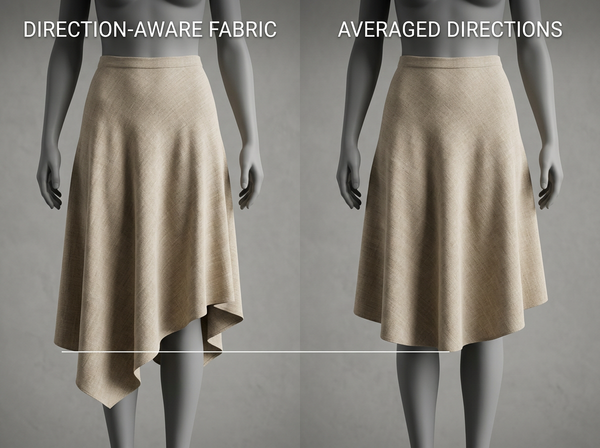
Detail helps where the garment touches the body and does little where it hangs away from it. A high-resolution surface improves collision behavior at fitted areas; it does not improve anything about a full skirt, which is governed by the fabric rather than the form underneath.
How do we know our avatar has gone out of date?
Watch for consistent one-way disagreement between simulated and physical fit at the same points of measure. Random disagreement points at the garment or the fabric data. Disagreement that always runs the same direction points at the body reference.
Where this leaves you
Find out when your avatar was last reconciled against the person your fit sessions actually run on. If nobody can answer, that is the finding.
Fabric data has a natural trigger for re-measurement — the material changes, and sourcing knows. Bodies have no such trigger, because the process that would have caught the change is the physical fitting, and the physical fitting has been quietly absorbing it all along. The avatar is the one input in a simulation that goes stale without anything going wrong.
Ask when it was last reconciled
Go find your avatar and answer three questions about it: which person it was built from, when they were measured, and what has changed since. If the file is called something like “Women’s M,” you have already learned what you needed to know. Then decide who owns the answer going forward — technical design is usually the right home, since they are the only ones positioned to notice when simulated and physical fits start disagreeing. See how avatars are built and maintained in a 3D workflow.
Written by