
Renders and Photos on the Same Product Page
A render next to a photo is not judged on its own quality. It is judged on why the two do not match. Where the mismatch lives and how to plan around it.
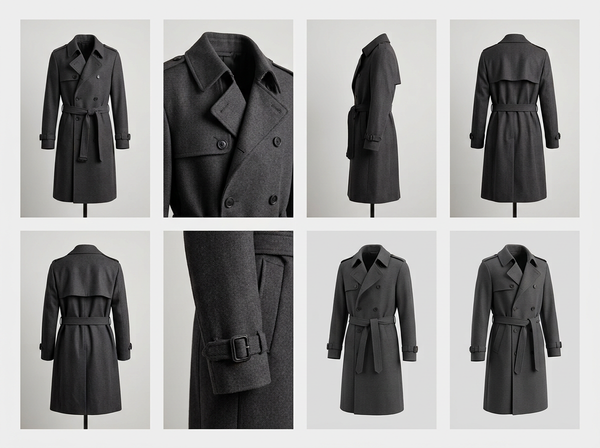
Nobody looks at a product image on its own. They look at it in a strip of thumbnails, next to five other images of the same garment, and what they are doing — without describing it this way — is checking whether the six of them agree.
That is why a render placed among photographs is not evaluated as a render. It is evaluated as a mismatch. And a mismatch does not require the render to be bad. It only requires it to be different.
Shoppers judge images against their neighbors
A single image gives a shopper very little to work with. A set gives them a lot, because the differences between images carry information: this angle shows the back, this one shows the fabric close up, this one shows it on a body.
The reading is comparative all the way down. Which means every property the images share becomes an implicit constant, and any image that breaks one of those constants gets flagged — not consciously, and not as “that one is a render,” but as a small unresolved question about the page.
The constants are things nobody lists: the same room, the same light, the same lens, the same distance from the subject, the same slight imperfections in all of them. Photography produces those constants for free, because the images came from one session. Renders produce a different set of constants, equally consistent internally, and the two sets do not overlap.
Trust flows one way
Here is the part that decides whether mixing is worth it.
When one image in a set reads as constructed, the effect does not stay contained. The photographs beside it become suspect too. A shopper who has just decided that one image is not quite real does not conclude that five images are real and one is not — they conclude that they cannot tell which are which, and they stop treating any of them as evidence.
This is the same mechanism that operates within a set of generated images, where consistency across the set carries the trust rather than the quality of any single frame. Applied across two production methods, it produces a conclusion that surprises people: a high-quality render can damage a page that a mediocre photograph would not. Quality is not the axis. Register is.
Where the mismatch actually lives
The differences are specific and catalogable, which is useful, because it means they can be worked on rather than felt about.
Property | What photography produces | What rendering tends to produce |
Perspective | Lens compression from a real focal length and distance | Geometrically correct projection unless deliberately matched |
Depth of field | Falloff that varies with distance across the frame | Uniform sharpness, or a blur applied evenly |
Light falloff | Imperfect, with spill and bounce from the room | Clean, symmetrical, from lights that have no fixtures |
Contact shadow | Dense and slightly messy where garment meets surface | Soft, even, often too small |
Micro-texture | Fiber ends, lint, pressing marks, minor fraying | Surfaces that are uniformly clean |
Color pipeline | One path through camera profile and retouching | A different path through the render engine |
Edge behavior | Hems and collars that fall as the material actually fell | Hems and collars that fall as the parameters predicted |
Read the right column and a pattern appears that connects to everything else in this series: the render’s errors are all in the direction of tidier. Cleaner surfaces, softer shadows, more even light. That direction is the reason a render reads as constructed even when it is technically excellent — real photographs of real garments carry evidence of a room and a person and a steam iron, and a render carries none of it.
The rule: give the render a job photography cannot do
The practical resolution is not to make renders indistinguishable from photographs. That is an expensive project with an unstable finish line.
It is to stop asking them to be photographs.
A render that is doing something photography obviously could not do reads as a different kind of image, and a different kind of image does not create a mismatch — it creates a section. A shopper who understands why an image looks different stops asking the question. The mismatch is only corrosive while it is unexplained.
A colorway that has not been produced yet cannot be photographed. A cutaway showing construction cannot be photographed. A size comparison across a range cannot be photographed without hiring several people. In each of those cases, the render is not a substitute for a photograph — it is the only way to answer a question the shopper actually has, and it is visibly so.
Colorways are the clearest case
Colorway galleries are where this pays back most reliably, for a reason that has nothing to do with cost.
A colorway view is not pretending to document a garment in a room. It is showing a relationship — how the same design reads in a different set of colors — and a colorway is a set of relationships rather than a set of colors. Rendered consistently across every option, the gallery answers the question better than photographs would, because photographs of nine colorways shot on different days introduce variation that has nothing to do with the colors.
The requirement is that the colorway views form their own complete set, presented as a group rather than shuffled into the main image sequence. Virtual showroom and display tools such as Style3D GoShop exist to produce sets like these, and the discipline they impose — one lighting setup, one camera, every option treated identically — is exactly what makes the group legible as a group.
The failure mode is putting one rendered colorway into the main strip alongside photographs of the primary color. That is the mismatch case again, wearing a useful job as a disguise.
If you must match, match three things first
Some pages genuinely need a render in the main sequence — a style that shipped before the shoot, a market where a colorway launched early. Matching everything is impractical; matching in the right order is not.
• Match the perspective first, because a wrong focal length is the difference people notice without being able to name, and it affects the whole silhouette rather than one region.
• Match the contact shadow second, since the point where a garment meets the floor or the body is where the eye checks whether an object is actually present.
• Match the micro-texture third, which usually means adding imperfection rather than resolution — pressing marks, slight lint, a hem that is not perfectly even.
Color and light falloff matter, and they matter less than these three, because a viewer forgives a slightly different white balance far more readily than they forgive an object that does not appear to be sitting on anything.
How to test a mixed page
Two checks, both cheap, both more reliable than asking whether the render looks good.
Build the thumbnail grid the way a customer will see it, at the size they will see it, and look at it for two seconds. Not at full resolution, not one image at a time. If one thumbnail pulls the eye at that size, it will pull the eye on the page.
Then run the neighbor test: place each image next to the one that will actually sit beside it and ask what changed between the two. Everything that changed should be something the shopper wanted changed — a different angle, a different detail. Anything that changed and was not asked for is the mismatch, and it is visible in seconds once you look for changes rather than for quality.
FAQ
Is it ever acceptable to use only renders?
An all-rendered page is internally consistent, which removes the mismatch problem entirely, and some categories run this way successfully. What it gives up is the evidence that a physical garment exists, which matters more for some products and price points than others. The choice is between two coherent options rather than between right and wrong.
Should we disclose which images are rendered?
Platform requirements vary and are changing, so the disclosure question needs checking market by market with whoever handles compliance. Setting that aside, labeling tends to help rather than hurt in exactly the case this article describes: an image that is explained stops generating the unresolved question that damages the set.
What about renders in the zoom view but photographs in the main strip?
Zoom is where micro-texture becomes visible, so it is the least forgiving place for a render. If one production method has to serve the zoom view, it should be the one that captured actual fabric.
Our renders are extremely photorealistic. Does this still apply?
Photorealism reduces the number of mismatched properties without eliminating them, and the ones that survive tend to be the structural ones — perspective, contact shadow, the absence of imperfection. Those are also the ones that read as wrongness rather than as low quality, which is why a very good render can still flag.
Can we shoot photographs to match our renders instead?
This works and is underused. Fixing the lens, the distance, and the lighting setup so that photography lands where rendering already sits removes the mismatch from the other direction, and it is often easier than moving a render engine toward a room.
How does this apply to video?
More strongly, because motion adds properties that have to agree — how the garment moves, how the camera moves, how light changes across a shot. A mixed video sequence has more constants available to break.
Where this leaves you
The question to ask about a render on a product page is not whether it looks convincing. It is what job it is doing that a photograph could not do.
If the answer is a real one — a colorway that does not exist yet, a construction detail no camera can reach — the render explains itself and the mismatch never forms. If the answer is that photography was expensive or late, the render is standing in for something, and standing in is exactly the condition under which a shopper notices, and having noticed, stops trusting the images that were real.
Look at the grid, not the image
Open one of your product pages at thumbnail size and look at the strip for two seconds without zooming. If one image pulls your eye, that is the one a customer will catch as well — and the question worth asking about it is not how to improve its quality but what job it is doing that photography could not. Renders earn their place on a page by answering something a camera cannot reach. See how a consistent image set gets built.
Written by