PLM in Apparel: A Versioning Problem, Not a Storage One
When a factory builds an outdated spec, the factory is not the problem. “Current” was never a property of the file. How to make it one.
PLM is usually bought as a place to put things. Files scattered across shared drives, inboxes, and someone’s desktop get consolidated somewhere searchable, and the pitch is that everything will finally be findable.
Findability is real and it is not where the money is. A system earns its cost by answering one question reliably, on demand, months later: which version of this is current, and who said so.
What gets bought and what actually pays back
Storage problems announce themselves. Somebody cannot find a file, they ask around, they lose an afternoon. It is visible, annoying, and easy to build a case around.
Versioning problems do not announce themselves. Nothing is missing. Everyone has a file, the file opens, the file looks complete, and the work proceeds. The problem only appears at the point where two people discover they were working from different documents — which is generally after one of them has made something.
That asymmetry is why organizations end up with excellent storage and unresolved versioning. The visible problem got solved and the expensive one was never framed as a problem.
The wrong-version failure, and why the factory is not at fault
The classic version of this: a style ships, and it is wrong. The pocket is in the old position, or a trim was substituted back, or a measurement reverted. Somebody looks at the factory.
The factory built the document they had. If that document was superseded, the supersession was communicated in some channel — an email, a call, a revised file with a slightly different name — and none of those channels made the old document stop being a valid-looking instruction. It still opens. It still has a title block. Nothing about it says do not build this.
“Current” was never a property of the file. It was a property of somebody’s memory, or of an inbox, or of an assumption that the newest attachment supersedes the older one. The default logic of email and shared drives is that the most recently sent file is the live one, and most recently sent is not the same as approved — a distinction most processes have never made explicit, because in a room full of people who all know what happened, it never needed to be.
What “current” has to mean before it can be enforced
For a system to answer the question, three things have to be true of the artifact itself.
There has to be exactly one designated version at any moment, and designation has to be an action somebody takes rather than a side effect of saving. There has to be a record of who designated it, because “approved” without a name is a rumor. And the designation has to survive copying — the moment a file can be downloaded, renamed, and forwarded with its status intact-looking but detached, the system is back to being storage.
That third condition is where most implementations quietly fail. A technical document exported to PDF and emailed to a vendor has left the system, and everything the system knew about its status stayed behind. Whatever the vendor is holding now looks exactly like an approved document, because it was one, on the day it left.
Where versions multiply fastest
Not the tech pack. The things around it.
A style is not one document; it is a family that versions independently. Colorways change on their own schedule. Size variants get adjusted after a size set. Trims get substituted when sourcing runs into availability. Factory-specific adaptations exist because one plant needs a construction the other does not. Market variants exist because a label requirement differs.
Each of those produces a document that is correct for its context and wrong everywhere else, and each of them looks like the others. This is the same multiplication problem that makes design variations easy to produce and expensive to evaluate — the cost never sits in creating the variant, it sits in knowing later which variant was the real one.
What 3D adds to the problem
A tech pack is a document. Changing it affects that document and nothing else.
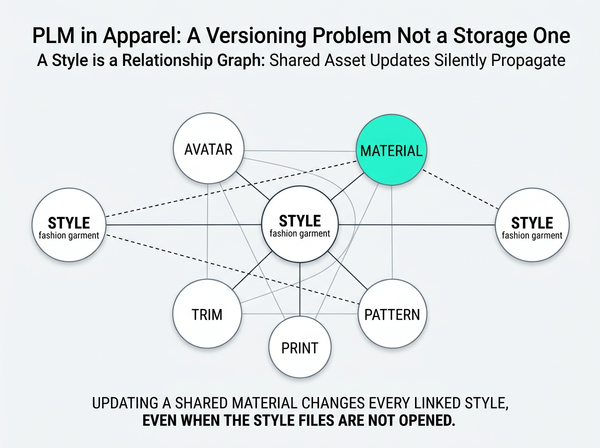
A 3D style is not a document. It is a graph: a garment that references a pattern, an avatar, one or more materials, trims, and prints. Every node in that graph has its own version and its own owner, and the garment does not contain them — it points at them.
Which produces a failure mode that has no equivalent in the document world. Update a material record — because someone re-measured it, or the mill changed, or a correction came in — and every garment referencing that material changes, silently, without anyone opening any of them. The fit that was approved last month was approved against a material that no longer exists in the library under that name. Nobody did anything wrong, no file was overwritten, and the approval is now unverifiable.
The same applies to the avatar. An updated body reference changes the meaning of every simulation built on the old one. This is why managed asset environments such as Style3D Cloud treat versions and dependencies as explicit objects rather than as folder conventions: the question “what was this approved against” has to be answerable after the underlying assets have moved on.
Who decides, and why it cannot be everybody
Designation is an act of authority, so someone has to hold it, per artifact type.
Pattern versions and fit approvals belong with technical design. Material records belong with whoever owns the supplier relationship. Colorways sit with design or merchandising depending on how the brand is organized. What matters less is where each one lands and more that each one lands somewhere nameable, because an artifact whose approver is “the team” has no approver.
The question of whether a digital artifact can carry the same authority as a physical one is a separate decision that deserves its own conversation, and most organizations have never had it explicitly — the authority just transferred by default when the workflow changed.
What to check in your own setup
This is a diagnostic, not a comparison. Pick a style that shipped last season and try to answer five questions about it.
• Which pattern version went to the factory, and can you open that exact file rather than a later one?
• Which material record was the fit approved against, and does that record still exist in the form it had then?
• Which avatar or fit reference was used, and when was it last changed?
• Who approved the final version, by name, and on what date?
• If a vendor is holding a copy of the spec right now, does anything in their copy indicate whether it is still current?
Reconstructing that should take a few minutes. If it takes an afternoon of asking people, the system in place is storage. If any of the five is unanswerable, that is not an implementation gap to fix later — it is the specific mechanism by which the wrong version eventually gets built.
FAQ
Can a shared drive with a strict naming convention do this?
It can carry the first condition — one designated version — as long as everybody follows the convention perfectly and forever. What it cannot carry is the approver’s identity or a status that survives the file being copied out. Naming conventions encode intent; they do not enforce it.
Does a small team really need PLM?
Small teams have the same versioning problem with fewer people to lose track between, which often means the problem is genuinely managed by memory for a while. The point at which it stops working is not a headcount — it is the first time an artifact outlives the person who knew its status, whether through a departure, a long gap between seasons, or an external vendor.
Where do 3D files fit — inside PLM or alongside it?
Either arrangement can work, provided the dependency relationships are represented somewhere. What does not work is a PLM holding documents and a separate asset library holding 3D, with no link between a style record and the material records its garment references. That configuration produces two systems that are each internally consistent and jointly unable to answer the approval question.
How do we handle versions that live at the vendor?
Treat every exported copy as a snapshot that begins going stale immediately, and make the export itself a recorded event — what was sent, to whom, when, and against which version. That does not stop a vendor from building an old file, and it does mean you can tell, afterward, exactly which file they had.
What should happen when a material record is corrected?
The correction should be visible to every garment referencing it, and any approval that predates the correction should be flagged rather than silently carried forward. Whether that means re-approving depends on how much the values moved, which is a judgment someone has to make with the record in front of them.
Is version history the same as versioning?
History tells you what happened, which is useful in a post-mortem. Versioning tells you what is true right now, which is what prevents the post-mortem. A system can have complete history and still be unable to say which version is current, and that combination is common.
Where this leaves you
Ask what your system does when two people disagree about which file is live.
If the answer involves checking with someone, comparing modified dates, or looking at who sent what last, the organization is running on storage and social memory. That works until it does not, and the moment it stops working is production — the one place where the cost of being wrong is a shipment rather than an afternoon. The factory will build what it was given, correctly and on time, and it will be the right answer to the wrong document.
Reconstruct one style from last season
Take a style that already shipped and try to answer five things about it: which pattern version went out, which material record the fit was approved against, which body reference was used, who approved it by name, and whether the vendor’s copy shows any status at all. Time yourself. What you learn is not whether your files are organized — it is whether “current” is a property of your artifacts or of your colleagues’ recollection. See how versions and dependencies get held explicitly.
Written by