
Reusing 3D Assets Across Seasons: The Number That Justifies the Investment
The cost of a 3D asset lands once; the value accrues per use. A method for working out your own reuse count, and which assets are worth building for it.
Arguments about whether 3D is worth it tend to run for years without resolving, and the reason is that both sides are arguing without the relevant number in front of them.
The cost of a digital asset lands once, when somebody builds it. The value accrues every time it gets used afterward. Which makes the whole question a division problem — and most organizations track the numerator carefully and have never counted the denominator at all.
The investment is per asset; the return is per use
Building a material record, an avatar, or a garment model costs what it costs, and that cost is visible. It appears on a timesheet or an invoice, once.
Uses are invisible by comparison. A material record referenced by a garment does not generate a line item. A block reused for a second style does not announce itself. So the side of the equation that determines whether any of this pays back is the side nobody has instrumented.
This is why the conversation stalls. Finance sees a cost with no measured return and concludes the return is not there. Design sees obvious usefulness and cannot express it as anything countable. Neither position is unreasonable given what each can see.
Four kinds of reuse, and teams usually count one
“Reuse” in most conversations means carryover — the same asset used again next season. That is the rarest of the four kinds and the hardest to guarantee.
Kind | What it looks like | How often it happens |
Within one style | One garment model serving fit simulation, then colorway views, then a lookbook, then product page imagery | Every time, if the asset was built for it |
Across styles, one season | One material record referenced by every style using that fabric | Often, and it scales with range width |
Across seasons | A block, an avatar, or a carried-over material used again next season | Depends entirely on whether the brand carries anything |
Across media | The same asset appearing in still imagery, video, and a virtual showroom | Increasingly common, and often uncounted |
The first two happen constantly and go unrecorded because they feel like using a file rather than reusing an asset. They are where most of the actual return sits, and they are the ones a reuse count will surface first. Within a single style, the same asset feeding a fit check and then a set of colorway variations has already been used more than once — before any question of next season arises.
Which assets reuse well, and which do not
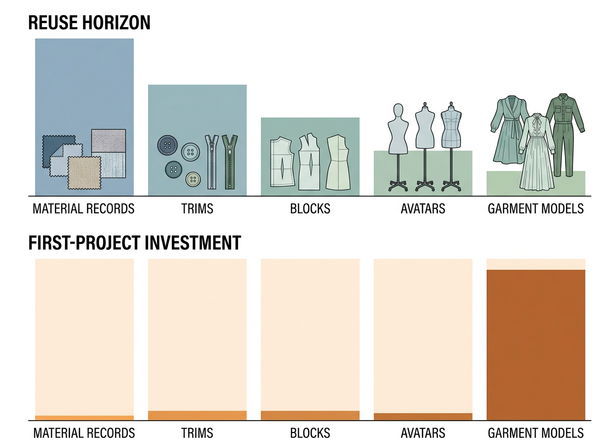
Asset type | Reuse horizon | Why |
Material records | Longest | One measurement serves every style using that fabric, this season and next |
Trims | Long | Buttons, zips, and labels recur across styles and years with little change |
Blocks and base patterns | Long, for brands that carry them | The whole point of a block is repeated use |
Avatars | Moderate, and it expires | Reusable until the body reference drifts |
Finished garment models | Shortest | A garment model is style-specific by definition |
Now put that beside what most first 3D projects actually are: a high-fidelity model of one hero style, built to prove the technology works.
That project demonstrates capability and reuses worse than anything else on the list. The asset with the longest horizon is the material record, which is unglamorous, produces nothing presentable on its own, and quietly makes every subsequent garment more accurate. Starting with measured materials instead of a hero garment inverts the usual sequence, and it is the version that produces a reuse count worth showing anyone.
Working out your own number
There is no benchmark worth quoting here, because reuse rates depend on things that vary enormously between brands — whether blocks carry, whether materials repeat, how wide the range is. What transfers is the method.
The numerator is the full cost of having the asset: creating it, measuring or scanning what it was built from, correcting it when something was wrong, and maintaining the discipline that keeps it findable. That last part is real work and usually goes uncounted.
The denominator is the count of distinct downstream uses over a window you define. Two rules keep that count honest:
• Do not count the first use. The first use pays for the physical thing it replaced, and reuse begins at the second — a team whose count is consistently one has not reused anything, it has substituted.
• Do not count uses that would have happened anyway in some other form. If a lookbook image would have been shot regardless, the asset saved a shoot rather than generating a new use, and mixing those two produces a number that flatters and misleads.
Run that on three or four assets of different types rather than on the program as a whole. An aggregate figure hides the finding that matters, which is almost always that one category reuses far better than the others.
What kills reuse
Assets decay for reasons that are mundane and almost entirely preventable.
Naming is the first. A record called “navy twill” cannot be found by someone who did not create it, and an asset nobody can find has a reuse count of zero regardless of its quality.
Season-scoped folders are the second, and they are close to universal. Filing assets by season guarantees that anything meant to carry over gets orphaned the moment the next season’s folder opens — the structure that makes assets easy to file makes long-horizon assets impossible to reuse.
Building for one output is the third. A garment modeled only to be rendered from the front, with topology and detail that hold up at that one angle, cannot serve the second use even when someone wants it to.
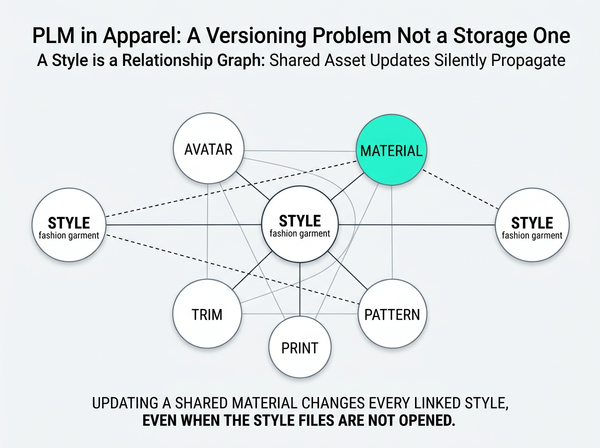
Ownerlessness is the fourth. An asset with no named owner is not maintained, and an unmaintained asset diverges from reality until somebody uses it and gets a surprise. Environments that hold ownership and version state explicitly, such as Style3D Cloud, exist to make this visible rather than to rely on a convention everyone is expected to remember.
Building for reuse costs more up front
Worth being straight about this: an asset built to be reused is a different asset, and it costs more.
It gets clean topology instead of whatever held up at the one angle it was needed for. It gets parameterized where a one-off would be hard-coded. It gets documented — what it was built from, when, by whom. It gets a neutral name rather than a project name. None of that improves the first deliverable at all.
Which means there is a real decision here, not a free lunch. If a category of asset is genuinely single-use — a garment model for a style that will never carry, made for one campaign — build it disposable and do not pay the premium. The mistake is not building disposable assets. The mistake is building disposable assets while telling the investment committee they will be reused.
Getting the organization to actually reuse what it built is a separate problem from the arithmetic, and it defeats more 3D programs than the arithmetic does.
The decision, restated
The investment case for 3D is not that it is faster than photography or sampling. Speed comparisons are contestable and depend on what is being compared.
The case is that a given asset will be used some number of times, and the cost divided by that number lands somewhere your organization can accept. Stated that way, the case is checkable — someone can go and count. Stated as speed, it is an argument.
If nobody in the organization can name the number for even one asset, the honest position is that the case has not been made yet. That is a very different situation from the case being weak.
FAQ
We do not carry blocks or materials between seasons. Does that rule out 3D?
It rules out the third kind of reuse and leaves the other three intact. Within-style and within-season reuse do not depend on carryover at all, and for a fast-moving range with wide material repetition inside a single season, the second kind alone can carry the case.
How long a window should the count cover?
Long enough to include at least one full development cycle, so that an asset gets the chance to be used at every stage it could serve. Counting over a shorter window measures how quickly an asset gets used rather than how often, which is a different question.
Should maintenance cost go in the numerator?
Yes, because it is real and it is the part that gets skipped in optimistic cases. Correcting a material record after a re-measure, updating an avatar, and keeping naming consistent all cost time that would not exist if the asset did not exist.
What if reuse happens but nobody records it?
Then the count understates the return, which is the common situation. Making uses visible does not require a tracking project — a system that shows which styles reference a given material record answers the question directly, and being able to ask it is most of the value.
Is a high reuse count always good?
A high count on an asset that has drifted from reality means an error propagated widely rather than that value accumulated. Reuse multiplies whatever the asset is, including its mistakes, which is why ownership and maintenance belong in this discussion rather than beside it.
Which asset should a team build first?
The materials used by the largest number of styles in the current range. It is the least impressive first project and the one that makes every subsequent asset better, which is exactly the profile of something with a long reuse horizon.
Where this leaves you
Pick one asset and count how many times it has been used. Not the program, not the season — one asset.
If the count is one, the organization bought a camera with extra steps, and the honest response is either to build for reuse deliberately or to stop paying the premium for assets nobody reuses. If the count is higher than anyone expected, that number is the investment case, and it was sitting in the system the whole time waiting for somebody to ask.
Count the uses of one asset
Choose a material record or a block that has been in your library for a while and find out how many distinct things reference it. Do not count the first use — that one paid for the thing it replaced. Everything after is the return, and if you cannot see the references at all, that is the finding: the number cannot be produced because nothing is tracking it. See how asset references and versions are held where they can be counted.
Written by