
Shooting a Product Page From a 3D Asset
With a 3D asset, consistency stops being something you fight for. What that gains you, what it costs, and which shots still need an actual camera.
A product page needs more than one image of the same garment. There are exactly two ways to get the second one: infer it from the first, or move a camera around an object that already exists.
Those two routes have opposite cost curves and opposite failure modes, and choosing between them is a more consequential decision than choosing between tools.
Two ways to get the second image
Inference works from what is already visible. Given a front view, a system proposes a side view — and whether that proposal is trustworthy depends on whether the side is a consequence of something the front revealed. Which angles can be inferred and which cannot is a question with a clear answer, and it has to be asked again for every new view.
The camera route works differently. The garment exists as an object with a back, an inside, and a thickness, all of which were decided when the asset was built. Getting the side view means positioning a camera at the side. Nothing is proposed, because nothing needs to be — the side was already there.
The cost profiles run opposite. Inference is cheap at the first image and stays roughly flat, since each new view costs about what the last one cost. The camera route front-loads everything into building the asset and then approaches free, because a camera position is not expensive to add.
Consistency: fought for, or structural
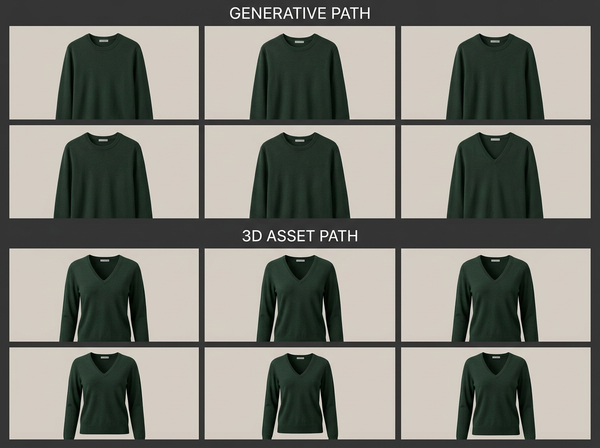
With inference, every additional view is an independent act. Errors in the third image are unrelated to errors in the second. That independence is precisely why a set of images has to be evaluated as a set — the images can each be individually plausible and collectively incoherent, and shoppers read the incoherence rather than the individual quality.
With a 3D asset, that problem does not arise. The garment in frame four is the same object as the garment in frame one, by construction. The hem is in the same place because it is the same hem. Consistency is not achieved through effort or review; it is a property of the method.
For anyone who has spent review cycles reconciling generated views, this sounds like the whole argument settled. It is worth sitting with what it actually costs.
The cost of consistent wrongness
An inconsistent set reports its own errors. A collar that renders differently in one image out of twelve is visible in a thumbnail grid — somebody notices, somebody fixes it, and the review process caught the problem it was designed to catch.
A 3D asset built with the wrong collar produces twelve images with the wrong collar, rendered identically, in perfect agreement with each other. Nothing pulls the eye. The set looks resolved because it is resolved — internally. The images corroborate each other, and they are corroborating a mistake.
What the method eliminated was not the error. It was the error’s visibility.
The practical consequence is a shift in where verification has to happen. In a generated workflow, cross-checking images against each other does real work. In a 3D workflow, that check returns nothing, because agreement is guaranteed. Verification has to move to the asset itself, checked against the physical garment, once — and once genuinely is enough, which is the compensating advantage. One careful check on the asset covers every image that will ever be framed from it.
What a product page’s shot list actually contains
Shot type | What it answers | Served by a 3D asset? |
Main image | What is this garment | Yes, once lighting and framing are set |
Additional angles | What does it look like from the side and back | Yes, and this is where the method pays most |
Detail shots | What is the construction, what is the fabric like up close | Partly — geometry yes, micro-texture is the limit |
On-model | How does it sit on a body | Yes, given an avatar that reflects a real body |
Lifestyle or context | Where would I wear this | Yes for the scene, with a caveat below |
Colorway views | What are my options | Yes, and this is the clearest case of all |
The middle of that list is where the method earns its cost. Additional angles and colorway views are the shots that multiply fastest with range width, and they are exactly the shots that require no new decisions once the asset and the camera set exist.
What still needs a camera
Zoom is the hard boundary. At the magnification where a shopper is assessing fabric, they are looking at fiber ends, weave irregularity, and the small imperfections that come from a garment having been made and pressed. Those are below the level any material record describes, and their absence reads as wrongness rather than as low quality.
Context imagery has a subtler limit. A rendered scene is unfalsifiable in a way a photograph is not — nobody was there, so nothing in the image is evidence of anything. For some categories that is fine. For others, the entire function of a lifestyle shot is to demonstrate that the garment exists in the world, and a render cannot perform that function no matter how well it is executed.
And a page that mixes both methods has its own set of problems, which are about register rather than quality and deserve handling on their own terms.
Build the rig once, not the shot
The reusable part of this workflow is not the garment. It is everything around it.
A camera set — the specific positions, focal lengths, and distances used for main, side, back, and detail — is defined once and applied to every style thereafter. So is the lighting setup. So is the framing convention that decides how much space sits above the shoulder. Virtual display environments such as Style3D GoShop exist to hold arrangements like these, and holding them is what converts a per-style effort into a per-program one.
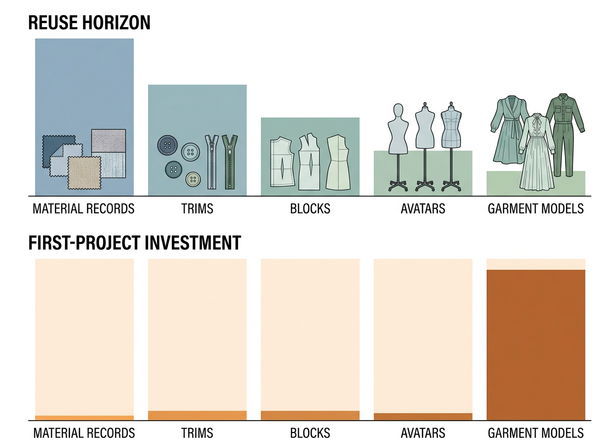
This is the same reuse logic that governs material records, applied to the studio instead of the fabric: the asset that reuses best is the one that is not style-specific. A camera set is used by every garment in the range and every garment next season, which places it at the long end of the reuse horizon and makes it worth building carefully.
How this changes the brief
A shot list written for photography is a list of setups: what to build, who to book, how long each takes. A shot list for a 3D workflow is a list of camera positions, and the difference changes who writes it and when.
It gets written once per program rather than once per shoot. It gets written by whoever owns image standards rather than negotiated with a studio each season. And it becomes a specification that can be checked — a style either has the defined frames or it does not, and that is answerable without opening a single image.
The list also stops being a budget conversation. Under photography, adding a frame to every style in a range has a cost that scales with the range, so shot lists get trimmed to what the shoot can absorb. Under a camera set, adding a frame is a decision about whether the frame is useful, which is the decision that should have been driving the list all along.
What does not change is the part before the list. Somebody still has to decide which questions the images need to answer, and no amount of camera automation supplies that. A camera set applied to the wrong shot list produces a consistent, well-lit, complete set of images that answer nothing a shopper asked.
FAQ
Can we use one asset for both fit simulation and product imagery?
That is the arrangement that makes the economics work, provided the asset was built to serve both. An asset modeled only for rendering at one angle will not hold up in a fit context, and an asset built for simulation may lack the surface detail imagery needs. Deciding both uses up front costs less than retrofitting either.
How much does lighting matter if the geometry is right?
It decides whether the garment reads as an object. Geometry determines the silhouette; light determines whether a viewer perceives volume, weight, and surface. A correct garment lit flatly reads as a diagram.
Do we still need a photographer?
The role shifts rather than disappears. Deciding framing, light, and which frames a page needs is the same skill in both media, and it is the part that does not automate. What goes away is the physical execution, not the judgment.
What happens when the garment changes after images are made?
Rebuild the asset and re-frame, which is fast, and that speed is a genuine advantage over a reshoot. The risk is that the old images stay live somewhere, so a change to the asset needs to trigger a replacement pass across everywhere the images were published.
Is there a category where this does not work well?
Anything where the material’s surface is most of the product — heavily textured knits, pile fabrics, anything with visible hand — sits closest to the limit, because those are the cases where zoom carries the purchasing decision and zoom is where rendering runs out.
How do we verify an asset before framing a whole page from it?
Against the physical garment, at the points a tech pack specifies, once. Comparing renders against each other confirms nothing, since agreement between frames is built into the method rather than earned by it.
Where this leaves you
The advantage of shooting from a 3D asset is not that images get cheaper. It is that consistency stops being work.
What comes with that is a quieter obligation. The review process that used to catch problems by comparing images against each other no longer catches anything, because the images will always agree. Every question about whether the garment is right now has to be asked once, of the asset, against something physical — and if nobody asks it, the page will be beautifully, uniformly, unanimously wrong.
Turn your shot list into a camera list
Take the images your product pages currently require and rewrite them as camera positions: where the camera sits, what it sees, why that frame exists. What survives the rewrite is what a 3D workflow can serve; what does not survive is the list of shots that need an actual room. Then verify the asset once, against the physical garment — because the images will never disagree with each other again. See how a consistent image set is produced and framed.
Written by