
Handing 3D Files to a Factory: They Still Need Flat Patterns
A 3D garment answers what shape. It says nothing about how to make it. What has to travel alongside the file before a factory can cut anything from it.
A garment that was built in 3D from real pattern pieces contains those pieces. That is the whole difference between this situation and one where a 3D model was inferred from an image — here, nothing has to be invented.
Which makes the actual problem easy to miss. The pieces are present, and they are still not what a factory can work from.
What the asset contains and what it delivers
Containing and delivering are different verbs.
A pattern piece inside a 3D environment exists as geometry — an outline, positioned relative to other pieces, joined along seam lines. That geometry is enough for the software to sew and drape it. It is not enough to cut it.
Missing from that geometry, in most cases: seam allowances, grain lines, notches, drill holes, piece names and counts, and any instruction about how the piece is meant to be cut. None of those affect the simulation, so none of them are required for the 3D garment to be correct. All of them are required for the garment to be made.
The asset answers what shape. It is silent on how to make it, and silence is not something a factory can interpret.
What a factory actually needs to receive
Item | What it is | Present in the 3D file? |
Graded pattern set | Every size in the run, as cuttable pieces | Only if grading was done there and exported |
Seam allowances | Added margin around each piece | Sometimes a parameter, not always exported |
Grain lines | The direction each piece is cut relative to the weave | Sometimes |
Notches and drill points | Alignment marks for assembly | Sometimes |
Construction callouts | Stitch types, seam finishes, order of operations | No |
Bill of materials | Every component and its quantity | No |
Points of measure | The dimensions the garment will be checked against | No |
Print and placement specs | Where artwork sits, at what scale | Partially |
Everything in the lower half of that table lives in the technical documentation, not in the model, and no export setting produces it. The 3D file does not reduce what the tech pack has to contain — if anything it raises the stakes, since a team working in 3D is more likely to assume the model communicated something it did not.
The mesh is not the pattern
Two distinct objects get conflated here, and the conflation causes real damage.
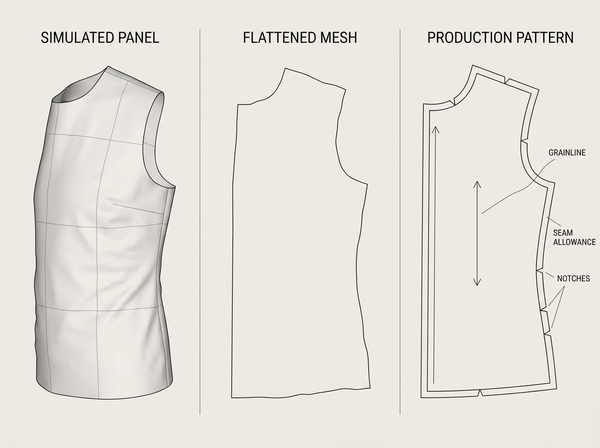
The mesh is the simulated surface — the garment as it hangs, with folds, thickness, and a shape produced by physics. The pattern is the set of two-dimensional pieces that were sewn together to generate it. One is a result; the other is an instruction.
Exporting the mesh gives a shell. It has no grain direction, because grain is a property of cloth rather than of a surface. It has no seam allowance, because allowance is a cutting decision that does not affect how the garment hangs. Its edges are where the simulation put them, not where a cutter should cut. Flattening that shell mechanically produces outlines that look approximately like pattern pieces and lack every property that makes a pattern piece usable.
A factory cannot cut a mesh, and the reason is not that the file format is wrong. It is that the information a cutter needs was never in the object.
The 3D file’s real job at the factory
None of this means the model should stay home. It means it travels in a different role than people expect.
A 3D garment is the fastest way to explain a construction. Questions that take a long call and several annotated drawings — how two panels meet at a curved seam, how a collar rolls, where a pleat originates — get answered by rotating a model. Factories with a technical team read them well, and they read them faster than they read a drawing.
So the file goes in the package as a reference, alongside the specifications, clearly marked as a reference. It is the best explanation and the worst specification. The failure mode is a package where the model is present and the specification is thin, on the assumption that anything visible in the model has been communicated.
How much value the model adds varies by who receives it. A factory with a technical team that works in 3D will open it, rotate it, and stop asking a category of question entirely. A factory without that capability will acknowledge receipt and work from the drawings, and the model contributes nothing beyond the file size. Neither situation changes what the package has to contain — it changes only how many clarifying emails follow, which is worth knowing before anyone claims the model reduced the workload.
Where grading happens, and when
3D garments are usually built and approved at one size. Grading is a separate act with its own logic, performed either inside the 3D environment or afterward in a two-dimensional pattern system.
The sequence matters more than the tool. If grading happens after the 3D fit approval, the graded sizes were never simulated — the approval covered the base size and inherited nothing about the rest of the run. That is a defensible arrangement as long as everyone knows it is the arrangement, and a dangerous one when a team believes the 3D approval covered the range.
Pattern systems that handle both the 3D garment and pattern modification with grading, such as Style3D Studio, remove the round trip between environments. What they do not remove is the decision about which sizes get checked, which remains a technical design judgment rather than a software setting.
What breaks in translation
The interesting problems are conceptual. The expensive ones are dull, and they consume days.
• Units and scale drift between systems, and a pattern that arrives at the wrong scale is usually caught, while one that arrives at a slightly wrong scale sometimes is not.
• Seam allowance conventions differ by factory and by region, so a package that assumes one convention and lands somewhere using another produces garments that are consistently and subtly wrong.
• Piece naming rarely survives export intact, and a set of pieces named by number rather than by function makes assembly guesswork for anyone who did not build them.
• Symmetry handling differs: some systems export half patterns with a fold line, others export full pieces, and a factory expecting one and receiving the other will either cut half a garment or ask a question that costs a day.
None of these are hard once someone has been bitten. All of them are invisible until someone has.
What belongs in the handoff package
The package that actually works contains four things: graded flat patterns in a format the factory’s system reads, the technical documentation with construction and measurement information, the material and trim specification, and the 3D file as reference material.
It also contains a record of which versions of each of those went out and when. An exported file has left the system that knew its status, so treating each export as a recorded snapshot is what makes it possible, months later, to establish which package the factory was actually working from.
The package should say explicitly what the 3D file is for. A single line — that it is provided for construction reference and that the patterns and specification govern — prevents the most common misunderstanding at almost no cost.
That line does something else worth having. It settles, in advance, who is responsible when the model and the specification disagree. They will disagree eventually, because they were produced at different moments by different people, and the question of which one wins is much easier to answer before a garment has been cut than after.
FAQ
If we grade inside the 3D environment, is the export enough on its own?
It covers the pattern set, which is the largest piece, and it still leaves construction callouts, the bill of materials, and points of measure to the technical documentation. Grading in 3D removes a translation step rather than removing the specification.
Can a factory work from the 3D file alone if they have 3D capability?
Some can read the file and extract pieces from it, and doing so shifts the pattern decisions onto the factory. That is a different commercial arrangement from supplying a graded pattern set, and it needs to be agreed rather than assumed — otherwise both sides believe the other one made the decisions.
What if the factory has no way to open the 3D file?
Then it contributes nothing and the package must stand without it, which is a useful test of whether the package is complete. A specification that only works when accompanied by a model was never a specification.
Does supplying a 3D file reduce the number of sample rounds?
It can compress the rounds that turn on understanding rather than on physical properties, since a model answers construction questions faster than a drawing. Rounds that check what a factory can produce with its own equipment are unaffected by how well the design was communicated.
Should the 3D file be sent at all if the patterns are complete?
Sending it is generally worth it for the questions it prevents, provided its role is stated. The cost of including it is close to zero, and the benefit is that a technician resolves an ambiguity by rotating a model instead of sending an email.
How do we know the exported pattern matches the simulated garment?
Compare defined measurements on the exported pieces against the same measurements in the simulation, before anything is sent. Export is a translation, and translations are where silent changes happen.
Where this leaves you
Open your last handoff package and ask what a cutter could do with it if the 3D file were removed.
If the answer is everything, the package is complete and the model is doing what it should — explaining, not specifying. If the answer is that something would be missing, that something was never communicated, because the model was carrying it and the model does not travel to the cutting floor. The file is the clearest thing in the package and the only thing nobody can cut.
Remove the model and see what breaks
Take the most recent package you sent to a factory, set the 3D file aside, and ask whether the remaining documents are enough to cut and assemble the garment. Where a gap appears, that is information the model was silently carrying — grain, allowance, piece naming, a construction detail everyone could see and nobody wrote down. Fix it in the specification rather than in the next email. See how patterns and grading move from 3D toward production.
Written by