
Evaluating 3D Fashion Tools: A Framework, Not a Ranking
Rankings fail here because the deciding variable is your workflow, not the tool. Five questions that discriminate between options, and how to test them.
Rankings do not survive contact with this category, and the reason is structural rather than diplomatic. The variable that decides whether a tool works is not the tool. It is the workflow it has to enter.
Two brands with opposite constraints — one carrying blocks across seasons, one starting fresh every drop; one with a pattern team in house, one buying pattern services — will rate the same options in opposite orders, correctly. A ranking that ignores that is measuring something other than fit.
Why evaluations go wrong before they start
The common failure is not a missing criterion. It is that the criteria got written after the first demo.
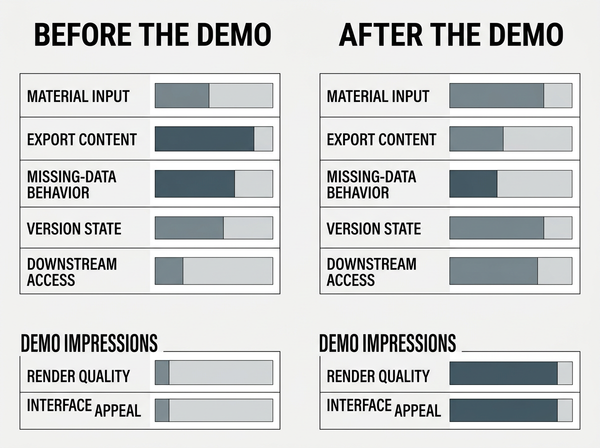
A demo is a designed experience, and its design decides what a viewer notices. Sit through a presentation that builds toward a beautifully rendered garment and the evaluation sheet that follows will contain a line for render quality, weighted heavily — not because render quality determines outcomes but because it was just seen. Everything that was not shown gets no line at all, since nobody writes an evaluation criterion for a capability they have not been reminded exists.
The order that works runs the other way. Write the criteria and the weights first, with nothing in front of you but your own process. Then look at products.
Start from the exit, not the entrance
Most evaluations open with “what can it do.” A more discriminating opening question is what has to leave.
Something always has to leave: patterns going to a factory, images going to a product page, technical documentation going to a vendor, assets going to whoever handles marketing. Value either transfers at that boundary or it dies there, and a tool that produces excellent work nobody downstream can use has produced nothing.
So the first list to write is not features. It is a list of exits: who receives what, in what form, and what they do with it. That list is specific to your organization, which is exactly why it discriminates between options in a way a feature comparison does not.
Five questions that actually separate options
• What goes in, and what happens to material data? Whether fabric parameters can be measured and imported, or whether everything runs from a preset library, determines whether simulation output can be trusted at all.
• What comes out, and in what state? Patterns with or without allowances and grain, graded or base size only, images at what resolution and color pipeline. Export state is where most disappointment originates.
• What does it do when data is missing? This is the question that separates most sharply, and it gets asked least.
• Where does version state live? If the answer is folder names and file naming conventions, the tool has no answer, and version confusion will arrive with scale rather than with time.
• Who can open the output downstream, and does it require a license? A format only readable inside the same software has not left the building, whatever the export dialog implied.
The third question deserves expanding, because the answer reveals a system’s attitude toward not knowing.
A tool can respond to a missing fabric measurement in two ways. It can flag the gap and let the result carry that flag forward, so anyone reading the output knows which parts rest on measurement and which on assumption. Or it can quietly substitute a plausible default and produce output identical in appearance to a fully measured one.
The second behavior is more pleasant and considerably more dangerous, because a simulation built on substituted values does not look like a simulation built on substituted values. Ask the question directly, and ask to see it happen rather than accepting the answer.
Test on your own material, not the demo garment
Demo assets are chosen because they perform. They are stable wovens, clean constructions, materials that simulate obediently.
Bring the opposite. A bias-cut style stresses shear data harder than anything else in a range. A fabric nobody has measured tests what the system does with absence. A style with several layers tests collision and friction handling, which is where solvers diverge most. Those three will tell you more in an afternoon than a month of feature comparison.
Bringing your own material also changes the conversation from a presentation into a working session, and the difference in what you learn is substantial. Vendors who are comfortable being tested this way are giving you information; vendors who steer back to the prepared asset are also giving you information. If measured material data is part of how the system is meant to work, ask to see the measuring step, not only the result.
What a demo structurally cannot tell you
Demos show the path that works. What determines whether a tool survives in your process is what happens on the paths that do not.
So ask to be shown something failing. Ask what a garment looks like when the fabric data is wrong. Ask what the export produces when a pattern piece has an unusual shape. Ask what happens when two people edit the same asset.
A vendor who can show you where their tool breaks is telling you something precise about where it does not. A vendor who cannot produce a failure case has either not looked or is not willing to, and both of those are findings. This is an uncomfortable request to make and it is the highest-yield question in the entire process.
There is a second thing demos cannot show, and it has no fix. A demo compresses into an hour a workflow that will take your team months to inhabit, performed by someone who has done it hundreds of times on material chosen to cooperate. Nothing about that hour predicts what the same sequence feels like on a Thursday afternoon with a difficult fabric and a deadline. The only partial substitute is talking to someone who runs the tool daily and is not being paid to recommend it, which is worth more effort to arrange than most evaluations give it.
Where the cost actually lands
License cost is the number that appears in the proposal and rarely the number that decides the outcome.
The costs that decide it are elsewhere: building the initial asset library, measuring materials, training people who have worked in two dimensions their whole careers, and the ongoing discipline of naming and maintaining assets so that they remain findable. That last one has no invoice and does not stop.
Those costs also scale differently than the license does. License cost scales with seats; asset costs scale with the range and with how much gets reused. A tool that is cheaper per seat and produces assets nobody reuses is more expensive, and the comparison that reveals this is not available in a proposal — it has to be estimated against your own reuse expectations before the decision.
Write the matrix before the first demo
Concretely: before any vendor conversation, write your exits, your five answers, and a weight for each, and have the people who will actually use the tool agree to the weights.
Then hold them. When a demo makes something look important that was not on the list, that is worth noticing rather than acting on — the reaction is evidence about the demo’s design, not about the criterion’s importance. Adding a criterion mid-process is legitimate; adding it because it was just demonstrated is how the sheet stops being yours.
Where external evidence helps most is not in vendor claims but in accounts of how other organizations actually work — case studies read against your own matrix rather than as endorsements, since the useful question is whether the described situation resembles yours.
FAQ
Is a feature comparison ever useful?
As a filter for hard requirements — a format you must produce, an integration you must have — a feature list quickly removes options that cannot work. What it cannot do is rank the remainder, because the differences that matter between viable options are behavioral rather than featural.
How long should an evaluation take?
Long enough to run your own material through each shortlisted option and to see at least one failure case. Evaluations that end after presentations end before the informative part.
Should the pattern team or the design team lead the selection?
Whoever owns the exits should lead, which usually means technical design, because they are downstream of design and upstream of production and can see both boundaries. Design leading alone tends to weight the creative experience; production leading alone tends to weight export and undervalue whether anyone will enjoy using it.
What if we have no pattern capability in house?
Then your exit list points outward, and the question becomes what your pattern service can receive and work with. That constraint is more determinative than any internal preference, and it should be established before the shortlist rather than discovered after.
How much should the interface matter?
Enough to take seriously, since a tool people avoid produces nothing regardless of capability. Not so much that it outweighs the export and data questions, since those determine whether the work has value once it exists and interface friction is at least visible immediately.
Can we evaluate properly without committing to a pilot?
A structured evaluation on your own material gets you most of the way. What a pilot adds is the organizational dimension — whether people adopt it, whether assets get maintained — which is a different question from whether the tool works and is often the one that decides the outcome.
Where this leaves you
The framework fits on one page: what has to leave, what happens to data going in, what the system does when it does not know, where version state lives, and who can open the result.
Weight those before anyone shows you anything. The demo is designed, competently, to make certain things feel important, and it will succeed unless the criteria already exist in writing. A ranking someone else produced is answering a question about their workflow. The only ranking that means anything is the one your own matrix produces.
Write your exits first
Before the next vendor call, list every exit from the system: who receives what, in what format, and what they do with it next. Then weight the five questions — data in, data out, behavior when data is missing, version state, downstream access — and get the people who will use the tool to agree on those weights. Do it before any demo, because after one the weights will have shifted and it will not feel like they did. Then read how other teams actually work and check the accounts against your matrix.
Written by