
Why 3D Adoption Stalls in Design Teams
Training does not fix a queue. Why 3D programs slow designers down before they speed anything up, and what actually clears the blockage.
The pattern repeats often enough to be diagnostic. A pilot runs well — a small group, a handful of styles, visible enthusiasm, results worth showing. The program expands to the full team, and within a season it has quietly reverted to being used for a few things by a few people.
Everyone involved reaches for the same explanations: the learning curve, resistance to change, not enough training. Those explanations have the advantage of being fixable with a budget line. They are also, in most cases, wrong.
The pilot-to-rollout pattern is the clue
A pilot has a property that is easy to overlook: it has dedicated attention. Somebody’s time was cleared. The styles were chosen. Whoever handled the pattern side was not simultaneously handling a production calendar.
The rollout removes all of that and keeps the tool. If the tool were the variable, the results would degrade gradually as more people with less aptitude joined. What actually happens is different — the results degrade at the point where the work stops having dedicated capacity, which points at capacity rather than at capability.
3D does not add a step; it moves work upstream
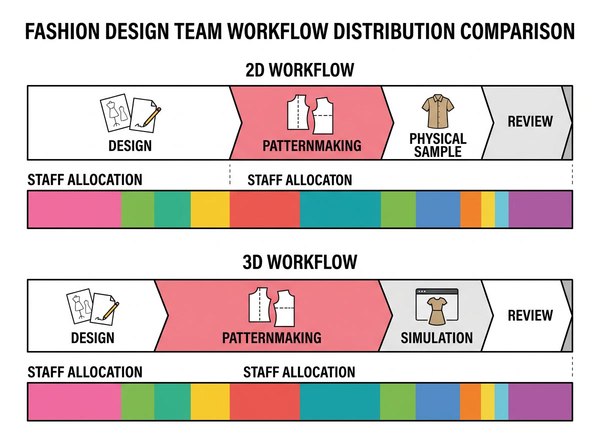
In a two-dimensional workflow the order is settled. A designer works out an idea in sketches. A patternmaker turns the agreed ideas into patterns. A sample reveals what neither of them could see. Each role receives work in a form it can act on, and the volume arriving at each stage is filtered by everything upstream of it.
In a 3D workflow, nobody can look at the garment until a pattern exists. Seeing is downstream of patterning, which reverses the order the organization is built around.
That reversal has a volume consequence that is easy to miss. Previously, only ideas that survived review became patterns. Now every idea anyone wants to see becomes a pattern first — and tools that generate a starting point from a description or a reference accelerate the front of the funnel further, which increases the number of things arriving at the pattern stage rather than reducing it.
More work, arriving earlier, at the same desk.
The role that absorbs the load
Patternmaking becomes a front-office function, and almost nobody plans for this.
The patternmaker’s queue used to contain styles that had already been through selection — a filtered, prioritized, production-bound list. Now it contains that list plus everything the design team wants to look at, and the second category has no natural limit, because looking is supposed to be cheap.
The role changes character as well as volume. Serving production means precision and finality; serving exploration means speed and provisionality, and those are different working modes with different quality bars. Systems where pattern modification and grading sit alongside the 3D garment reduce the friction of each iteration. They do not change how many iterations arrive, and they do not decide who is supposed to be doing them.
Ask a stalled 3D program where the queue is and the answer is almost always here.
The consequence lands on the designer as a change in what it costs to have an idea. Sketching was free and reversible; a sketch that turns out to be wrong costs the paper. A pattern request costs somebody else’s afternoon, and designers know it, so they self-censor. A program intended to widen exploration ends up narrowing it, and the narrowing is invisible because nobody files a record of the idea they decided not to ask about.
Who edits the pattern when the fit is wrong
There is a specific moment where two-dimensional workflows have an answer and 3D workflows often do not.
A fit issue appears. In the physical process this happens at a fitting, is recorded as a comment, and travels to the patternmaker, who makes the correction. Clear ownership, clear sequence, everybody knows their part.
In 3D the issue appears on a screen, during review, in front of the designer. They can see it precisely — better than they ever could from a fit photo. They cannot fix it, because pattern editing is not their skill. The patternmaker can fix it and is not in the meeting.
So the correction either waits for the queue, which erases the speed advantage that justified the program, or the designer attempts it, which produces patterns that simulate acceptably and do not sew. Neither outcome is a software problem, and no configuration setting addresses it. What addresses it is a decision, written down, about who edits patterns during review and how they get there.
Training does not fix a queue
Training is the standard response, and it solves the problem it is designed to solve: people who do not know how to use a tool learn how to use it.
If the constraint is that pattern work has doubled while headcount has not, a trained team hits the same constraint slightly faster. Everyone becomes more capable and the queue does not move, which produces the specific frustration common to stalled programs — people who like the tool, are competent with it, and cannot get their work through it.
Training is worth doing, and it belongs alongside a capacity decision rather than instead of one. Where structured onboarding helps most is with the second problem in this article rather than the first: it can establish who does what, which is a coordination question that training is well suited to answer and headcount is not.
What actually clears the blockage
Four moves, in rough order of how often they are the missing piece.
• Decide who edits patterns during design review, and give that person a way to be present — physically, on a call, or asynchronously with a defined turnaround.
• Put a limit on exploratory pattern requests, so that the queue has a shape. An unbounded intake is not a workflow, and designers will accept a limit far more readily than they accept unpredictability.
• Staff the pattern side for the new volume before the rollout rather than after the complaints, since the volume increase is predictable from the workflow change alone.
• Build a block library early, so that a portion of exploration starts from something that already exists rather than from zero.
The last one is where technical capability actually helps, and it is the reason a material and block library is a better first project than a hero garment.
What to watch while adopting
Adoption metrics usually count usage — logins, styles created, people trained. Usage is a lagging and misleading measure, since a program can show healthy usage while the queue behind it lengthens.
Better signals: how long a pattern request waits before someone starts it, how often a design review ends without the correction being made, and whether the number of ideas explored per style has gone up or stayed flat. That last one is the point of the whole exercise — if exploration has not increased, the organization bought a different way to do the same amount of work.
None of those require a dashboard. They require asking three people the same question every few weeks and writing down the answers.
Worth adding one qualitative check: ask designers what they wanted to look at and did not request. The answers are the clearest available measure of whether the queue is shaping the work, and they never appear in any usage report.
FAQ
Is the learning curve genuinely not a factor?
It is a real cost and a temporary one, and it affects individuals rather than the system. A team that has been working for a season is past it, which is precisely why programs that stall after a season are not stalling on skill. Treating the curve as the explanation keeps attention on the part that resolves itself.
What if our designers want to do their own patterns?
Some will, and a few will become good at it, which is a genuine solution for that subset. It is not a plan for a team, because pattern skill takes years and the ones who acquire it stop having time to design. Where this works, it works as an individual arrangement rather than as a policy.
Should we hire more patternmakers before rolling out?
Estimate the volume change first, from the workflow rather than from a vendor’s projection: count how many ideas currently get sketched versus how many get patterned, because in a 3D workflow those two numbers converge. That gap is the increase you are planning for.
Does starting from blocks solve this?
It reduces the per-request cost substantially for anything that can start from a block, which is a large share of most ranges and close to none of a creative-led collection. It is the most useful technical move available and it is not a complete answer.
Our patternmakers are resistant. How do we handle that?
Check whether the resistance is to the tool or to the role change, because they need different responses. Being asked to serve open-ended exploration with production-grade rigor and no additional time is a reasonable thing to resist, and the fix is a boundary on intake rather than persuasion.
How long before a rollout should show results?
Long enough for the pattern queue to reach steady state, which is the thing to watch rather than the calendar. A program measured on usage will look healthy before it is; a program measured on wait time shows the truth immediately.
Where this leaves you
Ask where the pattern queue is and how long things sit in it. That single question separates programs that are working from programs that are about to stop.
The uncomfortable part is that the answer has nothing to do with the software, which means it cannot be resolved by the people who chose it or fixed by the people who sold it. Work moved to the front of the process and the organization stayed the shape it was. Until somebody adjusts the shape, more training and better tools will keep arriving at the same bottleneck.
Find the queue
Ask two questions this week. How long does an exploratory pattern request wait before someone starts on it, and what happens in a design review when a fit issue appears and the person who can fix it is not in the room. The answers will tell you whether your program is limited by skill or by capacity — and if it is capacity, no amount of tooling addresses it. See what structured rollout support covers beyond software training.
Written by