
What a Garment Digital Twin Would Actually Have to Contain
Apparel already has something that behaves like a digital twin. It is not the garment model. Where the real correspondence exists and why it matters.
The term arrived in apparel from industrial manufacturing, and it brought a specific promise with it. In its original setting, a digital twin is fed by sensors on one particular machine and exists to answer questions about that machine — how it is running now, when it will need service, what happened during last Tuesday’s fault.
Garments have no sensors. Most of them do not persist as identifiable objects anywhere in a system after they leave a warehouse. Something has to give when the word travels, and what usually gives is the definition.
A definition you can test
Here is a version that can be checked rather than asserted.
A digital twin is a model that can answer a question about one specific physical object, without going to that object, and be right.
Three properties follow from it. The model refers to an identified physical thing rather than to a category of things. It was built from measurement of that thing rather than from intention about it. And it stays in correspondence as the physical thing changes, which means somebody maintains it.
Most objects called garment twins fail the first property before the other two become relevant. They refer to a design. A design is a specification — genuinely useful, the backbone of everything in this series — and a specification describes what should be true of many objects that do not exist yet. That is close to the opposite of what a twin does.
Three levels, and the industry means the first
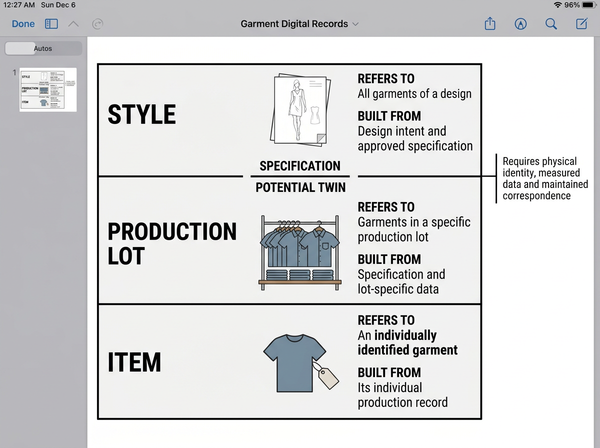
Level | What it refers to | Built from | Is it a twin? |
Style | A design, applying to every unit ever produced | Intent, then approved specification | No — this is a specification |
Production lot | One run, from one factory, one material lot | Specification plus lot-specific data | Possibly, if lot data is captured |
Item | One garment, individually identified | Production record for that unit | Yes, and almost nobody has this |
The style level is where nearly every conversation about garment twins actually sits. A 3D garment produced during development — the output of a design process — is a specification with excellent visual fidelity, and calling it a twin borrows credibility from a definition it does not satisfy.
The item level is what traceability requirements in some markets are moving toward, and what those regimes ask for is covered separately. What matters here is only that the item level is a different object from the style level, and that a program built for one does not deliver the other.
What a twin needs that a 3D model does not have
• Identity — a link to one physical object or lot, not to a style number that covers thousands of units.
• Provenance — which factory, which material lot, which date, which operator conditions, recorded at production rather than reconstructed later.
• As-made data — measurements taken from the produced garment, not the values it was designed to have.
• A maintenance path — a defined trigger and owner for updating the record when the physical thing changes.
The first two are recordkeeping problems rather than modeling problems, which is why environments that hold identity and version state explicitly are closer to the foundation of a twin than any rendering capability is. The third is the one nobody does.
The as-designed and as-made gap
A 3D garment describes the garment as designed. The garment that arrives is the garment as made, and the two differ in ways that are entirely normal and completely uncaptured.
The material came from a dye lot with its own color and its own hand. It shrank during finishing by some amount specific to that run. Operators sewed it with the tension their machines were set to that week. Fusing behaved according to the temperature and dwell of a particular press. None of this is error — it is what production is — and none of it exists in the model.
A model that never gets corrected after production is a plan. It was a good plan, it may have been an accurate plan, and it is describing a garment that was going to be made rather than one that was. The correction step is what would turn it into a twin, and the correction step is the part no workflow currently includes.
This is the same principle that governs verification everywhere in a digital workflow: the physical object is the reference, and a model that is only ever checked against other models has not been checked.
Apparel already has one — at the wrong level to be exciting
The material record satisfies all three properties, and it does so today.
It refers to a specific material rather than to a category. It is built from measurement — weight, thickness, stretch, bending taken from the actual cloth, which is what fabric digitization produces. And it has a maintenance trigger: when the mill changes or a quality is reworked, the material is re-measured and the record is updated.
That is a twin, by the definition above. It is unglamorous, it produces nothing presentable, and it is where the correspondence between digital and physical in apparel is actually strongest.
Which suggests a more useful way to think about the whole idea. The question is not whether a brand can build garment twins. It is at which level correspondence with physical reality is worth maintaining, and for most organizations the answer is the material level, because that is where a single record serves many decisions and where the physical thing is stable enough to be worth measuring.
Why the word travelled anyway
Worth asking why a term with such a specific meaning got adopted so loosely, because the answer is not carelessness.
The industrial version of the idea solves a problem apparel genuinely has. Somebody wants to know something about produced goods — how a fabric performed, whether a construction held, why returns cluster on one size — and the only way to find out is to physically retrieve garments and examine them. A model that could answer those questions without the retrieval would be worth a great deal. The appetite is real, and the word names the appetite well.
What arrived instead was a technology that produces convincing garments early in development, which is a different and also valuable thing. The vocabulary attached itself to the available technology rather than to the unmet need, and once a word has done that it becomes very hard to recover, because everybody using it is now describing something they actually have.
The practical cost is that the original need goes unnamed. An organization that believes it has twins stops looking for a way to learn about produced goods, since the box on the roadmap is marked complete.
What to do with the word
Two questions settle most conversations.
Which physical object does this refer to? If the answer is a style rather than a lot or a unit, it is a specification. That is not a criticism — specifications are what get things made — but it means the twin vocabulary is doing rhetorical work rather than descriptive work.
What happens to it when the physical object changes? If nothing happens, if there is no trigger and no owner, then correspondence exists only at the moment of creation and degrades from there without any signal.
A model that fails both questions is still valuable. It simulates, it communicates, it produces imagery, it carries a specification to a factory. The problem only appears when an organization budgets for correspondence and receives representation, then makes decisions as though it had the first.
The cheapest correction is a vocabulary one. Call the development model a specification or a digital sample, reserve the twin vocabulary for records that maintain correspondence with something physical, and the roadmap conversation becomes accurate without anything technical changing.
FAQ
Is calling a 3D garment a digital twin actually harmful?
It becomes harmful at the point where someone relies on correspondence that was never established — using a development model to answer a question about produced goods, for instance. Until then it is imprecise rather than damaging, and the imprecision is worth removing because it makes the genuinely useful cases harder to see.
Could a production lot twin be built today?
The pieces mostly exist: lot-specific material data, factory records, and measurements from production samples. What is missing is the practice of writing production reality back into the digital record, since every current workflow moves information in one direction only.
What would item-level twins require?
Individual identification carried on or with each unit and a record that persists after the garment leaves the supply chain. That is an infrastructure question rather than a design tool question, and it is being driven by traceability requirements rather than by product development needs.
Does this mean 3D development models are less valuable than claimed?
They are exactly as valuable as they have been in this series — for simulation, communication, imagery, and specification. What they are not is a record of any object that exists. Those are different kinds of value and only one of them is called a twin.
Where does the tech pack sit in this framing?
Firmly at the style level, as the specification a twin would eventually be compared against. A twin without a specification to compare to would be a set of measurements with nothing to say.
If we wanted to start building correspondence, where?
Materials, because the record serves every style using that fabric and because the physical thing is stable enough that measuring it pays back repeatedly. Starting at the garment level means building a record per style that will be superseded next season.
Where this leaves you
Ask which physical object the model refers to. That question does more work than any definition.
Apparel’s real digital twin is a fabric record sitting in a library, doing nothing photogenic, staying in correspondence with a roll of cloth because somebody re-measures it when the mill changes. The garment models are specifications, and specifications are what the industry runs on. The word is only a problem when it is used to claim a correspondence that nobody built and nobody maintains.
Ask the two questions
Next time something in your organization is described as a digital twin, ask which physical object it refers to and what happens to it when that object changes. If the answers are a style number and nothing, you are holding a specification — which is useful, and is not what you budgeted for if you budgeted for a twin. Then look at where correspondence is actually worth maintaining. See how identity and version state get held against real assets.
Written by