
3D Clothing File Formats: What Each One Drops
An export is a translation, and translations lose things without saying so. What to verify after every 3D garment export, and why the seams go first.
An export is a translation. Translations lose things, and file formats lose them without saying so — no warning, no error, just a file that opens correctly and contains less than it did a moment ago.
Knowing which things go missing in which direction is the difference between an export that works and one that appears to.
What a garment consists of, informationally
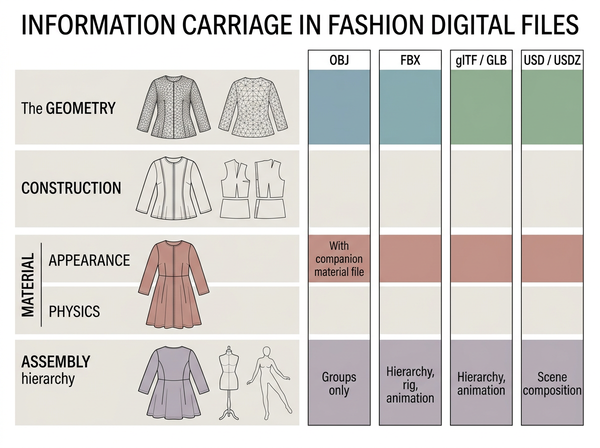
Four distinct layers of information sit inside a 3D garment, and they travel independently.
Geometry is the mesh — the surface the garment settled into after simulation. Construction is the set of pattern pieces and the seam relationships that joined them. Material is both appearance (color, texture, surface maps) and physical behavior (weight, bending, stretch). Assembly is everything about the arrangement: hierarchy, which avatar, what pose, how layers stack.
Most people think of the file as containing “the garment.” It contains some subset of those four, and the subset changes with every export dialog.
Environments built around pattern-based garment creation, such as Atelier, hold all four while the work is happening. The question is what survives when the work leaves.
General 3D formats carry the result, not the construction
Format | Geometry | Material appearance | Material physics | Construction | Assembly |
OBJ | Yes | Via a companion material file | No | No | Groups only |
FBX | Yes | Yes | No | No | Hierarchy, rig, animation |
glTF / GLB | Yes | Yes, physically based | No | No | Hierarchy, animation |
USD / USDZ | Yes | Yes | No | No | Strong scene composition |
Alembic | Yes, often baked per frame | Limited | No | No | Baked, not editable |
Two columns are empty all the way down, and that is the finding.
None of these formats was designed for apparel. They serve rendering, games, and film pipelines, where nobody needs to know how a surface was sewn because nothing is going to be sewn. Asking one of them to carry seam relationships is asking it to do a job it was never given.
The two things almost nothing preserves
Seam relationships go first. In the authoring environment, an edge belongs to a pattern piece and is joined to a specific other edge. In the exported mesh, that same location is a fold in a continuous surface with no record that two pieces meet there. The information is not compressed or approximated. It is absent.
Fabric physics never travels. Weight, bending, shear, and friction — the measured properties that determine how the garment hangs — have no field in any general 3D format. What travels is the shape those properties produced, frozen. Open the exported file in another system and re-simulate it and you will get a different garment, because the receiving system will apply its own defaults.
This second point catches people who assume a round trip is lossless. A garment exported and reimported looks identical while it is not being simulated, and diverges the moment anything moves.
Where the apparel-specific formats live
Pattern exchange is the one place the industry has its own conventions, and they work.
A DXF in the AAMA or ASTM convention carries piece outlines, internal lines, grainlines, and notches — the properties that make a piece cuttable rather than merely shaped. This is the route patterns take between CAD systems, between brands and factories, and into 3D environments.
It also contains the cleanest example of silent loss available. Grade rules do not live in the DXF. They live in a companion file, conventionally with a .rul extension, which has to travel alongside and be imported with it in order to generate the other sizes.
Send the DXF alone and the recipient receives a complete, valid, openable set of pattern pieces in one size, with no indication that grading information ever existed. Nothing is corrupt. Nothing warns anyone, and nobody on the receiving end has any reason to ask. The grading intent simply is not in the package, and it will be noticed when somebody needs a size that is not the base.
Material exchange has its own emerging conventions in apparel, aimed at carrying appearance and physical properties together rather than appearance alone. These are worth asking about specifically, because they are the only route by which measured fabric data reaches another system.
Why the gap has not closed
The obvious question is why, after years of 3D in apparel, no general format carries construction. It is worth answering, because the answer determines whether waiting is a strategy.
Formats are shaped by the pipelines that fund them. The general 3D formats exist because film, games, and web delivery needed them, and those industries are large, coordinated, and share a common requirement: get a surface from one tool to another and render it. Apparel construction is not on that list and never will be, because nobody outside apparel needs it.
Which means the information will keep living in two places — pattern data in apparel-specific conventions, surfaces in general ones — and packages will keep needing both. Efforts to unify pattern interchange into a single modern standard are underway, and they address the pattern side rather than the seam-to-mesh relationship that general formats drop.
The practical reading is that this is a permanent condition to design around rather than a temporary gap to wait out. Build the habit of sending two things, and stop expecting one file to be the garment.
Choose the format from the destination backwards
The common question is what to export as. The useful question is what the receiving system reads and what the recipient will do next.
• A factory or pattern room needs pattern exchange, in the convention their CAD expects, with the companion grade rule file.
• A rendering pipeline needs geometry with good material appearance, and does not care about construction.
• A web viewer needs a runtime delivery format sized for download, where compression matters more than fidelity.
• A film or game pipeline needs hierarchy and animation support, and will re-author materials regardless of what arrives.
Matching the destination rather than picking on principle also settles the convention question inside pattern exchange, where the right answer is whichever flavor the receiving CAD expects rather than whichever is more widely documented.
What to verify after every export
Verification takes minutes and is skipped almost universally, because the file opened and looked right.
Check the scale first, against a known dimension on a known piece. Unit mismatch is the most common single failure in pattern exchange, and a file that arrives at slightly the wrong scale is far more dangerous than one that arrives at obviously the wrong scale.
Then check that companion files traveled. Grade rules, material definitions, and texture maps all live outside the primary file in various formats, and a package assembled by dragging one file into an email is a package missing whatever the primary file merely referenced.
Then re-import into a clean environment rather than the one that made it. Reimporting into the authoring system frequently succeeds because that system fills gaps from what it already knows, which is precisely the confirmation bias a verification step exists to avoid.
Do this once per export path rather than once per file. A path that has been verified — this system, this format, these settings, to that recipient — can be trusted until something in it changes, and the thing that changes is usually a software update on the receiving end that nobody announced.
FAQ
Why not just send the native project file?
Because it requires the recipient to run the same software, which turns a file transfer into a licensing conversation. Native formats preserve everything and travel worst, which is the trade every exchange format exists to manage.
Is there a format that carries seam relationships?
Native project formats do, and apparel-specific exchange conventions handle the pattern side. Among the general 3D formats used for rendering and games, none does, and the reason is that the pipelines those formats serve have no use for the information.
Does re-importing a mesh give me back an editable garment?
It gives back a surface. Whether the receiving system can turn that surface back into pieces depends on the system rather than the file, and any such reconstruction is inference rather than recovery — the boundaries were not recorded.
What is the safest format to archive a garment in?
The native project file for completeness, plus a pattern exchange export for the construction, plus a general format for anyone who only needs to look at it. Archiving one format means choosing which future question you will be unable to answer.
How much does the export setting matter within one format?
Enough that two exports in the same format from the same file can differ substantially — triangulation, units, texture handling, and whether companion files are written are all settings. Recording the export settings alongside the file makes a package reproducible.
Should the technical documentation reference the file format?
Yes, naming the format, the convention, and the units. Recipients open what they are sent using their own defaults, and a stated unit is the cheapest possible prevention for the most common failure.
Where this leaves you
Do one round trip before you rely on any export path. Send a garment out, bring it back into a system that knows nothing about it, and compare.
What comes back is what the format actually carries, which is usually less than the export dialog implied and always less than the authoring environment held. The gap is not a defect in the formats — they carry what they were built to carry. It becomes a problem only when somebody assumes the file is the garment, and the file is the part of the garment that happened to fit through.
Run one round trip
Export a garment you know well, then import it into an environment that has never seen it — not the system that created it, which will quietly fill gaps from what it already has. Compare what arrives against what you sent: seams, material behavior, scale, and whether every companion file made the journey. Whatever is missing is what has been silently missing from every export you have sent so far. See how garments are built and held before anything leaves.
Written by