
Approving a Digital Sample Instead of a Physical One
Approving the garment and approving the substitution are two decisions, and they get made as one. What the second decision needs before anyone can rely on it.
Somewhere in the transition to digital sampling, a decision got made that nobody remembers making. A round that used to require a physical garment started being signed off from a screen, and the process continued without interruption.
Ask who authorized that and the answers get vague quickly. Not because anyone did anything improper — because the question was never posed. Authority did not get granted. It transferred, by default, attached to a workflow change that looked like a tooling decision.
Two decisions, made as one
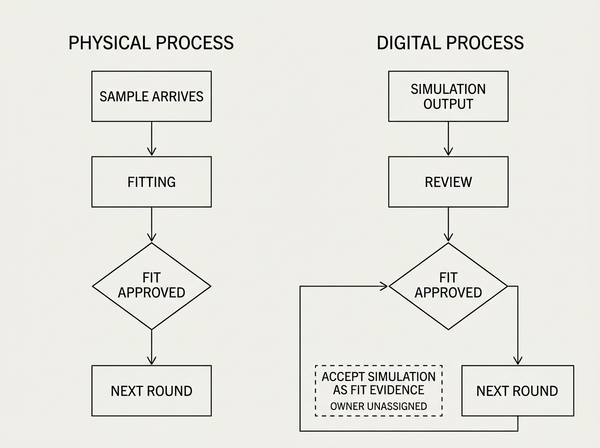
When a technical designer approves fit from a simulation, they are making a judgment they are qualified to make: this garment sits correctly on this body. That decision has an owner, a basis, and a professional standing behind it.
Underneath it sits a second decision that is rarely visible. Somebody has accepted that a simulated fit counts as evidence of fit. That is a different judgment, about the reliability of a method rather than about a garment, and it is usually not made by the person making the first one — it is inherited from the fact that the meeting was scheduled and the render was on the screen.
The two collapse into a single act, and the risk sits almost entirely in the second one. A technical designer reading a simulation can be entirely correct about what they see and still be looking at an output whose reliability nobody assessed for this particular garment, in this particular fabric, at this stage.
How authority transferred without being granted
Physical approval authority was implicit, and it worked, because the artifact was stable. A sample was a sample. Anyone who had approved one had approved the same category of thing as everyone else who had ever approved one, and the shared understanding of what an approval meant needed no documentation.
When the artifact changed, that shared understanding did not get renegotiated. The same people kept approving, in the same meetings, with the same words in the same fields. What changed was the evidence underneath, and evidence is exactly the thing an approval is about.
This is why the gap is so hard to notice from inside. Nothing looks different. The process is running, the approvals are happening, the fields are populated. The only thing missing is any record that anybody decided the new evidence was sufficient.
It is worth separating this from incompetence or corner-cutting, because the people involved are usually doing their jobs carefully. The failure is structural: a workflow change was introduced through a tooling decision, and tooling decisions do not come with a prompt asking who now holds which authority. Nobody skipped a step. The step was never in the process to begin with.
What a substitution decision actually needs
Four things, and none of them are onerous.
• A stated basis — why this garment, this fabric, and this round are considered safe to approve digitally. One sentence is enough, and writing it forces the reasoning to exist.
• A named decider — the person accountable for the substitution, who may or may not be the person approving the garment.
• A record of what the approval was made against — which asset versions, since the material record and the avatar can both change afterward.
• A fallback trigger — the condition under which this style reverts to physical approval, defined before anyone is under deadline pressure.
The third one is the least intuitive and the most useful later. An approval made against a material record that has since been re-measured is not an approval of anything currently in the library, and that fact is invisible unless it was recorded at the time.
Risk is not uniform, so the decision should not be blanket
The most common failure in policy here is treating substitution as a yes-or-no organizational stance. It is a per-case judgment, and the conditions that shift it are known.
Condition | Lower risk | Higher risk |
Fabric data | Preset library or estimated | |
Construction | Carryover block, familiar assembly | New construction, unfamiliar seaming |
Garment type | Stable woven, simple structure | Bias cut, high-stretch knit, tailored with fusing |
Avatar | Reconciled recently against the fit model | Unknown age, or built from a size chart |
Round | Early fit iteration | Final fit before production commitment |
A style sitting in the left column across every row is a reasonable candidate for digital approval. A style sitting in the right column on three rows is not, and the useful part of the table is that it makes the answer arguable with reference to something rather than settled by whoever feels strongest.
What the record has to say
“Approved” is not enough, and the reason becomes clear when you consider the question that actually arrives later.
Nobody comes back and asks whether a style was approved. They ask what it was approved against — when a garment arrives wrong, when a factory queries a measurement, when the same style is carried over and somebody wants to know whether the fit work can be reused.
A record that answers that question names the versions: this material record, this avatar, this pattern version, on this date, by this person, on this basis. Environments that hold asset versions and their relationships explicitly make this a matter of capturing state rather than of writing prose, and Style3D Cloud is one place that state can live. Where it lives matters less than that it exists.
Without it, an approval is a timestamp attached to a claim nobody can reconstruct.
When it goes wrong, nobody can tell why
Here is the consequence that makes this worth doing, and it is not the one people expect.
The risk of digital approval is usually described as producing a bad garment. That happens, and it is recoverable — garments get corrected, rounds get added, costs get absorbed. The more damaging outcome is quieter: when a digitally approved style comes out wrong, the failure cannot be assigned.
Was the simulation inaccurate? Was the fabric data estimated? Was this a garment type that should never have been approved digitally in the first place? With no record of the basis, all three remain possible, and the organization settles on whichever explanation is most comfortable — usually that the tool is not ready yet.
A process whose failures cannot be attributed cannot improve. The same substitution will be made next season, because nothing on record says it should not have been made this one. That is the real cost, and it compounds silently.
There is a second-order effect worth naming. Attributed failures build confidence as reliably as successes do — a team that knows why something went wrong knows what it can still trust. Unattributed failures do the opposite: they spread doubt evenly across the whole method, so one bad outcome makes people warier of digital approval in general rather than warier of the specific condition that caused it. That is how a program that is working in most cases gets quietly rolled back.
Writing the policy without stopping the work
The version that works is narrow and specific rather than comprehensive.
Name the cases where digital approval is permitted — a short list of conditions, drawn from the table above — and let physical approval be the default for everything else. A permission list is easier to write, easier to check, and easier to expand than a prohibition list, which has to anticipate every case that has not happened yet.
Then review the list each season with the outcomes in front of you. Styles approved digitally that arrived correct are evidence for widening it. Styles that did not are evidence for narrowing it, and the review is only possible because the basis was recorded at the time.
The point of the policy is not caution. It is that the decision becomes visible, arguable, and improvable, which it cannot be while it is being made by default.
FAQ
Should the same person approve the garment and the substitution?
They can be, provided both are recorded as separate judgments. Combining them into one signature is what created the gap; combining them in one person is fine as long as the second judgment is written down and can be questioned independently.
Does this slow the process down?
One sentence of stated basis at approval time is the entire overhead. What slows a process down is the reconstruction work that happens later when something arrives wrong and nobody can establish what was known at approval.
What if we have been doing this for years without a policy?
Then the policy is documenting current practice rather than changing it, which is a much easier conversation. Start by writing down what is already being approved digitally and what basis people believe they are using; the disagreements that surface in that exercise are the finding.
Who should own the substitution decision?
Whoever would be accountable for the consequence, which is normally technical design for fit and production for manufacturability. What matters more than the placement is that it is a named role rather than a committee, since a substitution approved by a group is approved by nobody.
How does this apply when a customer or licensor has approval rights?
External approvers usually have contractual language written around physical samples, so substituting a digital one may change what has been agreed. That belongs in a conversation with whoever handles the agreement rather than being decided inside the workflow.
What is the minimum viable version of this?
A field on the approval record with three items: approved digitally yes or no, on what basis, against which asset versions. Everything else in this article is refinement on those three.
Where this leaves you
Pull one digital approval from the last season and see whether it says what it was approved against.
If it says only that the style was approved, the record is a timestamp. Somebody decided a simulation was sufficient evidence for that garment, in that fabric, at that stage — and that decision, which carried all of the risk, left no trace. It is still being made, on every style, by nobody in particular, and it will keep being made until someone writes it down and puts a name on it.
Check what the record says it was approved against
Open a digital approval from last season and look for three things: whether it was flagged as a digital approval, what basis was stated, and which asset versions it was made against. If the record only carries a date and a name, the substitution decision is invisible — which means it cannot be questioned, learned from, or defended when a garment arrives wrong. See how asset versions and their relationships get held so an approval can point at something.
Written by