Tech Pack Templates: Why Most of Them Don’t Survive Contact With a Factory
A points of measure list says what to measure and rarely how. Which fields cannot be generic, and how to test a template before a factory does it for you.
A template looks like an empty container. It is not. It is a record of decisions somebody else already made — about their category, their supply chain, and what their factory could be trusted to know without being told.
Download one, fill it in, and you have inherited all of that silently. Most of the time it works, because the assumptions were reasonable and yours are similar. The trouble is concentrated in the places where they are not, and those places do not announce themselves.
What you inherit when you adopt a template
Every field in a template exists because somebody once needed it. Every field that is absent is absent because somebody once did not.
A template written for knitwear will have nothing useful to say about interfacing. One written around a long-standing relationship with a single factory will omit whatever that factory always got right. One written for a domestic supply chain will assume a shared vocabulary that stops working the moment a package crosses a border.
None of this makes templates bad. A template that captures what technical documentation has to carry is far better than a blank page, and starting from one saves genuine work. It is worth knowing that the thing you are starting from is an argument rather than a container.
Blank fields do not read as blank
Here is the mechanism that does most of the damage.
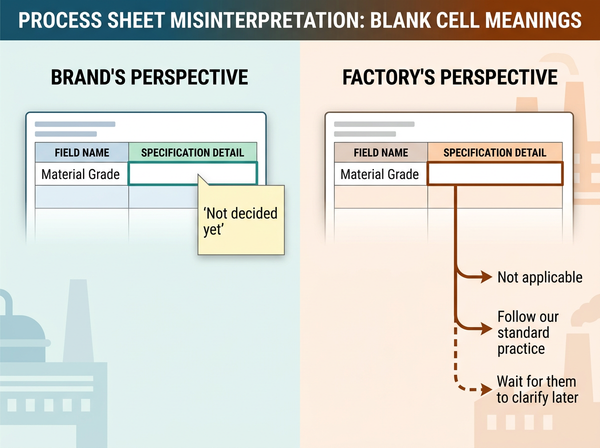
At the sending end, an empty field means “we have not decided this yet.” That meaning is obvious to the person looking at the document, because they know what they have and have not settled.
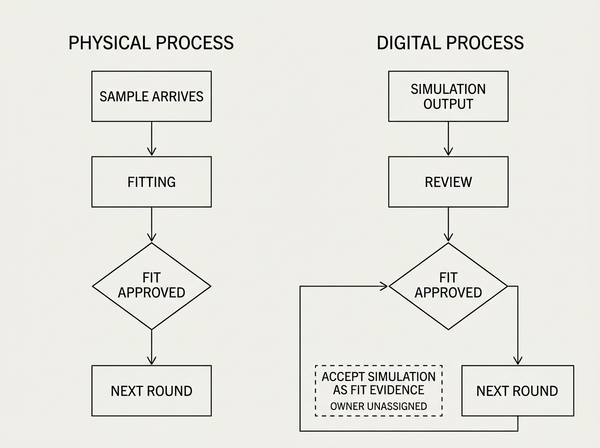
At the receiving end, that same empty field gets read as one of three things: this does not apply to this garment, this follows our standard practice, or they will tell us later. “Undecided” is not among them. A factory looking at a blank does not see an open question — it sees a field that has already been resolved by omission, and the resolution is whatever their default is.
The third reading is the most dangerous because it appears to be a safety net and is not. “They will tell us later” only triggers a question if somebody actively wonders about it, and a blank in a familiar form does not prompt wondering. The garment gets made, correctly, according to a decision nobody made deliberately.
Worth being clear that this is not carelessness on the factory’s part. A form arrives, the form has fields, some fields have values and some do not — and interpreting that pattern is a reasonable thing to do rather than a lapse. The factory is reading the document the way documents are meant to be read. The document is just saying something its author did not intend it to say.
The fields that cannot be generic
Field | Why it varies | What a generic template produces |
Seam allowance convention | Differs by factory, region, and garment type | Consistent, invisible dimensional drift |
Stitch and seam codes | Coding systems and internal shorthand differ | Correct-looking codes interpreted differently |
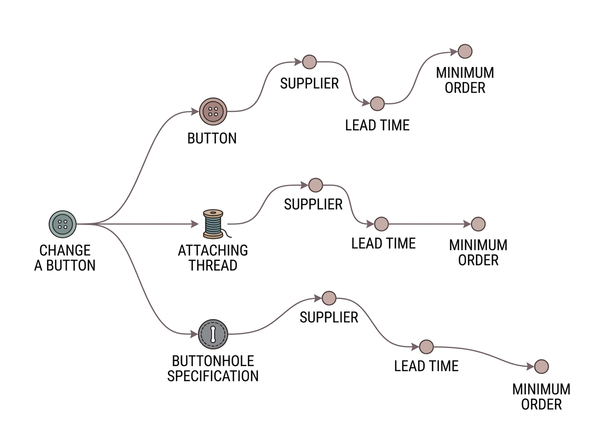
Trim sourcing responsibility | Who buys what varies per relationship | Trims nobody ordered, or ordered twice |
Tolerance convention | Whether tolerance is symmetric, and against what | Garments rejected or accepted on different bases |
Measurement method | How to measure, not only what | Two parties measuring correctly and disagreeing |
Material identification | Mill codes and quality names are not universal | The right fabric family, the wrong quality |
The material row has a straightforward fix, which is to reference a material record rather than a description. “Navy twill” is a category; a specific measured material is a thing. The rest require the template to be adapted rather than adopted.
A points of measure list says what, not how
This deserves its own section because it produces the most expensive category of disagreement: two competent people, measuring carefully, getting different numbers.
A measurement instruction like “chest” is underspecified in several directions at once. Measured at what height below the armhole. Laid flat and doubled, or measured around. With the garment relaxed or smoothed. Buttoned or open. Each of those choices is defensible and each produces a different figure, and a template that names the measurement without defining the method has handed the definition to whoever is holding the tape.
The consequence arrives at quality inspection, where a garment fails against a spec it actually meets, or passes one it does not. Reconciling that costs a round of communication and sometimes a shipment, and it is entirely preventable with a method definition that most templates simply do not have a place for.
Where a template does include measurement diagrams, check whether the diagrams define method or only location. Location is the easier half.
Write it from the receiving end
Most templates are authored from the brand side. They are organized around what the brand knows and wants to record, which is a reasonable way to build a form and the wrong way to build an instruction.
Rewritten from the receiving end, the organizing question changes: what does this factory need to be told in order to make this garment without asking? That list is different in composition and different in emphasis. It contains things the brand considers obvious. It omits things the brand finds important and the factory does not need.
The practical version of this is not a redesign project. It is to take one recently completed style, list every question the factory asked during production, and check whether the template had a field for each one. Questions asked repeatedly across styles are missing fields. Questions asked once are usually style-specific and belong in a note rather than in the template.
Version the template, not just the tech pack
Ask most organizations for their current template and the honest answer is that it is whatever the last person’s file was.
Templates propagate by copy-paste. Somebody duplicates the last style, clears the values, and starts filling. Any adaptation made for that previous style — an added field, a removed row, a changed unit — travels forward, and any improvement made in a parallel copy does not. Within a few seasons there are several templates in circulation, all called the template, differing in ways nobody has recorded.
The fix is unglamorous: the template is an artifact with a version and an owner, held somewhere that makes the current one identifiable rather than reconstructable. Environments that hold version state explicitly, as Style3D Cloud does for assets, apply to the template as much as to anything it produces.
How to test a template before a factory does
Give it to somebody who has never made this garment and watch what they ask.
Every question is a field that is missing, ambiguous, or in the wrong place. Questions are more informative than review comments, because a reviewer reads what is there and a maker notices what is not. Someone experienced but unfamiliar with your styles is the ideal tester, since they will not fill gaps from knowledge of your habits.
Run this once a season on one style. It takes an afternoon and it produces a specific list of changes rather than a general sense that the template could be better.
The same test works in reverse and is cheaper still: keep a running note of what factories ask across a season. Questions repeat, and repetition is the signal. A question asked about three different styles is not three misunderstandings — it is one missing field, appearing three times, and it will keep appearing until somebody treats it as a template problem rather than as an email to answer.
FAQ
Should we use a downloadable template or build our own?
Start from a downloadable one, because the blank page problem is real and a template at least tells you what categories of information exist. Then adapt it against your own factory questions rather than treating it as finished. The mistake is adoption without adaptation, not adoption.
How many templates should a brand have?
Enough that each one covers a group of garments with genuinely similar construction requirements, which usually means a small number by product type rather than one universal template. A single template covering everything will have many fields that are irrelevant to most styles, and irrelevant fields train people to skip fields.
What should go in a field that genuinely has not been decided yet?
Something explicit — a marker meaning undecided, with a name and a date attached. The goal is to make the blank readable as a blank, since that is precisely what an empty cell fails to do.
Does a 3D garment reduce what the template needs to contain?
It changes which questions get asked rather than how many fields are needed. Construction becomes easier to understand from a model, and none of the conventions, responsibilities, or measurement methods in the table above exist inside one.
Who should own the template?
Technical design, because they sit at the boundary and see both what the brand intends and what the factory asks. Ownership matters mostly for keeping one current version rather than for authorship, which benefits from more voices.
How do we handle a factory that has its own required format?
Fill theirs, and keep your own as the internal source of record so that nothing is lost when a style moves to a different supplier. Transcribing into a partner’s format is work; losing your own structure to it is a much larger cost later.
Where this leaves you
Open your most recent tech pack and count the empty fields. Then, for each one, ask which of the three readings a factory would apply.
That exercise takes minutes and usually produces at least one uncomfortable answer, because most empty fields are not deliberately empty — they are fields nobody knew how to fill, in a template nobody wrote for this garment. The document is not silent about them. It is saying something specific, and it is saying it on your behalf, to somebody who is about to cut fabric.
Count the blanks and read them from the other end
Take your last completed tech pack, count the empty fields, and for each one decide which reading a factory would apply: not applicable, our standard practice, or they will tell us later. Any field where you would not accept the factory’s default is a field that needed a value or an explicit undecided marker. That list is the specific, finite set of changes your template needs. See what technical documentation has to carry before it reaches production.
→ https://www.style3d.ai/ai-fashion-design/extract-technical-drawing
Written by