The Apparel Bill of Materials: Where Cost Actually Lives
The BOM is the only document where a design becomes a number. Which lines are counted, which are consumed, and why fabric cost is a design output.
Every other part of the technical documentation describes the garment. The bill of materials prices it.
That makes it the one place where a design stops being an idea with a feeling attached and becomes a number that somebody either accepts or does not. It is also the document most likely to be treated as an administrative task, filled in late by whoever has time, which is a strange fate for the only page in the set that determines whether the style is viable.
The one place a design becomes a number
A sketch communicates intent. A technical drawing communicates construction. Measurements communicate fit. None of them commit to anything commercially.
The BOM does. Once every component is listed with a quantity and a source, the style has a cost, and the cost can be compared against a target. That comparison is the first genuinely falsifiable statement anyone has made about the design — before it, opinions; after it, arithmetic.
Which is why an incomplete BOM is worse than a late one. A BOM missing components produces a cost that is confidently wrong in a specific direction: too low. Decisions get made against it, and the correction arrives when the missing items surface in production, at which point the style is committed.
Two kinds of line, with opposite behavior
Line type | Examples | What determines quantity | How it fails |
Counted | Buttons, zips, labels, hangtags | Construction — the design says how many | Wrong count, easy to catch |
Consumed | Fabric, interlining, thread, elastic | Efficiency — how much gets used per garment | Wrong consumption, hard to catch |
Counted lines are straightforward. A garment has the number of buttons it has, somebody counts them, and an error is visible to anyone who looks at the drawing.
Consumed lines are where the money moves and where estimates hide. Consumption is not a property of the design in any direct sense — it is a property of how efficiently the pieces fit together when laid out for cutting, which is downstream of the pattern, which is downstream of the design.
Fabric cost is a design output, not a sourcing input
This is the sentence that changes who is responsible.
Fabric consumption per garment depends on how the pattern pieces nest when laid out, and that nesting is determined by the shapes of the pieces. Asymmetry, unusual grain requirements, large one-piece panels, and directional prints all change how much cloth a garment eats, and all of them are design decisions made long before anyone lays out a marker.
Sourcing does not set this number. Sourcing negotiates the price per meter; the design decides how many meters. Treating fabric cost as a sourcing outcome puts the accountability in a department that can move one of the two variables and not the other.
The practical version is that consumption should be estimated early, at the point where the silhouette is still negotiable, rather than confirmed late when the only remaining lever is price. And the material line should identify a specific measured material rather than a description, because a fabric family has a price range and a specific quality has a price.
There is a design conversation buried in this that rarely happens explicitly. Two silhouettes that look similarly ambitious can consume noticeably different amounts of cloth, and a designer who knows which one is which can make that trade deliberately rather than discovering it as a costing problem. What blocks the conversation is not unwillingness — it is that consumption gets calculated after the design is settled, so the information arrives when it can only be received as bad news.
One button, three lines
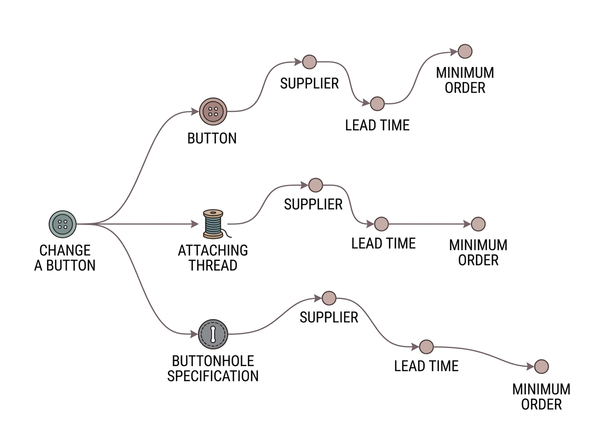
Change a button and three things move.
The button itself is the visible one — new component, new supplier possibly, new price. The thread that attaches it may need to change if the color no longer matches, which is a different supplier with a different minimum. And the buttonhole specification changes with the button’s diameter and thickness, which affects the buttonhole setting and sometimes the interlining under the placket.
Each of those has its own lead time and its own minimum order quantity. From the design side this reads as one small change. From the sourcing side it is three separate replenishment paths running at different speeds, and the slowest one sets the date.
This is the general shape of BOM changes rather than a special case. Components in a garment are coupled — by color, by size, by construction — and the coupling is invisible in a document that lists them as independent rows.
Which suggests something a BOM could carry and almost never does: a note on each line recording what else moves if this line changes. It does not have to be rigorous. Even an informal marker on the coupled lines converts a late surprise into a question asked at the moment of the request, which is the only point where the change is still cheap.
What most bills of materials leave out
• Consumption allowance. Cutting waste, shrinkage, and defect loss mean the fabric ordered is not the fabric in the garments, and a BOM that lists finished consumption understates the purchase.
• Secondary items. Thread, care and content labels, polybags, hangtags, hangers, and cartons are real costs that get omitted because they feel like packaging rather than materials.
• A responsibility column. Whether the brand or the factory sources each item is a commercial arrangement, and a BOM without it produces items ordered twice or not at all.
• Placement or usage notes. Where a trim is used matters when the same component appears in two positions with different specifications.
The responsibility column is the one worth adding first. It costs nothing, it prevents a category of error that is expensive and embarrassing, and its absence is almost universal.
A BOM belongs to a colorway, not a style
Colorways are usually treated as a variation on a style, which works for the design conversation and breaks in the BOM.
Change the colorway and the thread color changes. The zip tape changes. Labels may change if they carry color-specific information, and packaging sometimes changes. What does not change is the construction — which is exactly why the style-level documents can be shared and the BOM cannot.
Since a colorway is a set of relationships rather than a set of colors, each one carries its own component set and its own cost, and two colorways of the same style can price differently for reasons nobody anticipated. Organizations that maintain one BOM per style discover this when the second colorway goes into production and the components do not reconcile.
When it freezes, and who owns it
A BOM has to be provisional early, because components are still being decided, and it has to freeze before production, because ordering happens against it.
The moment between those two states is where ownership matters. Product development usually builds the initial version, sourcing corrects it as suppliers are confirmed, and costing reads it. What is often missing is a named person accountable for the version that goes to production being the version everyone believes it is.
The freeze should be an event with a date and a name attached, not a gradual settling. After it, changes become change orders with visible consequences rather than edits to a shared file — which is the only mechanism that makes the coupling described earlier apparent to the person requesting the change.
FAQ
How early can a BOM be built?
A skeleton can exist as soon as the construction is decided, with components named generically and quantities estimated. That version is useful precisely because it is early — it surfaces the cost shape while the design is still adjustable, which is the only window where the expensive lines can actually be changed.
Should the BOM live in the tech pack or separately?
It has to be reachable from the tech pack, and it changes on a different schedule from everything around it. Keeping it as a linked object rather than an embedded page avoids the situation where a package is reissued because one trim supplier changed.
Who should own consumption estimates?
Whoever can produce them from the pattern, which usually means the pattern room rather than sourcing. Estimates produced by anyone else are working from the drawing rather than from the pieces, and the pieces are what determine the answer.
What level of detail is too much?
Detail stops paying when a line describes something nobody orders separately. Thread is ordered and belongs in the BOM; the number of stitches is a construction specification and belongs elsewhere.
How do we handle components that vary by size?
List them per size where they genuinely differ, since zip lengths and elastic quantities commonly do. A single figure across a size run either overstates the small sizes or understates the large ones, and the error scales with the size curve.
What happens to the BOM after production?
It becomes the record of what was actually used, which is worth updating with substitutions that occurred. A BOM that reflects intent rather than outcome cannot answer questions about a shipment months later, and those are the questions that eventually get asked.
Where this leaves you
Open your last BOM and check three things: whether secondary items are listed, whether a responsibility column exists, and whether it is maintained per colorway.
Most bills of materials fail at least one of those, and each failure produces the same kind of error — a cost that looks settled and is not. The document is doing the only job in the whole package that finance will read, and it is usually the one assembled last, by whoever was available, from a template written for a different garment.
Check three things on your last BOM
Pull the most recent bill of materials you sent to production and look for three specifics: are the secondary items there — thread, labels, polybags, hangtags — does a column say who is buying each line, and does the document exist once per colorway rather than once per style. Any missing item is a cost that is currently invisible and will become visible at an inconvenient moment. See what technical documentation has to carry before it reaches production.
→ https://www.style3d.ai/ai-fashion-design/extract-technical-drawing
Written by