
Grading Rules: The Data No Generated Image Carries
Some measurements grow with the size run and some refuse to. Where grading errors appear first, and why the rule cannot be recovered from the garment.
A garment image shows one size. Whatever else it contains — construction, drape, proportion, styling — it contains nothing about how the next size differs, because that information was never in the garment it depicts.
This matters more than it used to, because images are now produced in ways that make them feel like they could contain more than they do.
Grading is a set of decisions, not a scaling operation
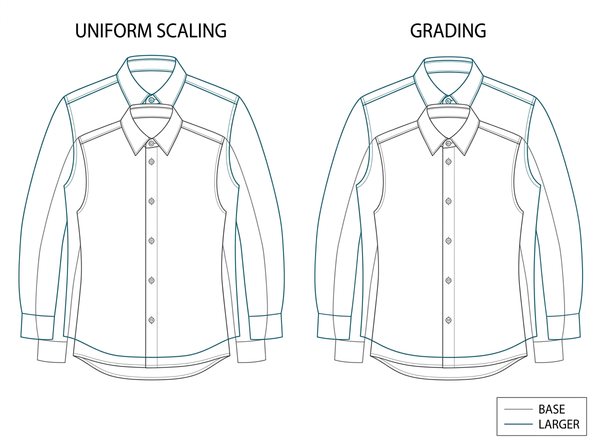
Scaling multiplies every dimension by the same figure. Grading does not, and the difference is the entire subject.
Bodies do not get larger uniformly. A larger person is not a smaller person photographed closer, and a garment that fits them is not the smaller garment enlarged. Somebody has to decide how much each dimension changes between one size and the next, and those decisions encode a view about how the brand’s customers are shaped across the range.
Those decisions live in a grade rule table, which is part of the technical documentation rather than a property of any pattern piece. The pattern is one size. The rules are what turn it into a range.
Which measurements grow, and which refuse to
Behavior | Examples | Why |
Grows with the range | Chest, waist, hip, sleeve length | These track body dimensions directly |
Grows slightly | Neck, armhole depth, shoulder width | These change far less across bodies than girth does |
Does not grow | Button diameter, collar point length, pocket opening in many styles | These are design constants, not body-dependent |
The third row is where uniform scaling betrays itself. Enlarge a garment proportionally and the buttons get bigger, the collar points lengthen, and the pockets grow — and the result reads as a costume rather than as a larger garment, because a customer’s hands and buttons and eyes did not scale.
The second row is subtler and causes more real problems. Necks and armholes change slowly across a size range while chests change quickly, so a rule that treats them alike produces a garment that fits at the chest and gapes at the neck, or vice versa at the other end of the run.
Why a generated image contains none of this
An image is of one garment, and a generated image is of one plausible garment. Neither carries a rule, because a rule is a statement about differences and a single garment has only values.
The tempting workaround is to generate an image of a larger size. What that produces is a larger garment — a coherent, well-proportioned, entirely plausible larger garment that corresponds to no decision your brand ever made. The model has no access to your grade rules. What it has is an average of how garments generally look at larger sizes, drawn from everything it learned, which is a different brand’s answer to a question you answered differently.
This is a boundary rather than a defect, and it sits alongside the other boundaries in generated product imagery: images communicate appearance well and carry no engineering. Using one to show a size is fine when the image is illustrating rather than specifying. It stops being fine at the point where somebody downstream treats the image as a description of the graded garment.
Where grading errors appear first
Not at the extremes, which is where most people look.
The errors surface where a proportion crosses a threshold, and there are three places this reliably happens. The armhole, where depth and width interact and a rule that is generous in one and stingy in the other produces binding that the wearer feels immediately. The crotch on trousers, where rise and inseam are graded separately and a mismatch changes where the garment sits rather than how large it is. The shoulder, where a small error tilts everything hanging below it.
What makes these hard to catch is that they do not present as sizing problems. The garment is not too big or too small — it has become a slightly different garment at that size, and the fitting comment that comes back describes a style issue rather than a grade issue.
That misdiagnosis has a cost beyond the individual style. A comment recorded as a fit problem gets corrected on that pattern, at that size, and the underlying rule stays as it was. The next style using the same block reproduces the same behavior, gets the same comment, and receives the same local correction. A grading fault can survive several seasons this way, being fixed repeatedly and never once addressed.
Grading is a fit promise, not only engineering
Two brands can share a base pattern and grade it differently, and they will fit different people. That is not a technical footnote; it is one of the more durable things a brand owns.
A customer who has learned that a brand fits them has learned something about the grade rules, whether or not anyone has told them that. When the rules change — quietly, during a supplier transition or a system migration — the brand has changed a promise it made without announcing it, and the feedback arrives as returns rather than as complaints about grading.
Which argues for treating grade rules as a controlled document with an owner, rather than as a setting inside whatever system happens to hold the patterns.
It also argues for reviewing them deliberately rather than only when something breaks. Customer bodies shift over time, and so do the markets a brand sells into; a rule set built for one customer profile can quietly stop matching the people currently buying. Nothing in the process surfaces that, because every individual garment continues to be made exactly as specified.
The rule cannot be recovered from the result
Measure a produced garment carefully and you will have that garment’s measurements. You will not have the rule.
A rule is about increments, and increments require at least two sizes to observe. Even with two, what you recover is the difference between those two sizes, which equals the rule only if the grading was applied uniformly across the run and nobody made a manual adjustment anywhere — and manual adjustments at the ends of a range are common enough that the assumption usually fails exactly where it matters.
The same applies to a mesh, a photograph, or a digital garment. All of them are results. The rule is upstream of all of them and does not travel with any of them.
What to check in your own grade rules
• Confirm they exist as a document rather than only as a setting inside a pattern file, since a setting is invisible to everyone who does not open that file in that software.
• Confirm they travel with the patterns, since grade rules are commonly held in a companion file that has to be sent alongside and frequently is not.
• Confirm someone owns them, so that a change is a decision rather than a side effect of a system migration.
• Confirm the ends of the run have been checked against real bodies rather than assumed to follow from the middle.
Systems that handle pattern modification and grading together reduce the round trips involved, and Style3D Studio is one of them. What no system decides for you is what the increments should be, which remains a judgment about your customers.
FAQ
Can grade rules be derived from a size chart?
A size chart describes bodies; grade rules describe how the garment changes between sizes, which includes ease decisions that the chart does not contain. The chart constrains the rules without determining them, and two brands working from the same chart will still grade differently.
How many sizes should be physically checked?
The base size and both ends of the run, at minimum, because the ends are where a rule that behaves reasonably in the middle stops behaving reasonably. Checking only the middle confirms the pattern rather than the grading.
Do knits need grading rules if the fabric stretches?
Yes, and stretch makes the rules harder rather than unnecessary. Stretch varies by direction and recovers differently at different tensions, so a rule that assumes the fabric will absorb an increment is making an assumption about the material that should be verified rather than relied upon.
What happens to grading when a range is extended?
Extending a range past its original ends usually requires new rules rather than continuing the existing increments, because proportions that changed linearly across the original run stop doing so. Treating an extension as more of the same is the most common way extended ranges go wrong.
Should grading be done in 2D or 3D?
Either can hold the rules; what matters is that the rules are recorded and that the graded sizes get checked rather than assumed. Grading inside a 3D environment removes a translation step and does not remove the judgment about increments.
Who should own the grade rules?
Technical design, as the function accountable for fit across the range. The important part is that it is a named owner rather than a system default, since the failure mode is a change nobody decided to make.
Where this leaves you
Ask where your grade rules are written down and who last changed them.
If the answer is that they live inside a pattern file, or that they came with a block acquired years ago and nobody has revisited them, then the range is fitting your customers according to decisions no one currently in the building has made. Images will not tell you this — every image you have is of one size, and it looks correct, because it is correct about the only size it depicts.
Find your grade rules and read them
Locate the grade rule table for a style currently in production and answer three things: does it exist as a document you can open without the pattern software, does it travel with the patterns when they go out, and does anyone own it. If the rules are a setting inside a file that one person opens, the fit of your entire range depends on a decision that is neither visible nor reviewable. See how patterns and grading are held together in one place.
Written by