
Digital Samples: Which Rounds They Replace and Which They Never Will
Digital samples replace some sample rounds and not others. Here is which questions each round settles, and why the last one still needs a physical garment.
“3D replaces samples” is the sentence that sells the software and the sentence that gets teams into trouble. It is not wrong. It is unfinished. Samples come in rounds, each round exists to settle a different question, and whether a digital version can settle that question depends entirely on what the question is about.
Some rounds ask about the garment. Those move to digital well. Some rounds ask about the people and materials that will produce the garment. Those do not move at all, and the reason has nothing to do with how good the software gets.
What each round is actually for
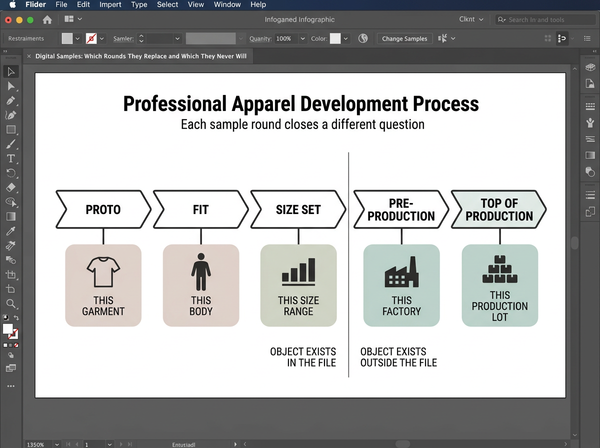
Sampling looks like a sequence of increasingly correct garments. It is better understood as a sequence of increasingly specific questions.
Round | The question it settles | Who has to be satisfied |
Proto | Does this design work as a garment at all? | Design |
Fit | Does it sit correctly on the body it is cut for? | Technical design |
Size set | Does the grading hold across the range? | Technical design and production |
Pre-production | Can this factory make it to this spec? | Production and the factory |
Top of production | Does bulk match what was approved? | Quality and sourcing |
Read down that right-hand column and the pattern appears. The first three rounds are about a garment. The last two are about a supplier and a shipment. That distinction, not the maturity of any simulation engine, is what determines which rounds can go digital.
The rounds that genuinely move
The proto round is the clearest case. Its question is whether the idea reads as a garment — whether the proportions hold, whether the design lines land where they were drawn, whether the silhouette is what the sketch promised. That question is answered by a shape, and a shape is what a simulation produces. Teams that move design proposals into a digital form at this stage stop paying for physical protos of ideas that were never going to survive the first review.
Early fit iteration moves partly. Gross errors — an armhole that binds, ease distributed to the wrong places, a hem that hits at an unintended point — surface in simulation reliably enough to fix before anything is cut. What does not move is the last increment of fit, which is a different problem and gets its own section below.
Showroom and salesman samples move furthest of all, and this is where digital sampling usually pays back first. Their question is “will a buyer order this,” which is a question about presentation. A digital garment answers it without a garment existing, and it answers it for the whole range rather than for the styles that made the sampling budget.
The rounds that do not move, and why it is not a software problem
The pre-production sample asks whether this factory, with its machines and its operators, can produce this garment to this specification. Nothing about your pattern answers that. You can simulate the garment perfectly and still learn nothing about whether the plant’s bartack settings will hold on that fabric weight, or whether a particular seam is achievable on the equipment actually installed. The question is about somebody else’s floor.
The top-of-production sample asks whether bulk matches what was approved. Bulk fabric is not sample yardage. Dye lots shift. Hand changes between mill runs. A simulation built on measured data from a sample cut describes that cut, and the shipment arriving in eight weeks is a different material with the same name.
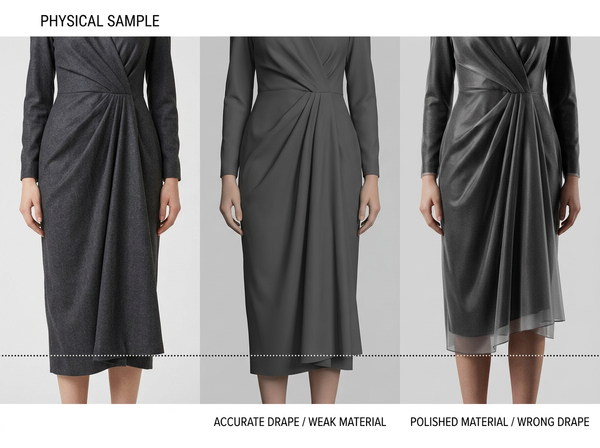
Final fit sits in the same category, for a subtler reason. What the last fit sample checks is not geometry. It is how the garment behaves after being worn — whether a knit recovers, whether a lining twists, whether the collar still sits after the piece has been on a body for an hour. Those behaviors are not currently captured by any parameter set. They are not hard to simulate; they are not being simulated, because nobody measures them.
The round that gets dropped by accident
Teams that move proto and early fit to digital often let size set go quietly along with them. The reasoning is that grading is parametric, so the sizes must be correct if the base is correct.
Grading rules are decisions, not derivations. Somebody chose how much to add at the chest and how little at the neck, and those choices encode a view about how bodies change across a range. A garment simulated on one avatar carries no information about any of it. The simulation is correct for the size it was run at and silent about every other size. Grading intent lives in the technical documentation, and a digital garment does not replace that document — it depends on it.
Size set is also the round where a grading error is cheapest to catch. Discovering it at top of production means discovering it across a shipment.
What changes when a round goes digital
Moving a round changes the artifact under review from an object to a file, and the review has to change with it.
Physical review is tolerant of vague language because everyone is holding the same thing. “A bit tight through here” works when a hand is on the garment. Sent as a comment on a render, that sentence produces a guess. Digital rounds require comments bound to points of measure, which is a discipline most fit sessions have never needed.
Version control stops being optional too. A physical round produces one garment; a digital round can produce twenty variants in an afternoon, and the question of which one was approved becomes real. Digital sampling depends on somewhere to hold assets with an unambiguous approved state — this is what asset platforms like Style3D Cloud exist to do, and skipping that layer is how a team ends up producing a version nobody signed off on.
Counting rounds is the wrong metric
The common way to report value here is a count: we used to build five samples, now we build two. The number is easy to say and it measures the wrong thing.
Removing a round at the end of the process saves shipping and a couple of weeks. Removing a round at the front changes what gets developed at all, because the styles that never justified a physical proto can now be explored. Two rounds removed at different ends of the sequence are not equivalent, and a count treats them as if they were.
The better question is how early the expensive decisions move. If digital sampling lets a range be reviewed and cut down before any physical commitment, the saving is not the samples — it is the styles that never entered development. If it only compresses the tail, the gain is real but small, and it will not justify the setup.
A count is also less useful than a division of labor, which at least names what closes each round out.
Round | Digital or physical | What closes it out |
Proto | Digital | Design agreement on proportion and line |
Early fit | Digital, with measured fabric data | Simulated measurements at defined points |
Final fit | Physical | Garment worn, then measured and assessed |
Size set | Either, given documented grading rules | Measurements across the run |
Pre-production | Physical | Factory produces to spec on its own equipment |
Top of production | Physical | Bulk compared against the approved sample |
The pattern is consistent: rounds whose subject exists inside your files can go digital, and rounds whose subject exists outside them cannot.
What has to be true before you drop a round
Dropping a round is a commitment that a digital artifact will carry the same evidential weight the physical one carried. Four things have to hold before that is safe:
• The fabric data has to be measured rather than borrowed from a preset library, because everything the simulation concludes about drape follows from those inputs.
• The avatar has to be built from the body the garment is actually cut for, not from a generic size chart.
• The grading rules have to exist as a document, so the size run is described somewhere other than in one person’s head.
• Someone has to hold explicit authority to approve a digital sample, and that authority has to be written down rather than assumed.
Miss any of the four and the round has not been replaced. It has been skipped, and the difference shows up later.
FAQ
Can a digital sample ever replace the pre-production sample?
Not as long as the question that round asks is about the factory rather than the garment. A simulation describes your pattern and your material; it says nothing about the equipment, operators, or process conditions at a specific plant. A factory could share verified capability data, but that is a different mechanism than simulating the garment.
We already skip the size set. Is that a problem?
It is the round most often dropped and the one where a mistake is most expensive to find late. Grading errors do not show up on a single simulated size, and by top of production they exist across the whole shipment. If the size set is going away, the grading rules need to be documented and checked with more care, not less.
How accurate does a digital sample need to be before we can approve fit from it?
Accurate enough that a measurement taken on the simulated garment matches the same measurement on a physical one within your normal tolerance. That is a verifiable standard, unlike “looks right.” Until a team has run that comparison on its own materials, it does not know where its digital samples stand.
Does moving to digital sampling change what the tech pack has to contain?
It raises the stakes on the parts that were already required. Points of measure, grading rules, and construction callouts become the only channel through which intent reaches production, since there is no physical object traveling alongside them to fill the gaps.
Which round should a team convert first?
Showroom and salesman samples, usually. They are high in volume, their question is presentational rather than technical, and getting them wrong costs an order rather than a production run. Proto follows naturally once the material library is in place.
What should we do with the time a removed round frees up?
Put it in front of the process rather than at the end. The value of removing early rounds comes from reviewing more options before committing, and a team that removes a round and keeps its range fixed has bought a schedule saving instead of a better range.
Where this leaves you
Ask of each round: is this question about my garment, or about somebody else’s factory and somebody else’s dye lot?
That single question sorts the sequence more reliably than any capability list. Rounds pointed inward can move to digital as fast as your fabric data and your documentation allow. Rounds pointed outward stay physical, not because the tools are immature but because they were never asking about the thing the tools describe. The last sample is not a limitation of the software. It is a different question.
Map your rounds before you cut any
Take your current sampling sequence and write, next to each round, the one question it settles and who has to be satisfied by the answer. Rounds whose subject lives inside your own files are candidates for conversion. Rounds whose subject is a factory or a shipment are not, however good the render looks. That single page will tell you more about where 3D pays back than any capability comparison. See how digital garments are built and reviewed end to end.
Written by