
3D Garment Simulation: The Render Is Not the Hard Part
A 3D garment simulation is only as accurate as the fabric data behind it. Learn which inputs decide the drape and how to verify a simulated fit.
Every 3D garment demo opens the same way. A dress appears on an avatar, the light catches the hem, the fabric settles into folds that look like fabric. The room reacts to the image. Somebody asks how long it took to render.
That is the wrong question, and asking it is how teams end up trusting a digital garment they should not have trusted. The render is a presentation layer. It decides how a shape is lit and textured. It does not decide the shape. And the shape is the part someone downstream will approve a fit against.
What a simulation computes, and the two ways it fails
A garment simulation takes pattern pieces, joins them along seam lines, and resolves the forces acting on that assembly against a body. Gravity pulls. The fabric resists in some directions and gives in others. Contact with the body and with other layers pushes back. The solver runs until the arrangement stops moving, and what it settles into is a shape.
Rendering happens after. Materials, lights, and camera are applied to a shape that has already been decided. Change the shader and the garment looks different. Change the fabric parameters and the garment is different — the hem falls somewhere else, the folds start in different places, the shoulder either collapses or holds.
Two separate systems, two separate failure modes, one screen showing you the combined result. A team looking at a bad image usually says the same thing — it doesn’t look right — and that sentence covers two problems with completely different costs.
Symptom | Where it originates | How to tell | What it costs |
Fabric reads as plastic or wax | Render — shader and lighting | Rotate the light. The problem moves with it | Embarrassment in a presentation |
Color reads wrong against the swatch | Render — color pipeline | Compare a flat swatch render, not the garment | A revision round |
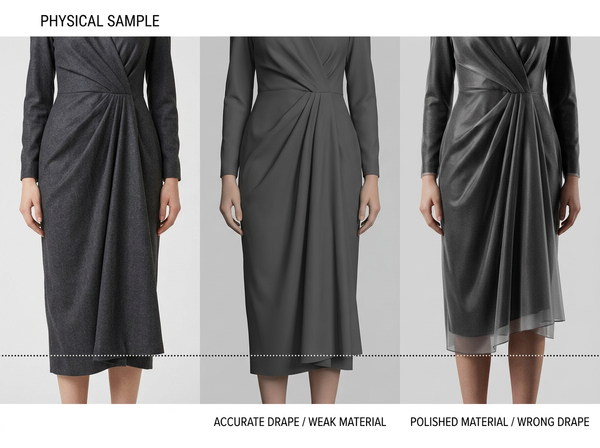
Hem hangs stiffer than the real thing | Simulation — bending and weight | Compare hem position against the physical sample | A wrong fit approval |
Folds appear in places they never appear | Simulation — shear and stretch | Same seam, same size, folds land elsewhere | A wrong fit approval |
Layers slide or clip through each other | Simulation — friction and collision | Zoom the overlap region, not the silhouette | Rework at sampling |
The first two are visible to everyone and get fixed quickly, because everyone in the room can see them. The last three are visible only to someone who knows what that garment does in real life, and they are the ones that turn into cost.
The inputs that decide whether the drape is real
Fabric is not a surface with a picture on it. It is a structure with mechanical behavior, and that behavior is what the solver needs. The same reasoning applies whenever a system is asked to reason about cloth rather than display it, which is why fabric has to be treated as structure rather than texture at every stage of the pipeline.
The parameters that matter are unglamorous:
• Weight determines how hard gravity pulls on every panel, and it is the single input that changes a silhouette most visibly.
• Thickness governs how layers stack and where a seam creates bulk.
• Stretch describes how far the material extends under load, separately along the warp and the weft.
• Shear describes how the weave distorts diagonally, which is what makes a bias-cut panel behave unlike anything else in the garment.
• Bending determines the radius of a fold, and it is why one fabric breaks into sharp creases and another rolls.
• Friction decides whether a lining slides over a shell or drags against it.
Where those numbers come from is the real question. Measured values come from testing the actual material — fabric digitization exists to capture texture together with these physical properties, so that a digital material carries both what the fabric looks like and how it behaves. Style3D Fabric pairs scanning with bending and tensile measurement for exactly this reason.
Estimated values come from picking something from a preset library that sounds close. Both produce a simulation. Only one of them produces a simulation of your garment.
Wrong data does not announce itself
A solver given bad parameters does not fail. It has no way to know the numbers are wrong. It computes an equilibrium from whatever it was handed and delivers a shape that is internally consistent, physically plausible, and confidently incorrect.
There is a direction to the error, and it is worth naming. Preset libraries are populated with well-behaved materials — stable weaves, predictable weights, fabrics that simulate cleanly. Real production fabric is messier. So the substitution tends to run one way: the simulated garment behaves better than the physical one. Folds are more even. The hem sits where a pattern maker would want it to sit. The whole thing looks slightly more resolved than the sample that eventually arrives.
That direction matters because of how review works. Nobody sends an image back for looking too good. A garment that simulates cleaner than it sews will pass every visual gate you have, and the discrepancy surfaces at the fitting, which is the most expensive place for it to surface.
The avatar is half of the equation
A garment is not simulated in isolation. It is simulated against a body, and every ease measurement in the result is the distance between two things. Get one of them wrong and the number is fiction.
An avatar built from a generic size chart produces a garment that drapes correctly for a person who does not exist. If your fit sessions run on a live fit model, the avatar has to be built from that person’s measurements — not from the size the brand calls a medium. This is the same distinction that separates appearance from fit in two-dimensional imagery: a try-on image can settle silhouette but not fit, and a simulation inherits that limitation whenever the body it runs against is an assumption.
Posture belongs in this too. A standing A-pose avatar tells you nothing about how a jacket behaves when an arm comes forward, and for anything fitted through the shoulder that is where the garment either works or does not.
Verify against the sample, never against the render
Here is the check that separates a team using simulation from a team being reassured by it.
Take the physical sample. Measure it at the points of measure the tech pack specifies. Take the simulated garment. Measure it at the same points. Compare the numbers.
What teams do instead is put the render next to the reference image and ask whether they look alike. That comparison confirms nothing, because both images came out of the same pipeline and share its assumptions. Two outputs of one flawed process will agree with each other perfectly. Verification requires the physical thing, or it is not verification.
The measurement loop also produces something a visual comparison never does: a record of where the simulation deviates. Consistent deviation at the hem points at bending data. Deviation across the chest points at stretch. The error becomes diagnostic instead of vague.
Where simulation earns trust, and where it does not yet
Reliability is not uniform across a range. It tracks how much of a garment’s behavior is captured by the parameters currently being measured.
Garment condition | How far simulation gets on its own | What still needs the physical sample |
Stable woven, simple construction | Silhouette and fit read reliably | Hand feel and final finish |
High-stretch knit | Depends entirely on accurate stretch data | Recovery after wear, and growth over time |
Bias-cut panels | Most sensitive input is shear; small errors compound | Always — bias amplifies every data gap |
Multi-layer or lined | Layer interaction is where solvers diverge most | Always — friction data is rarely complete |
Tailored with fusible or interlining | Interlining behavior is seldom parameterized at all | Always — the structure is not in the fabric data |
Read that table as a map of where to spend sampling budget, not as a list of things simulation cannot do. A stable woven shirt does not need three physical rounds. A bias-cut dress in a fabric nobody has measured needs every one of them.
What to ask when you evaluate a tool
The demo will always be a render, because the render is the part that photographs well. Redirect the conversation to the inputs.
Ask how fabric data enters the system, and what happens when you do not have measured data for a material. Ask what the system exports, and whether pattern pieces survive the export intact. Ask what the avatar is built from. Ask to see the same garment simulated in two fabrics with genuinely different weights, and watch whether the silhouette changes as much as it should.
A tool that answers those four questions well will produce useful work even with a modest renderer. A tool with a beautiful renderer and vague answers about fabric data will produce images you cannot approve anything against.
FAQ
Is a better renderer ever the right investment?
Yes, when the output is going to a customer rather than to a fitting. Marketing imagery, line sheets, and virtual showrooms are judged on how they look, and render quality is the whole job there. The distinction is what the image is being asked to prove.
Can I trust the preset fabric libraries that ship with a tool?
Treat them as placeholders for early exploration, not as substitutes for your material. A preset gives you a generic version of a fabric family, which is enough to check whether a design idea holds together and not enough to approve a fit. Presets are also the mechanism by which a simulation ends up looking better behaved than the garment will be.
How many parameters do I actually need before a simulation is useful?
Weight and bending will move a silhouette more than anything else, so a material with those two measured is already more trustworthy than one built entirely from guesses. Stretch and shear become non-negotiable for knits and bias cuts respectively. Friction matters once you have layers.
Does a higher-resolution mesh make the simulation more accurate?
It makes the fold detail finer, which is not the same thing. A dense mesh with wrong bending data resolves an incorrect drape more precisely. Resolution improves how well the solver expresses the parameters it was given; it does nothing about the parameters themselves.
Can a digital sample replace the physical fit sample?
It can replace several of the early rounds, which is where most of the calendar time sits. The final round is a different matter, because it is checking things no current parameter set captures — hand feel, how the garment recovers after being worn, how the construction behaves in production rather than in theory.
Who should own fabric data inside the organization?
Whoever owns the material relationship, which is usually sourcing rather than design. Fabric data has to be created once and reused across every style that uses that material, and that only works if it lives with the people who decide which materials are in the range.
Where this leaves you
The question worth asking of any digital garment is not whether it looks convincing. It is what the drape was computed from.
A render can be improved after the fact. A shape computed from the wrong inputs cannot — it has to be recomputed, and by the time anyone notices, a decision has usually been made on top of it. The teams getting real value out of simulation are not the ones with the best-looking output. They are the ones who treated fabric measurement as infrastructure and stopped evaluating the picture.
Start with the material, not the render
Before you judge any simulation, find out what its fabric came from. Pull three materials your team uses constantly and check whether anyone has measured their weight, bending, and stretch — or whether every digital garment made from them has been running on a preset. That answer tells you more about whether your 3D output is trustworthy than any image will. See what fabric digitization captures and how measured materials enter a simulation workflow.
Written by