
Which Garments Survive an AI Clothes Change, and Which Don’t
Change clothes AI succeeds or fails on construction, not settings. Which categories hold, which need slower review, and which to skip.
A category list is more useful than a tool comparison here, because the same tool that produces a clean result on a cotton tee produces something unusable on a sequined slip, and no setting closes that gap. The variable is the garment.
Most teams learn this by batch. They run a season, half the outputs pass, and the pattern in the failures turns out to be structural rather than random. Sorting the range before the first run costs an afternoon and removes most of that discovery.
What actually makes a garment hard
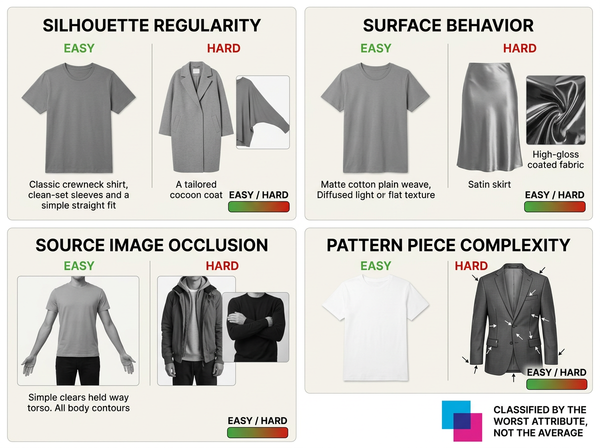
Four properties predict most of it, and they compound rather than add.
The first is silhouette conventionality. A set-in sleeve on a straight body is the shape that appears most often in training data, so it reconstructs well. A cocoon shape, a dolman sleeve (cut in one piece with the body, with a deep armhole) or an asymmetric hem is less common, and output tends to drift back toward the conventional version of the same garment.
The second is surface behavior. Matte, opaque, evenly woven surfaces are described adequately by a flat photograph. Anything specular, translucent or directional carries information a single reference cannot convey.
The third is occlusion in the source pose, which is a property of the shot rather than the garment, but interacts with it. A layered outfit hides the boundaries the model needs most.
The fourth is closure and panel complexity. Every seam, placket, pocket, dart and closure is a landmark that can land in the wrong place, and count matters. A tee has almost none. A tailored jacket has dozens.
These compound rather than add because a failure in one makes the others harder to assess. An unusual silhouette rendered in a shiny fabric gives a reviewer no clean surface to judge the silhouette against, so a garment that scores badly on two properties is disproportionately more trouble than one that scores badly on either alone. Sorting by the worst property rather than by the average is the practical version of this.
Categories that hold up
Category | Typically reliable | What still needs checking |
Jersey tees and basics | Yes | Neckline shape, print scale |
Woven button shirts | Yes | Placket centering, collar geometry, button spacing |
Straight-leg denim and chinos | Yes | Pocket placement, topstitch visibility |
Sweatshirts and hoodies | Yes | Hood volume, cuff and hem ribbing |
Simple shift and A-line dresses | Yes | Hem level, waist seam position |
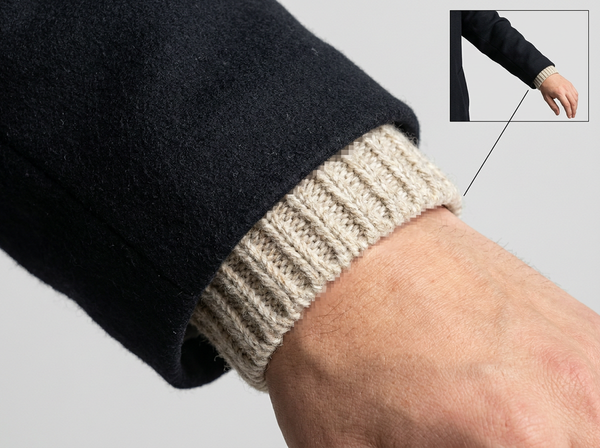
Mid-gauge knitwear | Mostly | Stitch texture flattening, cuff detail |
Puffers and simple outerwear | Mostly | Panel and quilt line alignment, collar bulk |
The common thread is that these garments read correctly from a flat photograph and have silhouettes the model has seen many times. Running a try-on anchored to your garment photograph on this half of the range is where the workflow earns its place, and colorway variants within these categories are close to free once the reference set exists.
Categories that need extra review
Tailoring is the clearest case. A jacket carries a lapel roll, a shoulder line, a chest canvas and a set of panel seams that together signal quality, and small errors in any of them read as a cheap garment rather than as an image defect. Suiting can go through generation for colorways, secondary angles and market variants, but it belongs in a slower review lane than a tee, and the main image — the one a customer uses to judge fit — stays on the photographic path. Generation handles the volume around a tailored style; it does not get to make the fit promise.
Heavily patterned wovens sit here too. Plaid and check need to meet at seams, and a pattern that fails at the side seam of a jacket is far more visible than the same failure on a jersey top, because the customer expects matching on tailored garments and reads its absence as a manufacturing fault. Why that failure happens at all is covered in how a clothes swap is actually computed.
Pleated and draped garments are the third group. A knife pleat has a defined count and depth, gathering has a density, and both tend to be reproduced as a general impression of pleating rather than the specific construction in front of the camera.
Categories to keep off the generative path
• Swimwear and lingerie, where coverage and fit are the product and an inferred drape becomes an implied fit claim on a body the garment was never measured against.
• Sheer, lace and mesh, where the edge between garment and skin is a soft transition rather than a boundary, which is exactly the case that produces unreliable results.
• Sequins, metallics and high-shine satin, where the appearance is specular behavior under moving light and a flat reference contains almost none of it.
• Leather and suede, where grain, break and sheen carry the price point, and a plausible substitute reads as synthetic.
• Complex layered looks, where the occlusion between layers leaves too little visible boundary to reconstruct from.
This list describes current behavior rather than a permanent ranking, and it is worth re-testing each season rather than treating as fixed. What will not change is the underlying reason: these categories carry their value in information a flat photograph does not capture.
Fabric behavior predicts more than category does
Two garments in the same category can behave completely differently, and the fabric is usually why. A rayon shirt and a poplin shirt are the same object in a catalog and different objects to a generative model, because one falls and the other holds.
Weight is the usual shorthand. GSM (grams per square meter, the standard measure of fabric weight) correlates loosely with how a garment hangs, and very light or very heavy fabrics both tend to produce weaker output — the light ones because drape dominates the silhouette, the heavy ones because structure does and the model defaults to something in between.
Nap matters more than most people expect. Velvet, corduroy and brushed fabrics have a direction the pile lies in, which changes their apparent color depending on viewing angle. A reference photographed from one angle carries one appearance of that fabric, and the output inherits it whether or not it suits the pose.
Hand — how a fabric feels and therefore how it moves — has no representation in the pipeline at all. It is inferred from what the fabric looks like, which is why a stiff garment photographed flat can come back looking soft.
Where the same rules apply outside apparel
The constraints are about surfaces and construction rather than about clothing specifically, so they carry over to adjacent categories with recognizable shapes and repeatable panels. Home textiles are the clearest example: a curtain shown in a room setting has the same dependencies as a garment on a body — the drape is inferred, the pattern has to survive the fold, and the header construction is a landmark that can land wrong.
The reasoning transfers cleanly. Ask what the flat reference actually shows, what the model would have to invent, and whether a buyer’s decision rests on the invented part. That question works the same way for a pleated curtain as for a pleated skirt.
What this list will not tell you
It will not tell you whether a specific garment works, only which way to bet before testing. Two knit tops with the same description can behave differently because of yarn, gauge (the number of stitches per inch, which sets how fine the knit reads) and finishing, and the only way to know is to run one.
It will not settle anything about fit. A category being reliable means the image looks right, not that the drape reflects how the garment sits on a customer with particular measurements. No stage in the process has access to a measurement.
It will not stay accurate indefinitely. Model behavior on unusual silhouettes has been the fastest-moving part of this, so a category that failed last season is worth one honest re-test rather than permanent exclusion.
Which is the argument for building your own version of this list rather than adopting anyone else’s.
• Run a pilot on one garment from each construction family rather than one from each product category, since construction is the axis that predicts results.
• Test the hardest fabric in each family once your references are proven on an easy garment, because the easy ones tell you nothing you did not already assume.
• Record the reason a category failed, not only that it failed, so the list stays useful when references or tooling change.
• Re-test the borderline categories each season rather than carrying the list forward unexamined.
The output of that exercise is a routing rule your team can apply without judgment calls, and that matters more than the accuracy of any individual verdict on this page. Your range is not the average range.
Frequently Asked Questions
Is knitwear harder than woven?
Usually, and gauge is why. Fine-gauge knits reproduce reasonably well because the surface reads almost as a solid, while chunky and cable knits carry texture that tends to flatten into a generic ribbed impression. Test the coarsest knit in your range before assuming the category is fine.
Can I use it for outerwear?
Simple outerwear such as puffers and straight coats generally works, with panel and quilt line alignment as the thing to check. Tailored coats belong in the slower review lane alongside suiting, with the main image photographed and anything with a complex collar, storm flap or belted waist needs a construction detail reference rather than a front-and-back pair.
Does print scale come out right?
Not automatically, and it is one of the more common quiet errors. A print sized correctly for a small garment can appear at the same physical scale on a large one, which is wrong in both directions across a size range. Check scale against a known measurement in the garment rather than by eye.
What about kidswear?
Body proportion is the issue rather than the garment. Children’s proportions differ enough from adult ones that a model image matters more here than in most categories, and reusing an adult pose set produces garments that read as badly cut. Use references shot on the right proportions.
Does the same garment behave consistently across colorways?
Mostly, with two exceptions worth watching. A colorway close to the model’s skin tone or to the background makes edges unreliable, and a very dark colorway hides the construction landmarks a reviewer would normally check, which means defects pass more easily rather than occur less often. Review dark and near-skin colorways at higher zoom.
Do these limits apply to video as well?
They apply and then some, since every constraint above has to hold across frames rather than once. Categories that are borderline in stills are generally not worth attempting in motion until they are comfortable in stills.
Sort the range, not the tool
The instinct when output disappoints is to change tools, and it is usually the wrong instinct. Half of a typical apparel range reproduces well enough to publish with normal review, a quarter needs a slower lane, and a quarter should not go through generation at all. Which quarter is which depends on construction and fabric rather than on price point or category name. A team that sorts its own range once has something durable, while a team that keeps changing tools is answering a question nobody asked.
Start with the half of your range that already works
Pick a jersey basic or a woven button shirt rather than your hardest piece — the easy end tells you whether your references are good enough before the garment adds a second variable. You need three files: a flat-lay of the front, one of the back, and a model image with the arms clear of the torso. Generate one candidate, review it at 100 percent, and only then run the hardest piece in your range. The easy garment tells you whether your references are good enough; the hard one tells you where the category boundary sits. Those two answers, in that order, decide whether a category belongs on this path.
→ Virtual Clothing Try-On — Style3D AI
Written by