
AI Clothes Changer vs Manual Editing: What Actually Changes
An AI clothes changer removes the masking and warping. It also removes your ability to ask for a two-millimeter fix. Where each path wins.
A retoucher has been able to put a garment on a model for twenty years. It takes a mask, a warp, a relight, a contact shadow rebuilt by hand, and the result is exact, because a person decided every pixel boundary and can decide it differently tomorrow if you ask.
The useful question is not which method is better. It is which parts of that work a generative tool removes outright, which parts it moves somewhere else without telling you, and which parts it cannot address at all. Teams that answer this before adopting one end up with a sensible split of labor. Teams that treat it as a replacement decision usually rebuild the manual step six months later, under a different name.
What “manual” actually means here
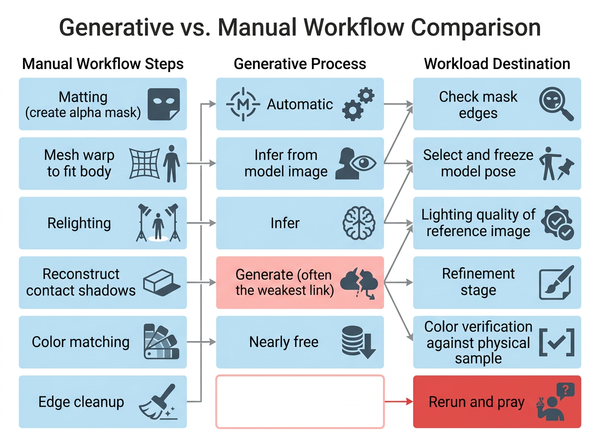
Compositing a garment onto a model is a defined sequence, not a vague craft. The retoucher cuts the garment out (building an alpha matte, the per-pixel transparency map that separates subject from background), warps it to the body with a mesh, relights it so the highlights fall where the scene’s light source says they should, rebuilds the contact shadow where fabric meets skin or floor, matches color, and cleans the edge.
Two properties of that sequence matter for the comparison. It is deterministic: the same file opened tomorrow gives the same result. And it is addressable: you can ask for the pocket to move four millimeters and get exactly four millimeters.
Neither property is a small thing. Most of the friction teams hit with generative output traces back to losing one of them rather than to output quality.
The sequence also has a known cost curve. A simple woven top on a clean pose is quick; a knit with loose fibers against a dark background is slow, because the mask has to be built rather than selected. Layered outfits multiply the work, since each layer needs its own matte and its own shadow relationship with the one beneath it. Anyone who has scoped a retouching batch knows the estimate depends far more on the garment than on the number of images.
What changes in the work
Task | Manual | Generative | Where the work moves |
Cutting the garment out | Hand-built mask, slow on knits and hair | Automatic | To reviewing the mask edge |
Fitting to the body | Mesh warp by eye | Inferred from the model image | To choosing and freezing the model pose |
Relighting | Dodge and burn against the scene | Inferred | To the lighting quality of the reference shots |
Contact shadow | Painted deliberately | Generated, often the weakest area | To the cleanup pass |
Colorway variants | Repeat the whole sequence | Near-free once set up | To color verification against samples |
A specific small correction | Direct and exact | No mechanism exists | To regenerating and hoping |
The last row is the one that surprises people. Running a try-on anchored to your garment photograph gives you a new image, not an edited one. There is no instruction that moves a seam two millimeters, so a small defect and a large one cost the same to address, and the answer to both is another candidate.
Where manual editing still wins
• Brand marks, licensed artwork and any small type, where an approximation is a legal exposure rather than a quality complaint.
• Exact, repeatable corrections, which matters most when a client or a licensor reviews in rounds and expects each round to change only what was flagged.
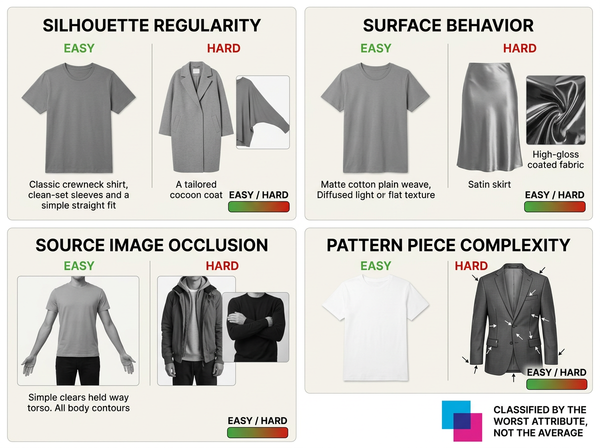
• Heavy occlusion: crossed arms, layered outfits, hair falling across a shoulder seam, a bag strap compressing fabric.
• Unusual silhouettes such as cocoon shapes, dropped shoulders (where the shoulder seam sits down the arm rather than at the joint) and asymmetric hems, which generative output tends to pull back toward a conventional shape.
• Anything a customer will compare side by side with a physical product in their hands.
That list is short but it covers a disproportionate share of hero imagery, which is why the manual step rarely disappears from a catalog operation. It relocates to the images that carry the most weight.
Where generation wins outright
Volume and variation, and not much else. A second colorway costs a retoucher nearly as much as the first, since the sequence repeats; it costs a generative pipeline almost nothing once the reference set exists. The same applies to model variation across markets, to secondary angles, and to producing a first pass fast enough that merchandising can react to it in the same week rather than the next one.
What generation does not win is anything requiring precision, and that boundary holds regardless of which tool you pick. Speed at volume and exactness at a point are different products.
Where the cost actually sits
The economic shape is worth naming plainly, without numbers attached, because the numbers vary too much by category to be worth quoting. Manual cost scales with the number of images and with garment complexity. Generative cost concentrates in setup — reference sets, model images, review rules, the people who write them — and then stays close to flat as variants multiply.
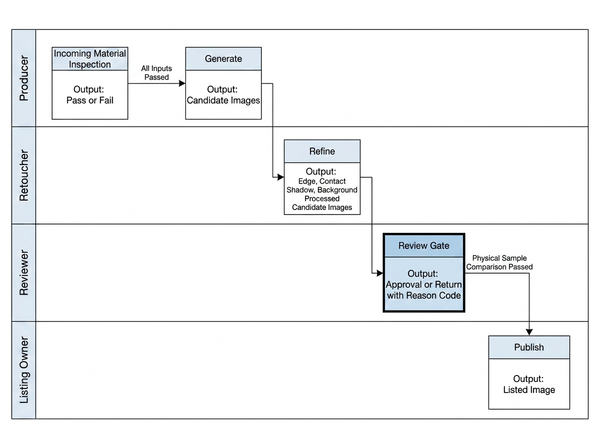
That difference has a consequence teams rarely plan for: the cost moves from production to review. Making the image gets cheaper and checking it gets more expensive, because there are more images to check and each one has to be checked against a physical sample rather than against a brief. A team that budgets the first shift and not the second ends up with a fast pipeline and a review queue nobody owns.
The ratio that predicts the payoff is variants per style. A catalog with many distinct styles and one or two images each gains relatively little, since almost all the cost is setup that never gets amortized. A catalog with fewer styles and many colorways, market variants and secondary angles gains a great deal. Working that ratio out for your own range takes an afternoon and settles the question better than any tool comparison.
The hybrid most teams end up with
Very few operations run purely one way after the first season. The split that survives contact with a real catalog looks like this.
• Generate the base image, treating it as a first pass rather than an output.
• Composite any brand mark, licensed graphic or small type by hand instead of accepting the generated version.
• Correct color manually against the physical sample, not against the reference file, which has already been through a camera and a screen.
• Send edges, contact shadow and any visible artifact through a proper retouching pass before the image goes anywhere near a listing.
• Keep hero and campaign imagery on the manual path entirely.
Described that way, the retoucher’s role shifts rather than shrinks. Less time cutting masks, more time on the judgment calls: which candidate is closest, what has to be composited, whether the color is defensible.
The split also needs writing down. Left to habit, teams route by whoever is available rather than by which path the image belongs on, and hero images quietly end up on the generative path during a busy week. Deciding the routing rule once, at the category level, costs nothing and prevents the version of this mistake that reaches a homepage.
What neither approach fixes
Both sit downstream of the garment reference. A poorly lit flat-lay with a shadow across the print produces a bad composite and a bad generation, and no amount of skill or compute at the next stage recovers information the photograph never captured.
Neither says anything about fit. A retoucher warping a garment to a body is making an aesthetic decision, not a measurement, and a generated drape is a plausible guess. In both cases the image describes how the garment could look, not how it will sit on a customer with a particular set of measurements.
Neither validates the words next to the image. Fabric weight, care instructions and country of origin are claims made in copy, and a perfect image beside a wrong claim is still a wrong listing.
Why generated output fails in the specific ways it does — and which of those failures are recoverable downstream — is covered in how a clothes swap is actually computed.
Frequently Asked Questions
Is it faster for a retoucher to fix a generated image than to composite from scratch?
For edges, contact shadow and color, yes, since the structure is already there and the work is corrective. For structural problems such as a misplaced placket or a pattern that fails at the side seam, often no, because fixing those means rebuilding the region that was generated wrong. Route structural problems back to a new generation and keep the retoucher on corrective work.
Do we still need a retoucher?
Yes, with a different brief. The masking and warping hours drop, while compositing brand marks, color verification against samples and final quality judgment stay exactly where they were. Teams that cut the role entirely tend to discover the gap at the point where a licensor asks why a logo is subtly wrong, which is a bad moment to be rebuilding a capability.
How do we decide which images go down which path?
Route by category and by the role the image plays rather than by who has capacity that week. Hero and campaign images, anything carrying a licensed mark, and any garment with an unusual silhouette go manual by default. Colorway variants, secondary angles and market-specific model images go generative by default, with the routing rule written down so a busy week does not quietly rewrite it.
Which garments should never go through generation?
Anything where the silhouette is the design rather than a variation on a familiar shape, and anything with heavy occlusion in the source pose. Sequins, sheer layering and technical shells belong on the manual or photographic path too, since their selling point is surface behavior that gets inferred rather than observed.
Can I ask a generative tool for a specific correction?
Not in the way you can ask a retoucher. Instructions steer a fresh generation rather than editing the existing pixels, so a two-millimeter change and a redesign are the same request from the tool’s point of view. When exactness matters, the correction belongs in a manual pass.
Is manual compositing more accurate for color?
More controllable, which is not the same thing. A retoucher can match a target precisely, but only against whatever reference they were given, so a mismatched reference produces a precisely wrong result. Color accuracy is decided by having the physical sample present at review, regardless of which method produced the image.
How should this change the brief we give an outside agency?
Specify which images are on the manual path and which are generated, and require that brand marks be composited rather than generated on every image in the batch. Ask for the reject reasons alongside the delivered files, since that is the part agencies rarely volunteer and the part that tells you whether your references are the problem.
The part that does not automate
Both methods are ways of putting a garment onto a body in an image. Only one of them lets you say what should change and get exactly that, and only one of them makes a hundred colorways cost about the same as one. Neither judges whether the result is honest about the product, and that judgment was always the expensive part of the job. The tooling decision is really a decision about where you want your skilled people spending their attention, which is worth deciding on purpose rather than discovering after a season.
Start from your own garment shots: virtual clothing try-on
Written by