How AI Clothes Swap Works, and When It Doesn’t
AI clothes swap re-draws the garment, it doesn’t paste it. What decides the result, the six ways it breaks, and when to shoot instead.
A swap usually fails in a boring, specific way. The composite reads fine at thumbnail size, then a buyer opens the zoom view and the button placket — the reinforced strip the buttonholes sit in — has drifted off-center, or a stripe that should meet at the side seam misses by a quarter of its own width. Nobody catches it in review, because the image still looks like a photograph. The return note catches it three weeks later.
Most advice treats this as a prompting problem. It rarely is. The quality of a clothes swap is mostly decided before generation starts, by what your garment reference actually contains and how close the target pose sits to the way the garment is built. Tool choice matters less than the intake rules you write around it.
Three different jobs hide behind one phrase
“Clothes swap” gets used for at least three tasks with different inputs, different failure modes and different acceptance criteria. Sorting them first saves an argument later about whether the output is good.
The job | What you feed it | What gets regenerated |
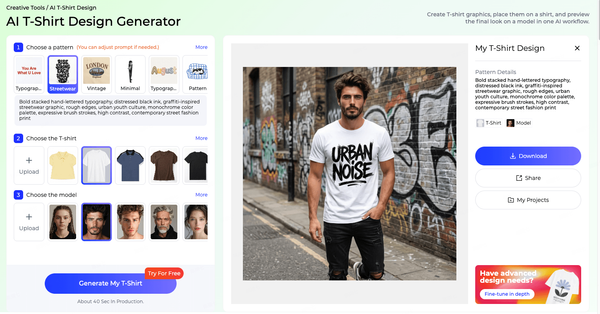
Dress a model in your garment | A flat-lay (the garment shot flat from above) or ghost-mannequin shot, plus a model image | The model’s torso and arm region, re-drawn to wear your piece |
Restyle an existing on-model photo | A photo where someone already wears something | The existing garment pixels only; face, pose and background stay |
Change an outfit across a clip | Video, plus the garment reference | Every frame, with frame-to-frame agreement as the hard part |
The first job is what most catalogs need, and it is the one this article is mainly about. The second sits closer to editing than to generation and tends to be more forgiving, since pose, lighting and shadow direction are already correct in the source. The third inherits every weakness of the first and adds drift over time.
What the model is actually doing to your image
Nothing is pasted. The pipeline segments the image — decides, pixel by pixel, which region is garment and which is body or background — estimates the geometry of that region, then generates new pixels inside it using your garment photo as the reference. The garment in the output is a drawing of your garment, not a copy of it.
That distinction predicts almost every artifact you will see. Anything the model can observe in your reference, such as a front print, a collar shape or a visible hem, it can reproduce closely. Anything it cannot observe it infers from everything else it has been trained on: the inside of a cuff, the back yoke, the way a hem falls when the hip is rotated away.
Anchoring generation to a real product photograph rather than to a text description is what keeps that inference small. A try-on that starts from your actual garment shot limits invention to the parts you never photographed, which is a far smaller surface than describing “oversized cotton shirt, ecru” and hoping.
The two inputs that decide whether it works
Garment reference first. Flat, evenly lit, no cast shadow across the print, the full graphic in frame, and the correct colorway — one color version of the same style — rather than something close that gets fixed in post. A wrinkle in a flat-lay is not read as a wrinkle. It is read as structure, and it comes back as drape. Clearing it belongs before generation, not after: flattening the garment in the reference changes what the model believes the fabric does.
Pose second. The model image has to give the garment somewhere to go.
• Arms should sit away from the torso, since a crossed arm hides the exact region that needs reconstructing and the sleeve will be invented.
• The pose should roughly suit the garment category, because a seated shot carries almost no information about how a long coat hangs.
• Hair, bags and props crossing the chest create occlusion that gets resolved by guessing, usually worst across printed areas.
• The garment already on the model should be simpler than the target one, since a bulky source jacket leaves a silhouette the swap has to fight.
Two inputs, and most complaints about swap quality trace back to one of them rather than to the generator.
Where it breaks, and what the break looks like
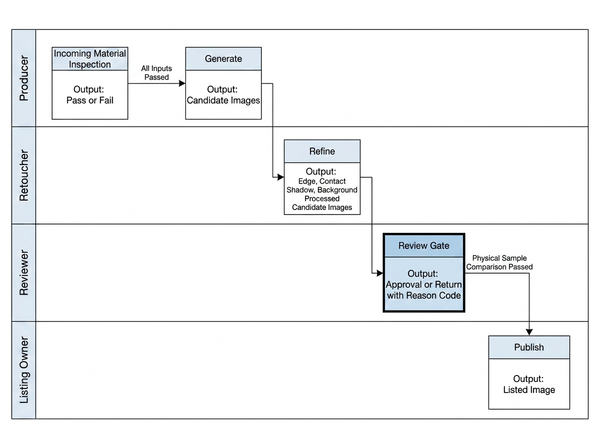
Failures are not random. They cluster, which means your reviewer can be told what to zoom in on instead of being asked whether the image looks real.
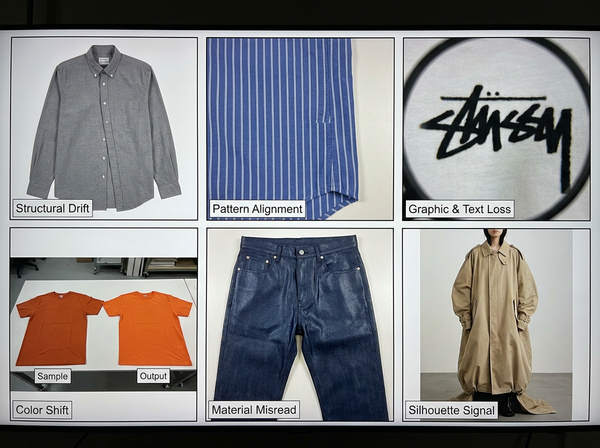
Failure mode | What you see | Usual cause |
Structural drift | Placket off-center, pocket at the wrong height, a dart (the stitched fold that shapes flat fabric to a body) landing in open space | Construction detail invisible or ambiguous in the reference |
Pattern registration | Stripes missing at the side seam, a check that changes scale across the chest, a repeat that shifts mid-panel | The pattern is warped with the body instead of with the panel |
Graphic and type loss | Small text turning to mush, a logo with the wrong proportions | The print occupies too few pixels in the reference or the output |
Color shift | Output sits visibly off the sample, often lighter and warmer | Reference shot under mixed light; no ICC profile (the file telling a device how to read color values) in the chain |
Material read | Denim that looks like twill, knit gauge (stitch density) too fine, sheen on a matte cloth | Surface behavior inferred from category priors rather than measured |
Fit signaling | Garment reads a size small or tent-like, hem lands wrong | No size data exists in the pipeline; the drape is a plausible guess |
Two of these are recoverable downstream and four are not. Color and small-graphic problems can usually be corrected in a retouching pass. Structural drift, pattern registration and fit signaling mean going back to the input.
What clothes swap cannot do
It cannot tell you or your customer anything about fit. You get one plausible drape on one body, generated with no size chart, no garment measurement and no body scan anywhere in the loop. Publishing that image beside a size guide implies a relationship that does not exist, and in categories where fit drives returns, the implication is expensive.
It cannot commit color. A generated image should not be what a buyer uses to choose between two close shades, and it should never be what a supplier matches to. Physical color decisions belong to a lab reading — a ΔE value, the numeric distance between two colors as the eye perceives them — or at minimum to a photographed physical sample under controlled light.
It cannot reliably reproduce anything small and typographic. Care labels, woven brand marks, licensed artwork and fine type degrade unpredictably and are easy to miss at review resolution. Where a legal or licensing obligation attaches to a mark being accurate, that mark should be composited in rather than generated.
It cannot produce a view you never supplied. A front-only reference makes any back view a fiction, and the fiction is typically plausible while being wrong about exactly the details customers ask about: vent, yoke seam, hood shape.
When shooting is still the right call
Swapping is cheap enough that the useful question is which images should still be photographed, not whether any should.
• Shoot the main image of a top-selling style, since an unnoticed defect there costs returns and listing suppression rather than studio hours.
• Shoot anything whose selling point is material behavior, including sequin flash, leather grain and sheer layering, because that behavior is precisely what gets inferred rather than observed.
• Shoot fit-critical categories, where a wrong drape reads to the customer as a fit claim. Swimwear and bras stay on the photographic path entirely. Tailoring is a split case: the main image gets photographed, since that is the image a customer judges fit from, while generated secondary assets belong in a slower review lane than basics — small errors in a lapel roll or shoulder line read as a cheap garment rather than as an image defect.
• Shoot lifestyle context, since hands in pockets, wind, and a bag strap compressing a shoulder are interactions rather than appearances.
Everything else tends to be fair game: colorway variants of an approved style, secondary angles, listing tiles, regional model variations. One shoot feeding many SKUs (stock keeping units, one sellable variant each) describes the realistic workflow better than “no more shoots”.
Moving from stills to video
A still has to be right once. A clip has to be right the same way in every frame, and the failure mode changes: a logo that breathes, a hemline that walks up and down, a color that drifts across a pan. Per-frame processing without a temporal constraint produces exactly this.
Two rules hold in most cases. Keep clips short and motion simple, since a slow turn survives far better than a hand crossing the chest. And treat carrying an outfit change across frames as a different acceptance test from the still version — review at full speed for flicker first, then frame by frame for structure, because the two failures mask each other.
Frequently Asked Questions
Can I use a generated swap as a marketplace main image?
Platform rules govern what the image must show, not how it was produced. Amazon’s main-image requirements, for instance, call for the actual product against a pure white background, which puts the burden on accuracy rather than on method. Read the current policy text for every marketplace you list on before publishing, since these rules get revised.
How many photos of the garment do I need?
Front and back at minimum, flat and evenly lit, with any print fully in frame. A third shot of construction detail — cuff, collar, closure — reduces structural drift, because it removes the region that would otherwise be inferred. A single angled hero shot is the weakest reference you can supply and produces the most invention.
Why do stripes and checks come out wrong so often?
The pattern is warped along with body geometry rather than with the garment’s panels, so a stripe follows the torso instead of the seam it was cut to meet. Fine, high-contrast repeats show this most clearly. Larger or irregular prints hide the same error well enough that most reviewers never notice it.
Does it work equally well on all body types? Results are typically weaker on bodies and poses less represented in training data, which shows up as garments snapping toward a standard silhouette instead of following the actual body. If you shoot diverse models, review those outputs more closely rather than assuming parity. That is a review-policy decision as much as a tooling one.
Can one model image be reused across a whole catalog?
Technically yes, and it is the main reason the workflow pays for itself. The limit is category and repetition: a pose framed for a fitted top produces poor outerwear, and one pose across every listing makes a category page look mechanically generated to a browsing customer.
Is a clothes swap the same thing as a virtual try-on?
The terms get used for the same underlying process, with a difference in who the output is for. A clothes swap usually describes a production task where a merchant generates catalog imagery, while a virtual try-on more often describes a shopper-facing feature on a listing page. “Clothes swapper” is the same thing again, named after the tool rather than the task. The technical constraints described above apply to all three.
Is swap output good enough to skip retouching?
Rarely, in current practice. Plan a cleanup pass for edges, for shadow contact where garment meets body, and for color alignment against the physical sample. Budgeting that pass upfront is cheaper than discovering it at upload.
The check that matters
The question worth asking about any swap output is not whether it looks like a photograph. It is which parts of that frame had to be invented, and whether a customer’s purchase decision rests on any of them. For a colorway variant on a secondary angle, almost never. For a main image where the placket, the print registration and the drape are the product, almost always. Teams that write that question into their review step move faster than teams arguing about which generator is best, because they are checking the thing that actually breaks.
Start from your own garment shots: virtual clothing try-on
Written by