AI Ghost Mannequin: What the Model Fills In at the Neckline
The interior of the neckline exists in no source image. A traditional shoot captures it. A generative tool infers it. What that difference costs you, and when.
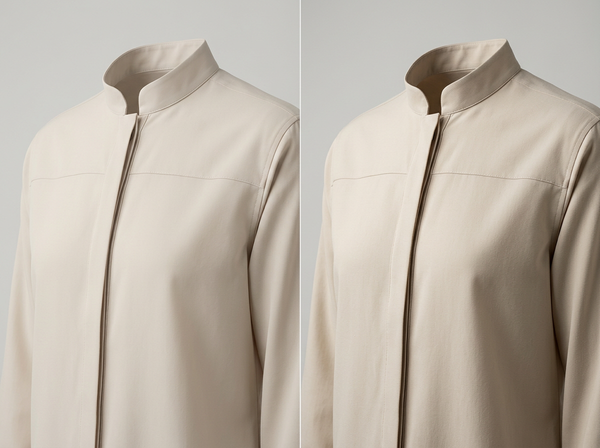
Every ghost mannequin image has the same hole in it. The neck opening shows an interior surface that the main photograph could not see, because a mannequin’s neck was in the way.
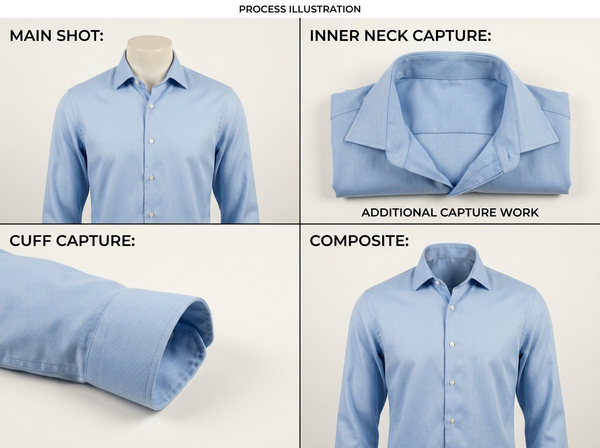
A traditional shoot solves this by photographing that surface separately and compositing it in. A generative tool solves it differently: it does not photograph the interior, and it does not recover it. It produces one.
The same gap, a different answer
The distinction matters more than it sounds like it should.
Compositing places real fabric into the image. The interior in the final picture is the interior of that garment, captured under matching light, positioned by someone who was looking at both frames.
Inference places likely fabric into the image. The model receives one photograph, identifies an opening, and generates a surface consistent with what it has learned garments look like inside — a task usually described as filling a region, which frames it as repair rather than as authorship.
Both produce an image. Only one of them produces an image of your garment’s interior.
What the model does with a neck opening
Given a front view, the model can read a great deal. It can see the fabric on the outside, so it can approximate weave or knit structure. It can see how light falls across the shoulders, so it can shade the interior plausibly. It can see the collar’s outline, so it can place the opening’s edge with reasonable thickness.
Everything it produces inside that opening is generated from those cues plus everything it learned elsewhere. This is the same operation as filling the space left behind when something is removed from a photograph: what appears in the gap is generated content, regardless of how convincingly it resembles what should be there.
The output is usually good. That is the difficulty — it is good enough that nobody checks it.
Worth separating this from a question about model quality. A better model produces a more convincing interior, not a more accurate one, because accuracy would require access to information that is not present anywhere in the input. Improvement along the dimension being improved does not move the dimension that matters here, and it makes the output harder to question rather than easier.
What it cannot know about your garment
• The lining. A jacket with a contrast lining shows that lining at the neck, and no cue in the exterior view reveals its color or pattern.
• The neck facing. Many garments have a facing in a different fabric, weight, or color from the shell.
• Binding and taping. Whether a seam is bound, taped, or overlocked, and in what color, is visible only from inside.
• Interior prints. Some garments print on the inside back neck instead of applying a woven label.
• Seam finish. How the shoulder seams are finished changes what the interior looks like at the exact point the opening reveals.
• The label. Which deserves its own section.
None of these are exotic. Most garments have at least two of them, and every one of them sits precisely in the region the model has to invent.
The label problem
Almost every garment carries something at the inside back neck — a woven label, a printed one, a size tab. It is one of the first things visible when a customer looks into a neck opening in a photograph, and it is entirely inside the generated region.
Two outcomes are possible, and both are problems.
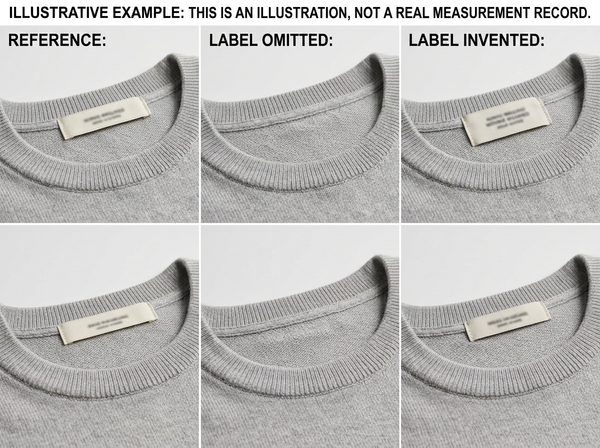
The interior comes back blank, and the image shows a garment with no label. Customers rarely complain about this, and it quietly removes a brand cue from the one image that would have displayed it.
Or the interior comes back with something label-shaped in it. A generated label is not your label. It is a plausible rectangle in a plausible position, with plausible marks that read as text at product-page scale. That is a fabricated brand mark on a product page, and it belongs to the same category of failure as an image that contradicts what the listing says — hard to defend, and noticed by exactly the customer who was looking closely enough to care.
Nobody sets out to publish this. It happens because the region looks finished, and finished regions do not invite inspection.
Where the free tier structurally stops
Free tools for this exist, and several of the search terms people use include the word free, so it is worth being clear about what changes and what does not.
What does not change is the inference. A free tool and a paid one both generate the interior, and both generate it from cues rather than from your garment. Paying more does not convert a guess into a photograph.
What changes is throughput and control. Free tiers tend to constrain batch size, output resolution, and the ability to correct a result you disagree with — and batch size is the one that matters commercially, because a technique that works on one image and cannot run across a range is a demonstration rather than a workflow.
Which means the free-versus-paid question is separate from the accuracy question, and answering the first does nothing about the second.
When inference is safe enough
There is a real case where generating the interior is reasonable, and it is worth naming precisely rather than hedging.
A garment qualifies when its interior genuinely matches its exterior and carries nothing distinctive: a single-jersey tee with a self-fabric neckband, no contrast facing, no interior print, and a label the brand is content not to display. In that situation the model is generating something that closely resembles what is actually there, and the error is small enough to accept.
The qualifying conditions are narrow, and they are checkable before any image is produced. Someone who knows the garment can answer them in a moment by looking at it, which is a far cheaper check than reviewing outputs afterward.
Outside those conditions, the interior needs to come from the garment — either photographed once for that style, or reused from a style with an identical construction.
Reuse is the part worth setting up deliberately. Most ranges contain groups of styles built on the same body with the same neck finish, and one interior capture can serve the whole group. That turns the cost from per-style into per-construction, which is a much smaller number and is the arrangement that makes the traditional approach viable at range scale.
Verify against the garment, not the source image
The verification error that matters is comparing the generated image with the photograph it came from.
They will agree. The source image does not contain the interior, so it cannot contradict anything the model put there. Two images sharing an origin will corroborate each other perfectly, and the corroboration means nothing.
The check that works takes seconds: pick up the actual garment and look inside the back neck. Compare it with what the image shows. That is the entire procedure, and it is the only one that can detect the failure this article describes.
For a range, the check scales the way consistency checks across an image set do — sample rather than exhaust, and pay attention to styles where construction changed, since those are where a reused interior stops matching.
FAQ
Does a higher-resolution source image improve the interior?
It improves the regions the camera actually saw. The interior is not one of them, so resolution changes how well the model reads the exterior cues and changes nothing about the fact that it is inferring from cues.
Can I supply a separate photo of the interior for the tool to use?
Where a tool accepts one, that is compositing rather than inference, and it resolves the accuracy problem entirely. It also means the second shot is back, which is the cost the generative approach was meant to remove.
Is the generated interior consistent across a batch?
Not reliably, since each image is generated independently. Two colorways of the same style can come back with different interior treatments, and a set with inconsistent necklines reads as an error even when no individual image looks wrong.
How noticeable is a wrong interior to a customer?
Usually not at all, until it is — a customer comparing the photograph with the garment they received is exactly the person deciding whether to return it. Small discrepancies matter more at that moment than at any other.
What about cuffs and hems?
The same reasoning applies to any opening that reveals an interior surface, and cuffs are the second most common case. They are smaller, so errors there attract less attention and are correspondingly less likely to be checked.
Should the image be labeled as edited?
Disclosure expectations differ by market and platform and are worth confirming with whoever handles compliance. Separately from any requirement, the practical question is whether the image accurately represents the garment, which is the standard a return will be judged against regardless of labeling.
Where this leaves you
The convenience is real and the gap it fills is genuine. What it fills the gap with is a guess about a region no camera in the process ever saw.
For a plain tee the guess is close enough to be indistinguishable from the truth. For anything with a lining, a facing, a binding, or a label — which is most garments — the guess is a small fiction sitting in the part of the image a careful customer looks at first. Checking it takes three seconds with the garment in your hand, and almost nobody does it, because the region looks finished.
Pick up the garment and look inside the neck
Take any ghost mannequin image your team has produced with a generative tool and put the actual garment next to it. Open the back neck and compare: is the label there, is it yours, does the binding match, is the facing the right color. Comparing the output against the source photograph will tell you nothing, because the source never contained that area. Three seconds with the garment is the entire check. See how a consistent product image set gets built and verified.
Written by