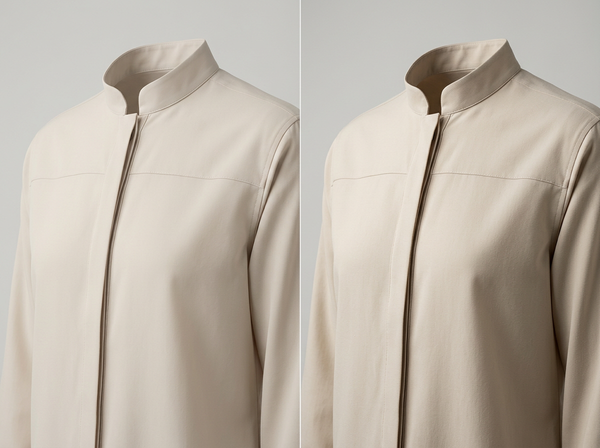
Ghost Mannequin for Ecommerce: When It Beats an On-Model Shot
A ghost mannequin image that looks clean and hides its seams has failed at the only job it had. What legible structure means and how to check for it.
The choice between a ghost mannequin image and an on-model image is usually made on budget or habit. It is better made on a question: what has the buyer not worked out yet.
Every product image is an answer to something. Which shot type wins depends entirely on which question is still open when the customer arrives at the page.
Start from the buyer’s unresolved question
Two questions dominate apparel purchases, and they call for different images.
The first is about the object. How is this made, what shape is it, how substantial is it, where do the seams fall. A customer asking this is assessing the garment as a made thing, and a body in the frame adds nothing to that assessment — it adds a posture, a proportion, and a styling decision, all of which are properties of the shoot rather than of the product.
The second is about the wearer. How will this sit, does it suit someone shaped like me, what does it look like in motion. A ghost mannequin image answers none of that, and no amount of quality in the image changes it — appearance and fit are different claims, and a form carries only the first.
Which question dominates is not a property of the category alone. The same garment sold at a higher price point, or to a trade buyer rather than a consumer, shifts which question is still open.
Where a ghost mannequin reliably wins
Outerwear and tailoring, where construction is most of what the customer is paying for and a coat’s structure is the argument for its price.
Shirting, where collar type, placket construction, and cuff detail differentiate products that otherwise look identical at thumbnail size.
Workwear and uniforms, where a buyer is checking specification compliance rather than browsing — the purchase is a comparison against requirements, and a model introduces variables that make comparison harder.
Wholesale and trade catalogs generally, for the same reason: a trade buyer is assessing the make.
Childrenswear, where using a form sidesteps the practical and ethical complications of child models entirely while still showing shape.
Where it reliably loses
Anything where the purchase decision turns on how the garment behaves on a body.
Dresses, particularly anything with drape or bias, where the appeal is movement and a rigid form cannot produce it. Knitwear that relies on how it settles rather than on how it is built. Swimwear and anything closely fitted, where the entire question is fit.
Categories with a strong lifestyle component, where the customer is buying an idea about themselves and a garment floating in space is a poor vehicle for one.
And any product where scale is ambiguous. A form gives no size reference, so a customer cannot tell a cropped jacket from a regular one, or judge how a bag will sit against a body. That ambiguity is fixable with a model and not fixable with better retouching.
Structure has to be legible, or the image failed
Here is the judgment most content on this technique gets backwards.
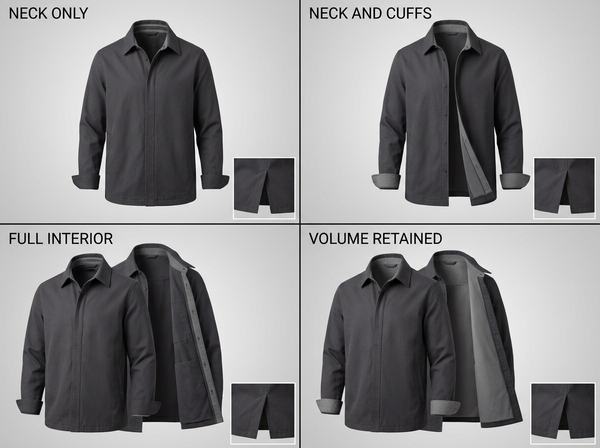
The purpose of lighting a ghost mannequin image is to reveal construction. Not to produce an even, flawless surface — to make it possible to see how the garment is built.
Those two goals conflict more often than people expect. Soft, even light flatters fabric and simultaneously flattens everything that distinguishes one garment from another: the thickness of a placket, the height a collar stand actually sits at, the line of a yoke seam, the way a shoulder is set. Heavy retouching finishes the job.
The result is a clean image containing less information than a model shot, which removes the only reason to have chosen it. A ghost mannequin image that hides its seams has spent the whole budget on the one thing it was not for. This is the same standard that applies to detail photography: the image exists to carry evidence, and evidence that has been smoothed away is not evidence.
The practical test is to look at the image and try to describe the construction from it. If you cannot say where the seams are without already knowing the garment, the lighting needs to change before the retouching does.
Retouching is worth singling out because it is where the loss usually happens, and because the person doing it has no way to know. A retoucher removes what looks like a blemish, and a shadow marking a seam and a shadow marking a crease are the same object on a screen. Telling them apart requires knowing which shadows are load-bearing, which is knowledge that lives with whoever specified the garment and rarely reaches the person editing the file. The fix is a note on the brief naming what must stay visible, not more rounds of review.
The range-size argument
Cost behaves differently between the two methods, and the difference compounds with catalog size.
An on-model shoot has a fixed cost per session — booking, styling, studio — that amortizes across however many styles are shot that day. A ghost mannequin setup has a fixed cost per garment, driven by the number of interior surfaces, and almost no session overhead.
For a small range shot a few times a year, the model session is efficient. For a large catalog with frequent additions, the per-session model spends dominate, and the scheduling problem gets worse than the cost problem — a style arriving between shoots waits for the next one.
That scheduling argument is often what actually decides it. Brands adopt the technique for cost reasons and keep it because a new style can be photographed the day it arrives.
There is a quieter benefit in the same direction. Because each garment is photographed independently rather than in a session, a style that needs reshooting after a construction change costs one garment’s worth of work instead of waiting for the next booking. For ranges that iterate during a season, that turns an image update from a scheduling negotiation into a task.
Using both, and what each one carries
The common arrangement is a ghost mannequin hero image with one or two model shots later in the sequence, and it works when each image is doing its own job rather than duplicating.
The hero carries the object: shape, construction, color, proportion of the garment to itself. The model shots carry the wearer relationship: scale, fit, how it sits, how it moves.
What breaks this arrangement is inconsistency between them. The two are produced differently — different light, different color pipeline, sometimes different days — and a mixed set is read as a set rather than as individual images. A model shot whose color does not match the hero undermines both, and the customer does not diagnose which one is wrong.
The mistake: treating it as a cheaper model shot
The failure mode worth naming is conceptual rather than technical.
A team that adopts ghost mannequin imagery as a budget substitute for on-model photography will review it against on-model standards. The feedback becomes “make it look better” — softer, cleaner, more polished — and each round of that feedback removes construction information.
After a season of this, the images are beautiful and carry nothing, the technique gets judged as underperforming, and the conclusion drawn is that the brand should go back to models. The technique did not fail. It was measured against a claim it was never making.
FAQ
Is this the same as an invisible mannequin image?
Yes — several names circulate for the same technique, and none of them signals a difference in method or in what the image can show.
Does the mannequin need to match the sample size?
It should be close, since a form much smaller than the garment shows it slack and one much larger stretches it. Photographing the sample size on a form fitted to it is what makes the shape in the image correspond to the shape a customer receives.
Can we use it for the main image on a marketplace listing?
Marketplace rules govern background and framing rather than technique, so the requirement to check is the platform’s image specification rather than anything specific to this method. Confirm the current rules for each marketplace before committing a range.
How many images does a listing need if the hero is a ghost mannequin?
Enough to close out the questions the hero cannot answer, which usually means at least one image establishing scale and one showing detail. Counting questions answered is more useful than counting images.
What about a flat lay instead?
A flat lay is a third option answering a different question again, and the comparison between all three deserves more room than a FAQ answer gives it.
Should the hero be a ghost mannequin if we sell mostly to one body type?
A narrow customer base makes the model shot more informative rather than less, since a model close to that body type answers the fit question directly. The construction question still exists, which is an argument for having both rather than for choosing.
Where this leaves you
Ask what your buyer has not worked out yet, then look at whether your current hero image answers it.
If the open question is how the garment is built, a ghost mannequin image is the right instrument — provided it has been lit to show construction rather than retouched until the construction disappeared. If the open question is how it will sit on a person, no amount of quality in a ghost mannequin image will reach it, and the answer is a body in the frame rather than better retouching.
Describe the construction from your own image
Open your current hero image and try to describe how the garment is built without referring to the garment itself. Where does the placket sit, how high is the collar stand, where does the yoke seam fall. If you cannot answer from the image, it has been lit or retouched for smoothness rather than for structure — and a ghost mannequin image that hides its seams has given up the only advantage it had over a model shot. See how a consistent product image set gets built.
Written by