Invisible Mannequin Photography: Same Technique, Three Names
Three names describe one technique, and the naming costs nobody anything. What does cost money is that one name covers several different deliverables.
Ghost mannequin. Invisible mannequin. Hollow man. Three terms in common use, describing one technique, with no difference in method between them.
That part is straightforward and costs nobody anything. What does cost money is the opposite problem, which nobody names: one term covering several different deliverables.
Three names, one technique
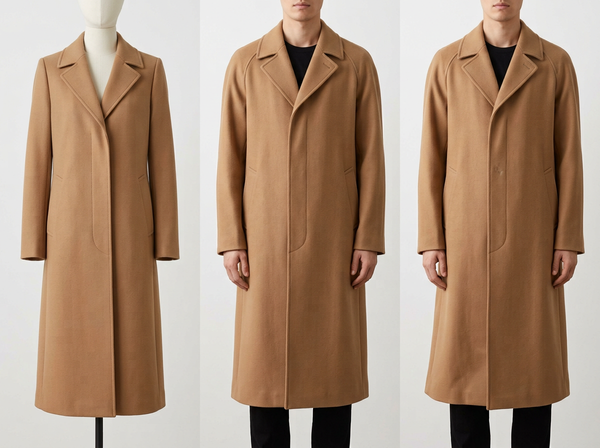
All three describe a garment photographed on a form, with the form removed and the interior surfaces supplied so the garment appears to hold its own shape. The process is a composite regardless of which word is used to order it.
No practitioner means something different by one term than by another. A studio that says hollow man and a retoucher that says ghost mannequin will produce the same kind of image, and neither will ask what you meant.
So the naming is a curiosity rather than a problem. It is worth understanding only because the word someone reaches for tells you where they came from.
Where each name came from
Ghost mannequin names the thing that was removed. It is the most common term in ecommerce and the one most brand-side people use, because it describes the effect from the outside — there was a mannequin, now there is not.
Invisible mannequin names the illusion rather than the removal, and tends to appear more in photography and studio contexts, where the emphasis is on what the viewer perceives rather than on what was edited out.
Hollow man is older and more common among retouchers and in production workflows, and it names what remains: a shape with nothing in it.
None of this changes the work. It does mean that a brief written in one vocabulary and read in another can create a small hesitation at the start of a conversation, which is worth nothing more than knowing that all three are the same request.
The naming confusion is harmless; the scope confusion is not
Here is the problem that actually shows up in invoices.
Two vendors quote the same request at noticeably different prices, and the brand concludes that one is expensive. Frequently both quoted accurately for different amounts of work, because the request did not specify how much of the garment’s interior had to be handled.
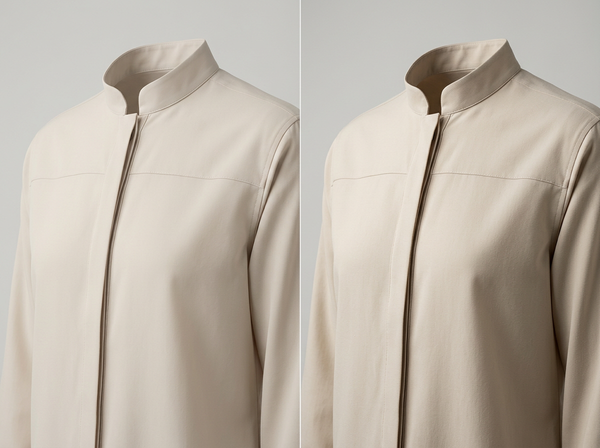
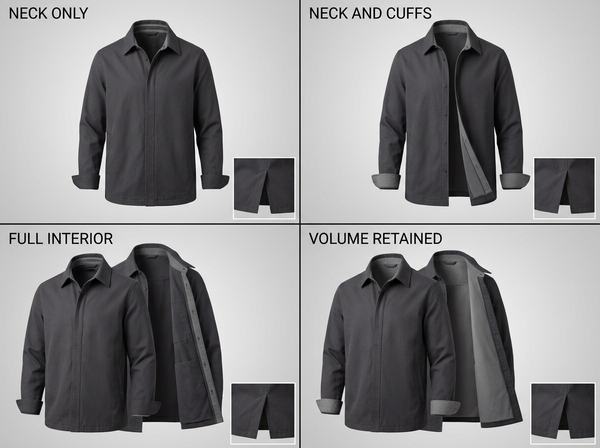
A garment has as many interior surfaces as it has openings. Each one requires its own capture and its own compositing. A quote that covers the neckline and a quote that covers the neckline, cuffs, front placket, and back vent are quotes for different jobs, and the request that produced both said the same three words.
The asymmetry runs one way, which is why it survives. A vendor who assumed a narrow scope and priced accordingly wins the job, and the gap appears at delivery when images come back with an untreated cuff. A vendor who assumed the full scope quotes higher, loses, and never finds out why. Over a few rounds of this the market appears to contain expensive vendors and reasonable ones, when what it actually contains is vendors answering different questions.
What actually varies under the umbrella
Scope | What gets handled | Typical fit |
Neck joint only | The inside back of the collar | Tees, crew necks, closed garments with one opening |
Neck plus cuffs | Collar interior and turned-back cuff interiors | Shirts, long-sleeve knits |
Full interior | Every opening: collar, cuffs, placket, vents, visible lining | Outerwear, tailoring, open-front garments |
Volume retained | Form partially kept to preserve shape; openings not treated | Where shape matters and interiors are not visible |
The last row is a genuinely different approach rather than a smaller version of the others. It keeps enough of the form to hold the garment’s volume and does not attempt to show any interior, which suits garments photographed closed.
All four are legitimate. All four produce usable images. What separates them is not quality — it is which openings the customer will be able to see into, and that decision belongs to whoever knows the garment rather than to whoever is quoting.
The decision is also garment-specific rather than range-wide, which is where most policies go wrong. A brand that standardizes on neck joint only will produce good images for its tees and images with a visible gap wherever a jacket is photographed open. A brand that standardizes on full interior pays for cuff work on garments whose cuffs are buttoned closed. Neither policy is wrong in principle; both are wrong applied uniformly.
Each additional opening also brings the edge problem with it. An opening is a folded edge with depth, and an edge in a composite is a band rather than a line, so every scope increase adds work that is not visible in a scope description.
Why the word you use changes what you receive
Vocabulary carries an assumption about who is doing what, and that assumption travels with the brief.
Send “ghost mannequin” to a photographer and it usually means the whole job: shooting the garment, capturing the interiors, delivering the composite. Send the same words to a retouching service and it often means the editing only, with the supplementary frames expected to arrive from you. Both readings are reasonable. Only one of them matches what a brand without a studio actually needs.
The failure surfaces late — after the shoot, when the retoucher asks for the neck shots that nobody took, and the garments have gone back to the warehouse.
Recovering from that is disproportionately expensive relative to how small the misunderstanding was. The garments have to be retrieved, re-lit to match frames shot on another day, and photographed again — and matching light after the fact is harder than getting it right in the session, because the original setup no longer exists. A single unasked question about who captures what turns into a partial reshoot with a lighting mismatch nobody can fully resolve.
What to specify in a brief instead of a name
Naming the technique is the least informative part of the request. Four things carry the actual specification.
• Which openings need interiors. List them per garment type rather than assuming a general standard applies.
• Who captures the supplementary frames. The single most common gap, and the one that costs a reshoot.
• Whether volume or interior visibility matters more for this range, since these pull in different directions for closed garments.
• What the form is, since a form that does not match the sample size changes the shape the customer sees regardless of how well the interiors are handled.
A brief with those four is unambiguous whichever name it uses, and a brief with none of them is ambiguous however precisely it names the technique.
Software names are not method names
A meaningful share of searches on this subject include a software name, which reflects how people look for this work: by the tool they assume is involved.
The tool determines who can do the work and how quickly. It does not determine where the interior surface comes from, and that is the only question that affects the result. Whether the compositing happens in one editor or another, the interior either was photographed or it was generated to fill the region, and those two produce different images of your garment regardless of what the file was assembled in.
Which means a brief that specifies a tool has specified almost nothing. A brief that specifies whether interiors are captured or generated has specified the thing that matters.
FAQ
Is one of the three terms more correct than the others?
None is more correct. Ghost mannequin is the most widely used in ecommerce and is the safest choice for being understood, which is a practical consideration rather than a linguistic one.
Do vendors price by scope or by garment? Both arrangements exist, and per-garment pricing embeds an assumption about scope that is worth surfacing before a range with mixed complexity goes out. A flat per-garment rate applied across tees and coats will not stay flat once the coats arrive.
Can I ask for neck joint only to save money?
Yes, and it is the right choice for garments where no other interior is visible. The decision should be made per garment type rather than as a blanket policy, since the same rate applied to an open-front jacket produces an image with a visible gap.
What is the volume-retained approach actually doing?
Keeping enough of the form to hold the garment’s shape while not attempting to show any interior. It suits closed garments photographed front-on, and it is not a lesser version of the full technique — it answers a different requirement.
Does the name affect what I find when searching for a vendor?
Slightly, since vendors optimize for the term their clients use. Searching more than one of the three surfaces a different set of providers, which is worth doing once when building a shortlist.
Should the brief specify the technique at all?
Naming it helps everyone start in the right place, and it should be followed immediately by the four specifics above. The name orients; the specifics instruct.
Where this leaves you
The vocabulary question resolves itself: all three terms mean the same thing, use whichever your vendor uses, and move on.
The scope question does not resolve itself, and it is the one that produces mismatched quotes, reshoots, and images with a gap where a lining should be. One name covers four different jobs, and the request that names the technique without naming the openings has left the most expensive variable unstated — to be settled later by whoever is holding the invoice.
List the openings, not the technique
Before your next brief goes out, write down for each garment type which interiors a customer will be able to see into: collar only, collar and cuffs, everything including lining. Then state who is capturing those supplementary frames. Those two lines remove the ambiguity that makes quotes incomparable and causes garments to come back for a second shoot. The name you use for the technique matters far less than either. See how a consistent product image set gets specified and built.
Written by