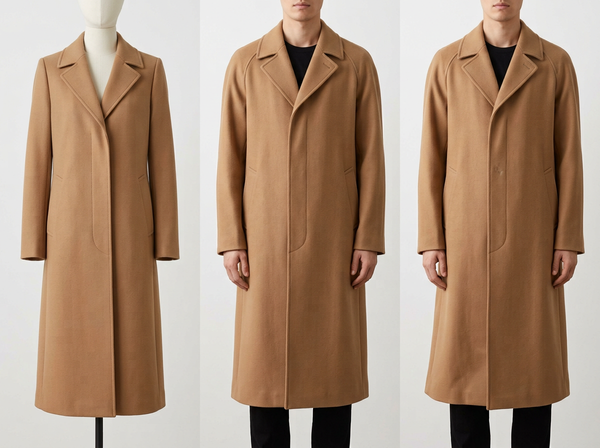
Clothes on a Mannequin: What the Form Shows and What It Hides
A form is a rigid, symmetrical abstraction of a body. Every way it differs from a person shows up in the garment, and most of it runs in one direction.
A mannequin is an abstraction of a body: rigid where a body is soft, symmetrical where a body is not, and permanently still. Every one of those differences shows up in the garment hanging on it.
Most of them run in the same direction, which is the part worth knowing.
What a form actually is
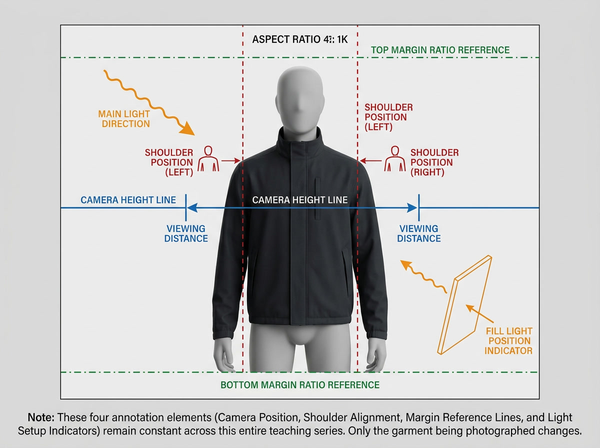
A form gives a garment somewhere to be. It provides shoulders to hang from, a chest to fill, and a vertical axis, which is enough to show shape, volume, and how a garment is built.
What it does not provide is a body. It has no weight to shift, no breath, no warmth, and no reason to move. Those absences are not incidental features of cheap mannequins — they are what a mannequin is.
The garment responds to what it is on. Put it on a form and it responds to a form.
Four things a body does that a form does not
Weight shifts. A person standing is almost never symmetrical. Weight rests on one leg, which drops one hip, which tilts the shoulders, and a garment hanging across that tilt falls differently on each side. A form is symmetrical, so garments on it hang level in a way they never do on anyone.
The body expands and contracts. Chest and waist circumference change continuously with breathing, and a fitted garment is in constant slight negotiation with that. On a form, the circumference is fixed, so the garment finds one arrangement and stays in it.
The body is warm and slightly damp. Fabric against skin behaves differently than fabric against fiberglass — it clings, it moves with the surface beneath it, and lightweight or clinging materials in particular sit closer to the body than they will ever sit on a form.
The body moves. Even standing still, a person makes small adjustments constantly. Every one of them redistributes the garment.
The drape you see is one static solution
Put those four together and the conclusion follows.
A garment on a form is solving a simple problem: arrange yourself under gravity, on this fixed shape, with no other forces acting. It has one solution and it will hold it indefinitely. A garment on a body is solving a harder problem continuously, and its solution changes every second — which is why changing a pose changes the drape rather than merely changing the angle you see it from.
The static solution is not wrong. It is one of the states the garment can be in, and it happens to be the one with the fewest forces acting on it — which makes it the least informative of all the states the garment will actually occupy once somebody is wearing it.
This is worth holding onto when reading a mannequin image. The image is accurate about a condition that only exists in a studio.
The distortion runs one direction, and it is largest where you would expect
Property | On a body | On a form |
Hem level | Uneven, follows the hip tilt | Level |
Shoulder line | Asymmetric, follows the stance | Symmetric |
Front closure | Pulls where the body pushes | Sits flat |
Drape at the waist | Responds to breathing and posture | Fixed |
Cling on light fabric | Follows the body’s surface | Falls away from the form |
Every entry in the right column is tidier than its counterpart on the left. Garments photographed on a form hang more evenly, sit straighter, and look better resolved than the same garment on a person.
That direction matters because of how images get reviewed. Nobody sends an image back for looking too well-behaved, so this particular distortion passes every check it will ever encounter. It is also the reason a customer occasionally feels that a garment “looked different online” without being able to say what changed — nothing about the color or the shape was wrong, only the tidiness.
It is worth adding that most commercial mannequin images have also been adjusted at the back of the garment so it sits cleanly on the form, which compounds the same effect. How that is done is its own subject.
The size of the effect varies by garment in a way that follows directly from the four differences. Structured outerwear distorts least. A tailored coat holds its own shape, so a form and a body produce broadly similar results and the differences concentrate at the hem.
Fitted and bias-cut garments distort most. Their entire behavior depends on responding to a body, and a form gives them nothing to respond to. A bias skirt on a form hangs as a cone; on a person it spirals.
Knitwear sits in between and behaves unpredictably. Knits cling to a warm body and fall away from a cold form, so a sweater can read as significantly looser on a mannequin than it will feel on.
Anything lightweight and drapey belongs with the bias-cut cases. The lighter the fabric, the more of its behavior comes from interacting with a moving surface, and the less of that a form supplies.
A rough rule falls out of this: the more of a garment’s character comes from the fabric rather than from the pattern, the less a form can tell you about it. A structured jacket is mostly pattern, so a form shows most of what there is to see. A slip dress is mostly fabric, so a form shows almost none of it.
What the form shows better than a body
Repeatability, first. A form does not get tired, change posture between styles, or stand differently after lunch. Every garment in a range is photographed against the identical shape, which makes them comparable in a way that model images are not — and a set of images is read as a set, so comparability across a range is worth real money.
Neutrality, second. A model brings a body type, and a customer whose body is different has to translate. A form belongs to nobody, which removes the translation and also removes any sense of who the garment is for.
Availability, third, which is prosaic and often decisive. A form is in the studio when the sample arrives, so a style photographed the day it lands does not wait for a booking.
Scale consistency, fourth and least discussed. Because the form is the same object in every image, a customer comparing two styles is comparing them against a constant. Model images introduce a different body, a different height, and a different way of standing, and any of those can make one garment read as larger than another when it is not.
Form size decides more than people expect
A form that is not the sample size changes the image in ways no amount of lighting or retouching can fix.
Too small, and the garment hangs slack, reads as oversized, and shows drape that belongs to a larger size. Too large, and it stretches, the closure strains, and the customer sees a fit that does not exist at that size.
The error compounds across a range if one form is used for everything, since the mismatch is different for every style. A brand photographing its sample size on a form fitted to that sample size gets images that correspond; anything else produces a systematic offset that is invisible in any single image and consistent across all of them.
Adjustable forms help and introduce their own version of the problem, since the adjustment points are limited and the resulting shape corresponds to no particular person.
How to read a mannequin image
Read it for construction, shape, and proportion of the garment to itself. Those are the things a form shows honestly, because they are properties of the garment rather than of the interaction between the garment and a wearer.
Do not read it for fit, for how the fabric will feel, or for how the garment will hang on a person — an image can settle appearance without settling fit, and a form removes even the partial fit evidence a model image carries.
And read the tidiness with a discount. Whatever you see is the neatest version of that garment that will ever exist.
FAQ
Should I use a mannequin image as the main product image?
It works well for categories where construction is the purchase driver and less well where fit is. The decision depends on what your customer has not yet worked out, which is a question about the category and the price point rather than about the technique.
Do more expensive mannequins solve any of this?
Better forms improve shape accuracy and finish quality, which affects how the garment sits. None of them shift weight, breathe, or warm up, so the four differences described here are unaffected by cost.
What about articulated or posable forms?
Introducing an asymmetric stance recovers some of the weight-shift behavior and is genuinely useful for garments where that matters. The other three differences remain, and a posed form adds a variable that has to be kept consistent across a range.
How do customers actually experience this gap?
Usually as a vague sense that the garment looked different online, without a specific complaint. The color was right and the shape was right; what differed was how neatly everything sat, which is difficult to articulate and easy to feel.
Is a flat lay better for showing fabric?
A flat lay removes drape entirely rather than distorting it, which is a different trade rather than a better one. Neither answers the question of how the fabric behaves on a moving body.
How does this relate to ghost mannequin images?
Those start from a mannequin image and remove the form, so everything described here applies to them as well — the drape in a ghost mannequin image is still a form’s drape, with the form edited out.
Where this leaves you
A mannequin image is accurate. It is accurate about a garment at rest, on a symmetrical rigid object, in a room where nothing moves.
That condition never occurs again after the photograph. Reading the image for what a form genuinely shows — how the garment is made and what shape it is — gets you real information. Reading it for how the garment will hang gets you the neatest arrangement it will ever achieve, presented as though it were typical.
Compare one garment on the form and on a person
Take a style you photograph on a mannequin and shoot it once on someone, standing normally, without direction. Put the two side by side and look at the hem line, the shoulders, and the front closure. The differences you find are present in every mannequin image you have ever published, running in the same direction each time — and knowing which direction is most of what it takes to read your own catalog accurately. See how a consistent product image set gets built.
Written by