Digital Mannequin: A Reusable Frame, Not a Single Image
The term names two different objects, and buying one while expecting the other is a common and expensive mistake. What each is, and which one you need.
The term covers two different objects. Teams buy one while expecting the other often enough that it is worth separating them before anything else.
Two things share the name
The first is a body. A digital form with measurements and a posture, existing so that a garment can be draped on it and assessed — does it fit, where does it pull, how does it hang. Whether this object is correct depends on whether it corresponds to a real body, which means it has to be built from the measurements of the person your fit sessions actually run on. Its job is answering questions about fit.
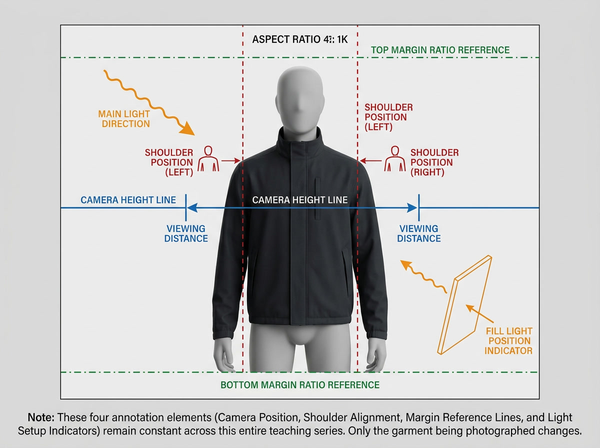
The second is not a body at all. It is a setup: a form, a camera position, a lighting arrangement, and a set of framing conventions, bound together so that every style in a range lands in the same place. Whether this object is correct depends on whether the tenth garment through it matches the first. Its job is consistency, and it says nothing about fit.
A team that acquires the second and expects the first gets a very stable imaging process that cannot answer a single fit question. A team that uses the first to produce product imagery gets a set of individually correct pictures that do not read as a range.
The rest of this article is about the second one.
What a digital mannequin actually consists of
Four things, and the form is the least important of them.
The form provides shape and volume. It matters, and it is the part people focus on, and it is also the part that varies least between reasonable setups.
The camera position — height, distance, focal length, angle — determines proportion. Two images of the same garment from different distances show different garments as far as a customer’s perception is concerned.
The lighting arrangement determines what is visible. Which seams read, whether texture registers, where shadow falls at the hem.
The framing conventions determine placement: how much space sits above the shoulder, where the shoulder point falls vertically in the frame, how the garment is cropped at the bottom.
Fix all four and you have a digital mannequin. Fix only the form and you have a form.
It is a coordinate system, not an image
The word for what those four things establish is a coordinate system: a set of fixed references against which anything placed inside them can be located and compared.
Once the system is fixed, a garment entering it acquires a position. Its shoulder point is at the established height. Its hem falls at a measurable distance below a known line. Its silhouette occupies a comparable share of the frame. None of that is a property of the garment — it is a property of the garment relative to the system, and that relationship is what makes two images comparable.
An image, by contrast, is a single instance. It can be excellent and it establishes nothing for the next one.
The practical difference shows up in how problems get diagnosed. Inside a coordinate system, an image that looks wrong can be checked against the references — the shoulder is low, the crop is tight, the light has moved. Outside one, the same image can only be judged against an impression of how the others looked, which is why disagreements about product imagery so often turn into disagreements about taste. Fixed references convert an argument into a measurement.
This is the distinction that decides whether a setup is worth building. A setup that exists as a saved arrangement — reproducible, checkable, handed to somebody else — is a coordinate system. A setup that exists as what the photographer did last time is not, however consistent that photographer happens to be.
The value shows up on the second garment
On the first garment, a digital mannequin does nothing that a careful one-off setup would not do, and it costs more, because establishing the conventions takes work that shooting one garment does not require.
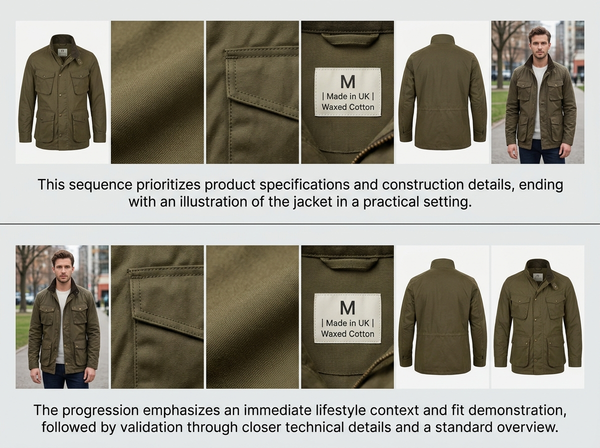
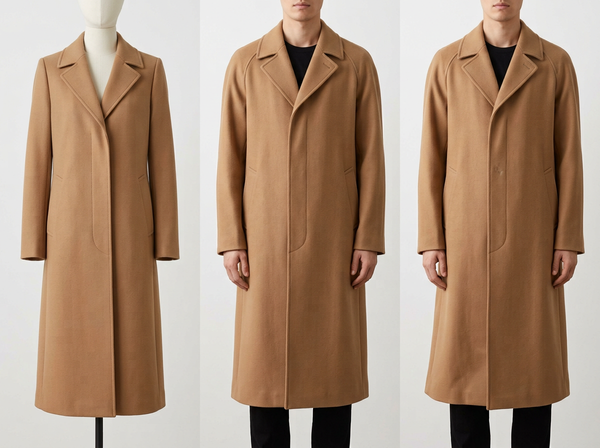
On the second, something changes. The garment lands in a position that can be compared with the first, and the comparison is meaningful because everything except the garment held constant. On the tenth, the range starts to read as a range — and a set of images is judged as a set rather than as ten individual pictures.
Which means the honest way to present the investment is that it does not pay back on the first use, and the point at which it does depends on how many garments will go through it and how long the system will hold. A brand shooting a handful of styles a year gains little. A brand adding styles continuously gains something that compounds.
Anyone evaluating this on the quality of a single output image is measuring the wrong thing. The right question is whether the second one matches.
What breaks reuse
• Undocumented adjustments. Somebody moves the camera slightly for a difficult garment and does not move it back, and every subsequent style inherits the change.
• Form substitution. A different form for a different garment type is often necessary and always breaks comparability unless the substitution is recorded and applied consistently by category.
• Drift in post-production. Color handling, sharpening, and output settings are part of the system even though they happen after capture, and they are the part most often left to whoever is processing that batch.
• No owner. A system nobody maintains diverges from itself, and the divergence is invisible in any single image and obvious across a season’s catalog.
The common thread is that all four are recording problems rather than technical ones. A coordinate system that exists only in someone’s habits will drift, because habits do.
Drift also has a direction worth noting. Adjustments made for difficult garments tend to be accommodations — a little more distance so a wide coat fits the frame, a little more light so a dark fabric reads. Left in place, they become the new baseline, and the range gradually shifts toward whatever the hardest garment needed. Nobody decides this and no single step is wrong.
Where it does and does not replace a physical form
It replaces the physical form for anything where the question is about the image: framing, angle, consistency across a range, and generating additional views once the primary one exists.
It does not replace the physical form for anything where the question is about the garment as an object. A physical form tells you whether the sample actually hangs, whether a seam pulls, whether the garment as constructed sits the way the pattern intended. A digital setup shows you a representation and cannot discover a construction problem you did not already know about.
And it does not replace the body. Neither form does — the differences between a form and a person are the same whether the form is physical or not, and a digital setup inherits every one of them.
How to tell whether you have one
The test is a handover. Give the setup to somebody who has not used it and ask them to photograph a new style.
If they can produce an image that sits alongside the existing range without adjustment, the coordinate system exists and is documented. If they have to ask how the last one was done, or compare against a previous image by eye, then what exists is a practice rather than a system — which works while that person is available and stops working at the exact moment it matters most.
The other test is time. Photograph a style, wait a season, photograph another, and put them side by side. Systems that only exist as habits drift over months in ways that are invisible week to week.
FAQ
Is a digital mannequin the same as a 3D avatar?
They are different objects with overlapping vocabulary. An avatar represents a body and exists to answer fit questions; an imaging setup represents a frame and exists to answer consistency questions. A workflow can contain both, and they are not substitutes.
Do we still need a physical form if we have a digital one?
For assessing samples as physical objects, yes. The physical form is doing quality and construction work rather than imaging work, and those tasks do not go away when imaging moves.
How specific should the framing conventions be?
Specific enough that two people produce the same result from them. That usually means writing down the shoulder position and crop rather than describing the look, since descriptions are interpreted and positions are not.
What happens when a garment does not fit the conventions?
It becomes a documented exception with its own conventions, applied to every garment of that type. The failure mode is a one-off adjustment that quietly becomes the new default for everything shot after it.
Can the system be shared with an external vendor?
That is the strongest argument for documenting it properly. A vendor who receives the conventions can produce images that match what was shot internally, which is not achievable when the system lives in an in-house photographer’s judgment.
How often should it be reviewed?
When the range changes character, when a new category is added, or when someone notices two images that should match and do not. Reviewing on a schedule tends to produce changes for their own sake; reviewing on those three triggers catches the cases that matter.
Where this leaves you
Ask whether your setup could be handed to somebody else tomorrow.
If the answer is yes, you have a coordinate system, and its value will keep accumulating as long as styles keep going through it. If the answer is that they would need to be shown, then what you have is a way of working — good, possibly excellent, and located in one person rather than in the process. That distinction does not show up in any single image, which is exactly why it goes unexamined until the images stop matching and nobody can say when they started to.
Hand it to somebody else
Take your current imaging setup and give it to a colleague who has not used it, with a style they have not shot. If they can produce an image that sits alongside your existing range without asking a question or comparing by eye, the system is real and documented. If they cannot, what you have is one person’s practice — which works until that person is unavailable, and which drifts quietly in the meantime. See how a consistent product image set gets built.
Written by