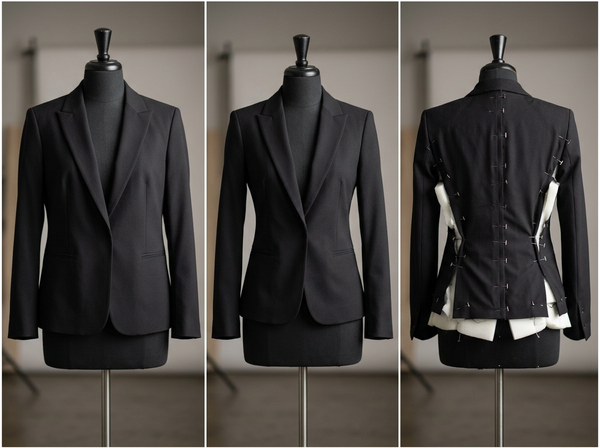

Mannequin or Model: Which One Your Product Page Needs
The choice is usually cast as binary and almost never is. Which claims each image type can carry, which one leads, and what order the rest should run in.
Two different searches use this phrase, and they want opposite things.
One group is deciding how to photograph a range: a form, or a person. The other is looking for modeling work — agencies, casting, how to become one. If you are in the second group, this is not the article you want, and the rest of it will not help.
For the first group: the choice as usually stated is a false binary, and reframing it is most of the work.
The decision is almost never binary
Product pages that carry only one image type are rare, and the ones that do usually got there by budget rather than by decision.
Most pages need both, because the two answer different questions and neither substitutes for the other. So the real question is not which technique wins. It is which claims this page has to make, and which image carries each one.
Once stated that way, two decisions fall out that were previously tangled: which image leads, and what order the rest run in. Both are answerable. “Mannequin or model” is not.
What each image type can claim
Claim | Form | Ghost mannequin | Model |
What shape is it | Yes | Yes | Partly — posture interferes |
How is it constructed | Yes | Yes, if lit for it | Rarely |
What does the fabric look like | Partly | Partly | Partly |
How large is it | No reference | No reference | Yes |
How does it hang on a body | No | No | Yes |
Does it suit someone like me | No | No | Yes |
How does it move | No | No | Only in video |
Read down the two rightmost columns and the division is clean. Everything about the garment as an object sits on the left. Everything about the garment in relation to a person sits on the right, and no amount of quality moves a claim across that line — an image can settle appearance without settling fit, and a form cannot settle either of the last three rows.
The scale row deserves attention because it is the one most often assumed rather than checked. A garment photographed with no body in frame gives a customer nothing to judge size against, so a cropped jacket and a regular one look identical until somebody reads the measurements.
Which one leads
The hero image answers a different question from the set, and conflating them produces a specific failure.
The set answers “should I buy this.” The hero answers “is this worth opening,” which is a question asked at thumbnail size, in a grid, in under a second. An image that is rich in information and slow to read is a good set image and a poor hero.
Which type leads depends on what the buyer has not yet worked out — a decision that turns on category, price point, and channel rather than on any general rule about the two techniques.
What is worth adding here is that the hero decision is reversible cheaply and the set decision is not. Reordering a set costs nothing; reshooting to add a missing claim costs a session.
Sequence
Order carries meaning, and it is usually treated as layout rather than as a decision.
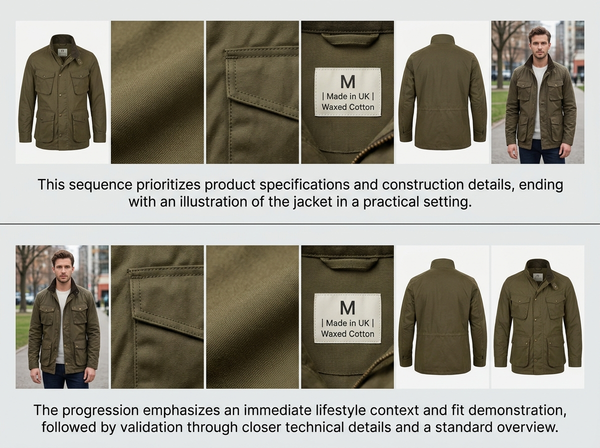
Two sequences dominate. One runs object-first: what is this, how is it made, then what it looks like worn. The other runs wearer-first: how it looks on, then details, then the full object. Both are defensible, and they suit different purchases — the first where the customer is evaluating a made thing, the second where they are imagining themselves in it.
What matters more than which sequence is that consecutive images advance rather than repeat. Two images making the same claim waste a position, and positions are scarce because most customers stop scrolling before the end. Page structure exists to keep images and copy advancing together rather than restating each other, and the same discipline applies within the image set alone.
A practical version: write the claim each image is making next to its position. Any two adjacent positions with the same claim written beside them are a reordering opportunity or a deletion.
The exercise tends to expose a particular pattern. Sets accumulate rather than get designed — an image gets added because a category manager asked for it, another because a competitor had one, another because the shoot produced a good frame. Each addition was reasonable and nobody ever removed anything, so the set ends up with three images making the shape claim and none making the scale claim. Writing the claims down is the cheapest way to see a structure that formed by accretion.
When a page genuinely needs only one
Some cases are real rather than budgetary.
Trade and wholesale catalogs, where the buyer is assessing specification and a model adds nothing they are evaluating. Uniform and workwear programs for the same reason. Categories where a body would be a distraction from the thing being sold, which includes some accessories and most hard goods.
And the reverse case: categories where the object claims are trivial and the wearer claims are everything, where a form contributes little beyond a flat product view that a flat lay would serve as well.
Outside those, a page with one image type has a gap. Whether the gap matters depends on whether customers were going to ask that question, which return reasons will tell you faster than any analysis.
The cost asymmetry nobody mentions
Two cost structures, and they behave differently as a range grows.
Model photography carries a session cost — booking, styling, studio, crew — which amortizes across however many styles get shot that day. Per style it is cheap when the session is full and expensive when it is not.
Form photography carries a per-garment cost with almost no session overhead. The tenth garment costs roughly what the first did, and a style arriving on a Tuesday can be photographed on Tuesday.
For a small range shot a few times a year, sessions win. For a large catalog with continuous additions, the scheduling problem tends to decide it before the cost comparison does — a style that has to wait for the next booking is a style that is not selling.
This asymmetry is often the actual reason a brand photographs the way it does, and it rarely appears in the stated rationale. Worth naming, because a decision made on scheduling grounds and defended on aesthetic grounds is difficult to revisit when the range changes shape.
There is a hybrid that follows directly from the two cost structures and is underused. Photograph every style on a form as it arrives, and run model sessions periodically covering the styles that most need wearer claims — typically the ones carrying the season or the ones where returns cluster on fit. Every style gets a page, the session cost lands only where it earns something, and nothing waits for a booking. The arrangement is obvious once the costs are separated and invisible while the question is framed as a choice between two techniques.
Consistency across types
A mixed set introduces a problem neither type has alone: the images were produced differently, and a set is read as a set.
Color is the usual failure. Two production paths, two color pipelines, and a garment that is one shade in the hero and another in the on-model shot — which a customer reads as uncertainty about the actual color rather than as a technical inconsistency.
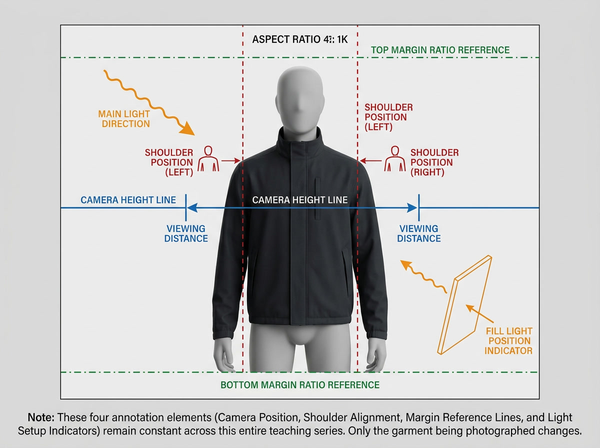
Scale is the second. If the form and the model produce garments occupying noticeably different proportions of the frame, the set reads as assembled rather than shot.
Both are solvable by treating the mixed set as one deliverable with one specification, rather than as two shoots that happen to feature the same garment.
FAQ
Should the hero always be the same type across a catalog?
Consistency at the grid level is worth a lot, since a category page full of mixed hero types reads as disorganized before anyone evaluates a product. Exceptions are better made per category than per style.
Can a ghost mannequin image serve as the model shot?
It cannot carry any of the wearer claims — scale, fit, suitability — so it substitutes for a form image rather than for a model image. Treating it as a cheaper model shot is a common misreading of what it does.
What if we only have budget for one?
Choose based on which claims your customers are actually stuck on, which return reasons reveal more reliably than intuition. Returns citing fit point toward a model; returns citing quality or construction point toward a form.
How many images should the set contain?
Enough to settle each open question once, which is a different calculation from a target number and deserves its own treatment.
Do marketplaces require a particular type?
Marketplace rules generally govern background, framing, and content rather than technique, so both approaches are usually permitted. The specific requirements are worth confirming per platform before committing a range.
Does video change this division?
It adds the movement claim, which neither still type can carry. It does not replace either — a video is poor at the comparison work a still set does, since a viewer cannot hold two moments side by side.
Where this leaves you
Write down the claims your page has to make, then write which image is making each one.
The exercise usually surfaces two things: a claim nobody is making, and two images making the same one. Neither is visible while the question is framed as mannequin or model, because that framing asks which technique is better rather than which questions are unanswered. The techniques are not competing. They are answering different things, and a page needs whichever answers the questions its customers are still asking.
Write the claim beside each position
Open a product page and list the image positions in order. Next to each, write the single claim that image is making — what shape it is, how it is built, how large it is, how it sits on a body. Two adjacent positions with the same claim are a wasted slot. A claim that appears nowhere is a question your customer is answering from the returns policy instead. See how a consistent product image set gets built across production methods.
Written by