AI Virtual Veil Try-On: Why Sheer Layers Are the Hard Case
Where a veil folds, opacity doubles. That single behavior is the fastest way to tell a convincing virtual veil from one that will not survive a second look.
Virtual try-on has become good enough that most garments look convincing. Veils are the exception, and the reason is structural rather than a matter of how much the technology has improved.
Every other garment is a surface. A veil is something you look through.
Why that difference matters so much
For a dress, a jacket, or a skirt, the question is what the outside of the garment looks like. Whatever is behind it is hidden, so it does not have to be computed at all.
A veil reverses this. To show a veil correctly, the result has to establish what is behind it — the dress, the hair, the shoulders, the background — and then work out how much of each survives passing through. Change what is behind it and the veil itself looks different, because most of what you see when you look at a veil is not the veil.
That is why a try-on image settles appearance rather than experience with unusual force here: a veil’s appearance is not even a property of the veil on its own.
What sheer actually requires
Three things have to be right together, and they are properties of the material rather than of the picture — which is the general principle that cloth is a structure rather than a surface, arriving in its most visible form.
How much light passes through. Tulles differ considerably, and two veils that look similar folded on a table can differ substantially when held up.
How the light scatters. Some sheer fabrics transmit light cleanly, so what is behind stays reasonably sharp. Others diffuse it, so everything behind goes soft. This is what makes one veil look like a mist and another like a window.
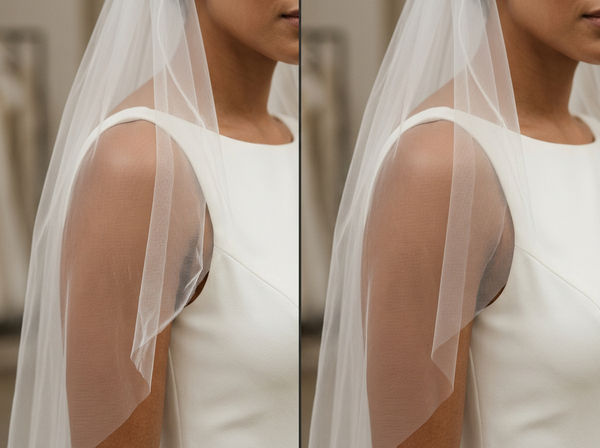
What happens where it doubles. A veil folds — over the shoulder, at the edge, wherever it gathers — and every fold means light passes through two layers instead of one. Doubled areas are visibly denser.
That third one is the most useful to know, because it is the easiest to check and the most frequently wrong.
Three ways it goes wrong
Uniform opacity. The veil is rendered at one transparency across its whole area, so the section folded over a shoulder looks exactly like the single-layer section beside it. Real veils never do this, and once you have noticed it you will see it every time.
A missing edge. Veil hems are often finished with a narrow rolled edge, a ribbon, or a cut edge that catches light. Generated results tend to fade the veil out toward its boundary instead, so the veil appears to dissolve rather than to end.
Wrong behavior behind the veil. What is behind should be softened and shifted in tone, not simply dimmed or blurred. Results that blur uniformly read as a frosted-glass effect placed over the image rather than as fabric.
Any of the three produces the same overall impression — that something has been laid on top of the photograph rather than worn.
The three also tend to arrive together, which is worth knowing because it makes the diagnosis easier. A result that gets the folds right has usually got the edge right too, since both follow from the same thing being computed rather than approximated. Finding one of the three is generally enough to predict the others, which is why a single quick check is more informative here than it would be for a garment with more independent failure points.
The face is the hardest region
Anything covering the face is the least forgiving part of this problem, for two reasons that compound.
Skin has a color that shifts in a particular way when seen through white tulle — it lightens, but not evenly, and the parts nearest the fabric behave differently from the parts further from it. Hair behind a veil does something else again, because its texture is fine enough to interact with the fabric’s own weave.
The second reason is us. People are unusually good at reading faces, so an error that would go unnoticed on a skirt registers immediately here without the viewer being able to say what is wrong. It tends to be described as looking strange rather than as looking incorrect.
Which means a virtual result showing a veil over the face deserves more scrutiny than the same result showing one behind the shoulders, and the two are not equally reliable even within a single image.
What length and volume understate
Two properties are systematically underrepresented in images, and both are easy to check for.
Length, because most try-on images are cropped somewhere around the waist or knee. A veil that extends well past the hem of the dress cannot be assessed from a frame that does not include it, and the longer the veil, the more of its character is in the part that got cropped.
Volume, because a veil gathers where it attaches, and how much fabric bunches there determines how it sits. Two veils of the same length can be cut with very different fullness, and gathering is compressed into a small area of the frame where it is easy to miss.
Veil lengths have conventional names, and the names correspond to different measurements in different markets — so a name in a listing is a starting point rather than a specification.
Two checks that take seconds
Both of these are faster and more reliable than judging the overall impression.
Look at a fold. Find somewhere the veil doubles over itself — a shoulder is usually easiest — and see whether that area is denser than the single-layer area next to it. If it is not, the veil is an overlay rather than a computed layer.
Watch what happens where the background changes. If the dress beneath the veil goes from light to dark, or the veil crosses from the dress onto the background, the veil’s appearance should change with it. A veil that looks identical across a boundary is not transmitting anything — what sits behind a subject changes how the subject reads, and for a veil that relationship is the whole thing.
Neither check requires knowing anything about how the image was made.
What still needs the physical veil
Three things, and they are the same three that matter most on the day.
Weight at the comb, which is where a long veil pulls. A veil is light in absolute terms and concentrated at one point, and how that feels after several hours is not visible anywhere.
Movement. A veil is the most mobile thing anyone wears, and it responds to wind, to walking, and to being near other people. A still image records it at rest, which is the state it will spend the least time in.
Whether it stays put, which depends on hair, comb, and how the veil is weighted — and which is the practical failure that most often gets solved on the morning rather than in advance.
None of the three has a visual signature, which puts them in the same category as the weight and movement questions that apply to the gown itself. An image narrows the choice; the physical object answers what wearing it is like. For a veil the split is unusually clean, because almost everything an image gets right about a veil is appearance and almost everything it cannot reach is behavior.
FAQ
Are some veils easier to show virtually than others?
Shorter veils sitting behind the shoulders are the most reliable, since they avoid the face entirely and involve fewer folds. Long veils and anything covering the face are where results become least trustworthy.
Does image quality change how reliable the result is?
A sharper source improves the regions the camera captured, and a veil’s difficulty is not a resolution problem. The layering behavior is either being computed or it is not, at any resolution.
Can I judge veil color from a virtual result?
Only roughly. Bridal whites vary, and a veil’s apparent color depends on what is behind it, so the same veil reads differently against a dress in a different shade — which is the same property that makes veils hard to render.
Why do some results look convincing and then wrong on a second look?
Usually because the overall impression is right and one specific behavior is missing, most often the doubling at folds. First impressions read the whole image; second looks find the region that does not agree with the rest.
Should the veil be tried on with the dress or separately?
Together, since the veil’s appearance depends on what it is over. A veil assessed against a plain background tells you very little about how it will look against the gown it will actually be worn with.
Is this a limitation that will improve?
Sheer layering is being worked on across image generation generally, and the underlying difficulty — needing to know what is behind — does not disappear with better models. Improvements make results more convincing rather than removing the dependency.
Where this leaves you
The veil is the one part of a bridal look where an image is describing a relationship rather than an object.
That makes it both the hardest thing to generate convincingly and the easiest thing to check, because a relationship leaves evidence. Folds get denser. Appearance changes when what is behind changes. Two seconds spent looking at a shoulder fold will tell you more about whether a virtual result can be trusted than any amount of looking at the veil as a whole — which is the part that was designed to be convincing.
Find a fold and look at it
The next virtual veil result you see, ignore the overall effect and find somewhere the fabric doubles over itself — across a shoulder is usually easiest. That area should be visibly denser than the single layer next to it. Then follow the veil to where the dress or background changes tone behind it and check whether the veil changes too. Two seconds, two checks, and they catch the failures that a general impression will not. See how virtual try-on works and where it stops.
→ https://www.style3d.ai/ai-photoshoot/virtual-clothing-try-on
Written by