
Virtual Wedding Dress Try-On: How It Works and Where It Stops
Your input photo decides more than the tool does. What to send it, what it can return, and the one question none of these methods can answer.
Three different methods share this name, and they know different amounts about the dress. Which one produced your result determines how far it can be trusted — and you can work that out from the result itself, without knowing which tool made it.
Three methods, three levels of knowledge
Overlay. A photograph of the dress is reshaped and placed onto a photograph of you. What it knows about the dress is the shape the dress was in when it was photographed, and nothing else.
Generation. A model produces a new image of you wearing the dress, drawing on the dress photograph plus everything it has learned about how dresses look. What it knows is that photograph, plus a general sense of gowns — which is a different brand’s gown, averaged.
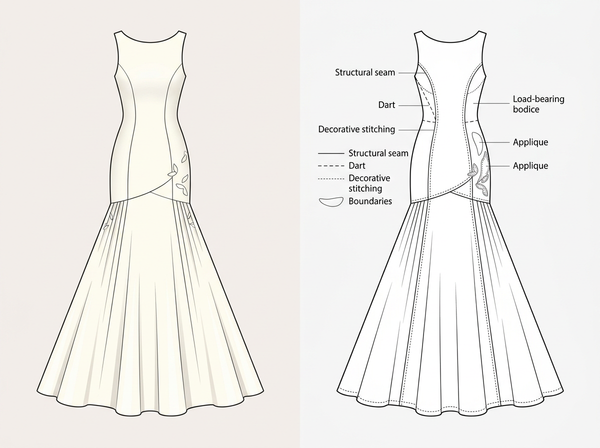
Simulation. A three-dimensional garment is draped on a body model. What it knows is the pattern the dress is cut from and how its fabric behaves, which is considerably more, and which is why this method is common in production settings and rare in consumer ones.
The order of reliability follows directly from the order of knowledge. Virtual try-on is not one capability with varying quality; it is three capabilities with different ceilings.
What each one can and cannot invent
An overlay cannot invent anything, which is both its limitation and its safeguard. It shows the dress as photographed, distorted to fit your outline. Where your pose differs from the pose the dress was photographed in, the result stretches — but it never fabricates a detail that was not in the source.
Generation fills gaps, and gap-filling is where results become both more convincing and less reliable. A generated image will produce a plausible back, a plausible hem, a plausible way the fabric falls at your waist — plausible according to gowns in general rather than to this gown. This is the same boundary that applies to generated imagery of any garment: the regions with no source information are the regions that look most finished.
Simulation computes rather than invents, provided it was given real pattern and fabric data. Where it is given approximations, it produces a confident result from approximate inputs, which looks the same as a result from real ones.
An unhelpful consequence follows from all three: the amount of invention in a result is not visible in the result. An overlay that stretched badly announces itself, and that is the least serious failure of the three. A generated image that fabricated an entire back does not announce anything, because a fabricated back is exactly as smooth and coherent as a real one — smoother, usually, since nothing constrained it.
Your input photo decides more than the tool does
Whatever the method, the result is bounded by what your photograph contains.
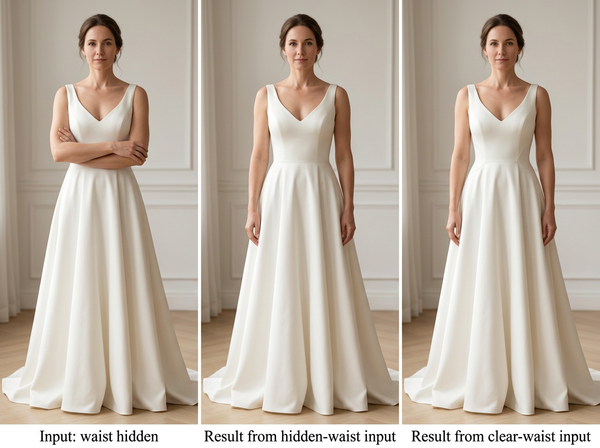
Pose determines what is visible. A photograph with arms crossed in front hides the waist entirely, so anything the result shows at the waist was not derived from you — changing a pose changes what a garment reveals, and a pose that hides a region removes it from every result built on that photograph.
Distance and framing determine proportion. A photograph taken close, from slightly above, compresses the lower body, and every gown tried on against it will read shorter than it is. That error is consistent rather than random, which makes it harder to notice — every result is wrong in the same direction, so nothing looks out of place.
Lighting determines color. Indoor light shifts whites toward itself, so a comparison between two ivories taken under a warm bulb is a comparison of the bulb.
A few practical consequences: stand square to the camera, arms away from the body, in daylight, with the phone at chest height and far enough back to include your whole figure. That single photograph will improve results across every tool more than switching tools would.
Where all three stop
None of them know your measurements unless you provided them, and most consumer tools do not ask.
That matters more for bridal than for most categories, because fit here means something specific: where the gown sits, and whether it stays there. A strapless bodice that holds is a structural achievement, not a visual property, and no method that works from photographs has access to whether a particular gown will do it on a particular body.
The same applies to length, which for a floor-length gown is a relationship between the dress, your height, and the shoes you have not chosen yet. A result can only show a length that was assumed.
This is the boundary that gives the article its second title. What these tools do well is narrow a list. What they do not do is tell you a gown fits — and the gap between those two is where the appointment goes.
Worth saying plainly that narrowing a list is a real service rather than a consolation. Appointments are limited, travel takes time, and most people will look at far more gowns than they can try. A shortlist assembled from good information means the in-person hours get spent on genuine candidates instead of on gowns that were never going to work. Judged against that job, these tools do well; judged against replacing the appointment, they were never going to.
Reliable and unreliable uses
Use | How well it holds |
Comparing silhouettes against your proportions | Well, on any method |
Judging a neckline | Well, if the photograph shows shoulders clearly |
Comparing two whites | Only in daylight, on any method |
Seeing the back | Poorly — usually generated, rarely sourced |
Judging length | Poorly — depends on assumptions about height and shoes |
Assessing how it sits or stays | Not at all |
Read the table as a guide to which parts of a result to look at. The top rows are what you came for; the bottom rows are what the image will show you anyway, convincingly.
What free tools structurally do and do not do
Many of these tools are free, so it is worth separating what changes with payment from what does not.
What does not change is the method. A free overlay tool and a paid one are both overlays, with the same ceiling. Paying does not convert an overlay into a simulation, and it does not give a generated result access to information it never had.
What changes is throughput, resolution, and whether you can correct a result you disagree with. For shortlisting a handful of gowns, none of those constrain the task much — which is the honest answer for this particular use.
Which means the free-versus-paid question is less consequential here than the question of what method is being used, and the second question is the one nobody asks.
How to check a result
Three quick checks, in order of how often they catch something.
Look at what your input photograph hid. Whatever region was occluded — behind an arm, below the crop, turned away from the camera — is the region the result invented. Compare two results from two different input photographs and the invented regions will disagree.
Look at the hem. Overlays stretch it, generated results place it according to an assumed height, and a hem that sits implausibly level or implausibly high is the most common visible error.
Look at a detail you know the dress has. If the gown has a specific beading pattern or a particular strap construction, check that it survived. Details that got smoothed away indicate a result that reconstructed rather than reproduced, and a gown chosen for a detail that the result quietly removed is a gown you have not actually seen on yourself.
FAQ
Which method am I using?
Most consumer tools do not say, and the checks above will tell you more than the label would. A result that shows a convincing back from a front-facing input photograph is generating; one that distorts oddly when your pose differs from the product photograph is overlaying.
Can I trust a result enough to buy from it?
For narrowing a list, yes. For committing to a gown without wearing it, the questions that decide satisfaction — how it sits, how heavy it is, how it moves — are the ones no method reaches.
Does a better photograph of the dress help?
For overlays, considerably, since the source is the whole content. For generated results, it improves the parts derived from the source and does nothing about the invented parts.
What about veils?
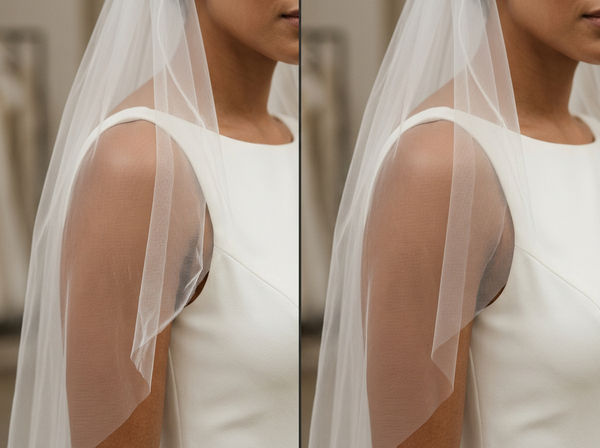
Sheer layers behave differently from solid fabric and are the hardest case for every method, because a veil’s appearance depends on what is behind it. That deserves treating separately.
Should I use several tools and compare?
It is genuinely useful, because the places where results disagree are the places at least one of them is inventing. Agreement across tools does not prove correctness, but disagreement reliably locates uncertainty.
Do these tools store my photograph?
Practices differ and are worth checking in the tool’s own terms before uploading, particularly for images you would not otherwise share. This is a question about the service rather than about the technique.
Where this leaves you
Ask what the result knew about the dress, and what your photograph gave it.
Those two questions bound everything a virtual try-on can tell you, and they are answerable without any technical knowledge. A result built from a good photograph, by a method with real information about the gown, is a reliable way to decide which gowns are worth your appointments. A result built from a photograph that hid half of you, by a method that fills gaps convincingly, is a picture of a gown that does not exist, on a version of you that was partly invented.
Take one good photograph and reuse it
Before trying anything on virtually, take a single reference photograph properly: standing square to the camera in daylight, arms clear of your body, phone at chest height, far enough back to show your whole figure. Use that same photograph everywhere. It improves every result more than changing tools does, and reusing one photograph means differences between results come from the gowns rather than from the input. See how virtual try-on works and where it stops.
→ https://www.style3d.ai/ai-photoshoot/virtual-clothing-try-on
Written by